The Engines of Negentropy: Installment 2 - The Safe Burn
If you mix hydrogen and oxygen gas and apply a spark, the result is a violent, explosive release of heat and energy, leaving behind water as the thermodynamic ash. This is combustion.
To run a complex organism—or a closed-loop city—you need the massive energy yield of that combustion. But you cannot detonate a fire inside a living cell, nor can a highly efficient industrial loop rely on the brute-force, chaotic thermal loss of an open flame. You must achieve the burn without the fire.
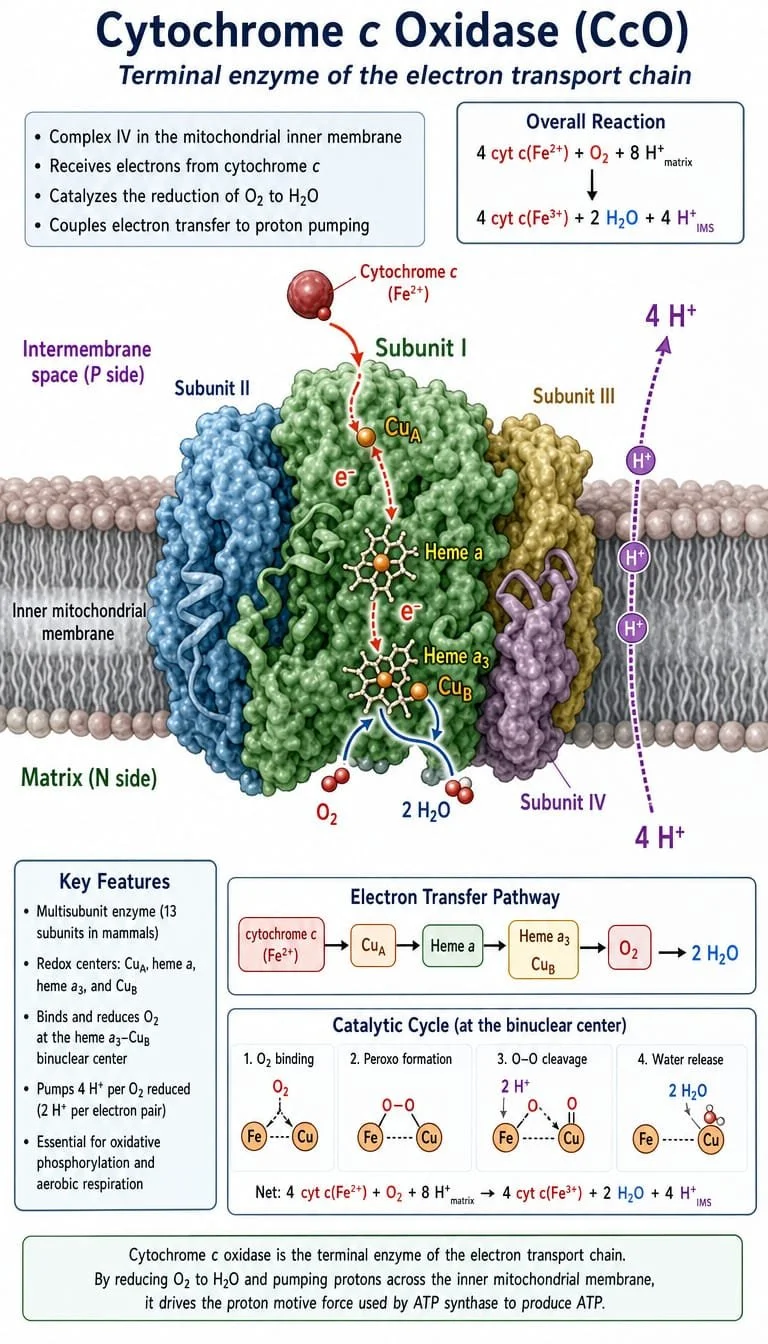
Biology solved this problem through the terminal enzyme of the electron transport chain: Cytochrome c Oxidase (CcO). This is the engine of the safe burn.
The Problem of the Leaky Engine
The goal of aerobic respiration is simple: take molecular oxygen (O2), feed it four electrons (e-) and four protons (H+), and produce two molecules of water (H2O).
The danger lies in the intermediates. If you reduce oxygen one electron at a time and the intermediate escapes the active site, you generate Reactive Oxygen Species (ROS)—superoxide radicals (O2(rad)), hydrogen peroxide (H2O2), and hydroxyl radicals (HO(rad)). These are the biological equivalents of stray sparks; they will aggressively oxidize and destroy cellular machinery, lipids, and DNA.
To survive, the cell's engine must be perfectly sealed. It must bind the oxygen and hold it relentlessly until all four electrons have been delivered.
The Engine: The Bimetallic Binuclear Center
The heart of Cytochrome c Oxidase is a masterpiece of transition metal coordination known as the binuclear center. It consists of a high-spin heme iron (Fe(a3)) and a tightly associated copper ion (Cu(B)).
Unlike Photosystem II, which uses an asymmetrical cluster to pool oxidizing equivalents, CcO uses this perfectly spaced bimetallic trap to capture oxygen. The O2 molecule binds directly between the iron and the copper, forming a stable peroxo bridge (Fe(III)-O-O-Cu(II)).
Once the oxygen is locked in this bimetallic vise, it cannot escape as a radical. The enzyme rapidly funnels electrons (delivered by the protein cytochrome c) and protons (channeled through highly specific water-lined pathways in the protein structure) directly into the active site. The O-O bond is cleanly cleaved, and the oxygen is seamlessly reduced to water.
The Gradient: Capturing the Drop
If the enzyme simply reduced oxygen to water safely, it would still just be generating heat. The true negentropic genius of Cytochrome c Oxidase is how it captures the thermodynamic momentum of that chemical reaction.
As the electrons fall toward oxygen (the ultimate electron sink), they release a massive amount of free energy. CcO acts as a mechanical pump. It uses the energy of the electron transfer to induce precise conformational changes in the protein structure, physically pumping protons (H+) across the inner mitochondrial membrane, against their concentration gradient.
This creates a massive electrochemical differential—a proton-motive force. The cell then lets those protons flow back across the membrane through a different protein, ATP synthase, physically spinning its microscopic turbine to forge the energy currency of the cell (ATP).
The Blueprint for the Retrofit
Why must we understand the Fe(a3)-Cu(B) center? Because it is the ultimate blueprint for the synthetic fuel cells that will power our closed-loop infrastructure.
Human fuel cells often rely on rare, expensive platinum catalysts to reduce oxygen. Nature proves that you can achieve near-perfect catalytic efficiency and absolute safety using iron and copper, provided the atomic geometry is perfectly tuned to manage the electron flow and trap the reactive intermediates.
Cytochrome c Oxidase proves that we do not need to fight the laws of thermodynamics with brute force. By directing the electron flow with atomic precision, we can capture the energy of combustion without losing it to the chaos of fire.
We have now established the complete water/oxygen loop. We have seen how water is split in the sun, and how it is reformed in the dark.
For our next installment, we must move to the carbon loop. We will tackle one of the most notoriously difficult bonds in all of chemistry, looking at the di-iron active site of Soluble Methane Monooxygenase (sMMO).