The Engines of Negentropy: Installment 3 - The Methane Tamer
(06/12/2026)
The global carbon ledger is currently bleeding methane (CH4). It is a greenhouse gas with a warming potential roughly 30 times greater than carbon dioxide over a century. In human industry, when we capture stranded methane, we usually just flare it (burn it into CO2) because it is incredibly difficult to transport or chemically upgrade.
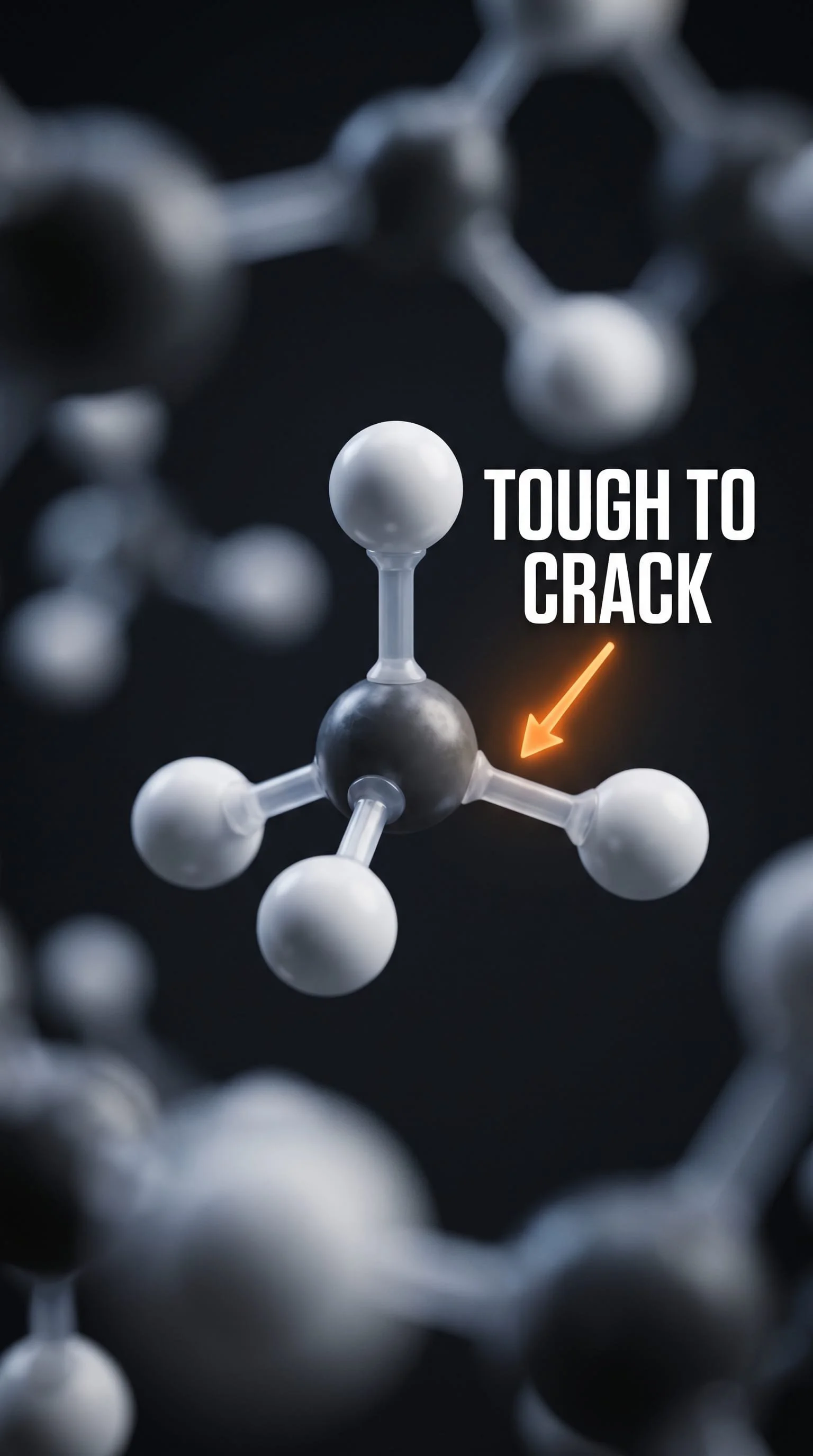
The difficulty lies in the chemistry. Methane is perfectly symmetrical, non-polar, and heavily fortified. Its C-H bond possesses a bond dissociation energy of roughly 104 kcal/mol. To break that bond and attach a functional group in a chemical plant—typically through steam reforming—requires brutal force: massive pressures and temperatures exceeding 800°C.
Yet, beneath the soil and in the oceans, a family of bacteria known as methanotrophs use methane as their sole source of carbon and energy. They break this notoriously inert bond in water, at neutral pH, at room temperature.
The engine that performs this miracle is Soluble Methane Monooxygenase (sMMO).
The Engine: The Di-Iron Carboxylate Center
The active site of sMMO does not rely on exotic or rare-earth elements. It relies on the absolute geometric precision of biology.
Hidden deep within the hydroxylase protein component (MMOH) is a di-iron center. Two iron atoms are suspended in a highly specific coordination environment, bridged by oxygen atoms and tethered by the carboxylate groups of surrounding glutamate and aspartate amino acid residues.
This is a molecular bear trap, designed to catch and split molecular oxygen (O2), using the resulting thermodynamic drop to forge a molecular hammer capable of shattering the C-H bond.
The Mechanism: Forging Intermediate Q
The catalytic cycle of sMMO is a masterclass in managing high-valent states.
The cycle begins with the di-iron center in a resting Fe(II)-Fe(II) state. It binds O2 and is supplied with two electrons and two protons. Through a rapid, heavily orchestrated series of internal electron transfers, the oxygen-oxygen bond is cleaved.
This cleavage generates the holy grail of biological C-H activation: Intermediate Q.
Intermediate Q is a high-valent di-iron(IV) bis-oxo species, formulated as Fe(IV)2(mu-O)2. It is an intensely powerful, tightly constrained oxidant. It is the negentropic hammer.
The Strike: Rebound and Release
When methane enters the active site, Intermediate Q strikes.
The exact quantum mechanics of this strike (whether it is a concerted reaction or a radical rebound mechanism) remain a subject of intense kinetic and spectroscopic study. However, the result is flawless. The Fe(IV) center abstracts a hydrogen atom from the methane, breaking the 104 kcal/mol bond and generating a transient methyl radical (CH3(rad)) held tightly in the active pocket.
Before this radical can escape and cause chaotic side reactions, the enzyme rapidly forces it to "rebound" with one of the bridging oxygen atoms. The iron center relaxes back to its lower oxidation states, and the enzyme ejects a perfectly formed molecule of methanol (CH3OH).
The Blueprint for the Retrofit
Why must we obsess over the structure of Intermediate Q? Because transforming gaseous methane into liquid methanol at ambient temperature is a critical requirement for a closed-loop economy.
If we can synthesize stable coordination architectures—whether relying on di-iron, or pushing the boundaries into high-valent complexes of cobalt and nickel—that mimic the geometric restriction and redox tuning of the sMMO active site, we change the world. We stop flaring stranded gas and start valorizing it. We turn a fugitive atmospheric liability directly into a dense, liquid chemical feedstock.
Soluble Methane Monooxygenase proves that the toughest bonds in the universe do not require the brute force of a furnace. They require the surgical precision of a properly tuned transition metal.