The Engines of Negentropy: Installment 4 - The Nitrogen Forge
(06/19/2026)
Look at any thriving forest, sprawling agricultural field, or human city. The fundamental limit to all that biological and economic growth is not carbon, and it is not water. It is nitrogen.
Nitrogen is the essential scaffolding of amino acids and DNA. Our atmosphere is literally drowning in it—roughly 78% of the air we breathe is nitrogen gas (N2). Yet, to almost all life on Earth, that vast ocean of nitrogen is completely inaccessible. It is locked behind one of the most impenetrable thermodynamic walls in nature: the nitrogen-nitrogen triple bond.
In human industry, breaking this bond to create the synthetic fertilizer that feeds half the planet requires the Haber-Bosch process. We force the reaction using massive iron catalysts, brutal temperatures (400-500°C), and crushing pressures (150-250 atm). It consumes roughly 1-2% of the entire global energy supply.
Nature, however, solves this bottleneck in the soil, in the dark, at ambient temperature and neutral pH. The engine that performs this modern alchemy is Nitrogenase.
The Engine: The FeMo-Cofactor
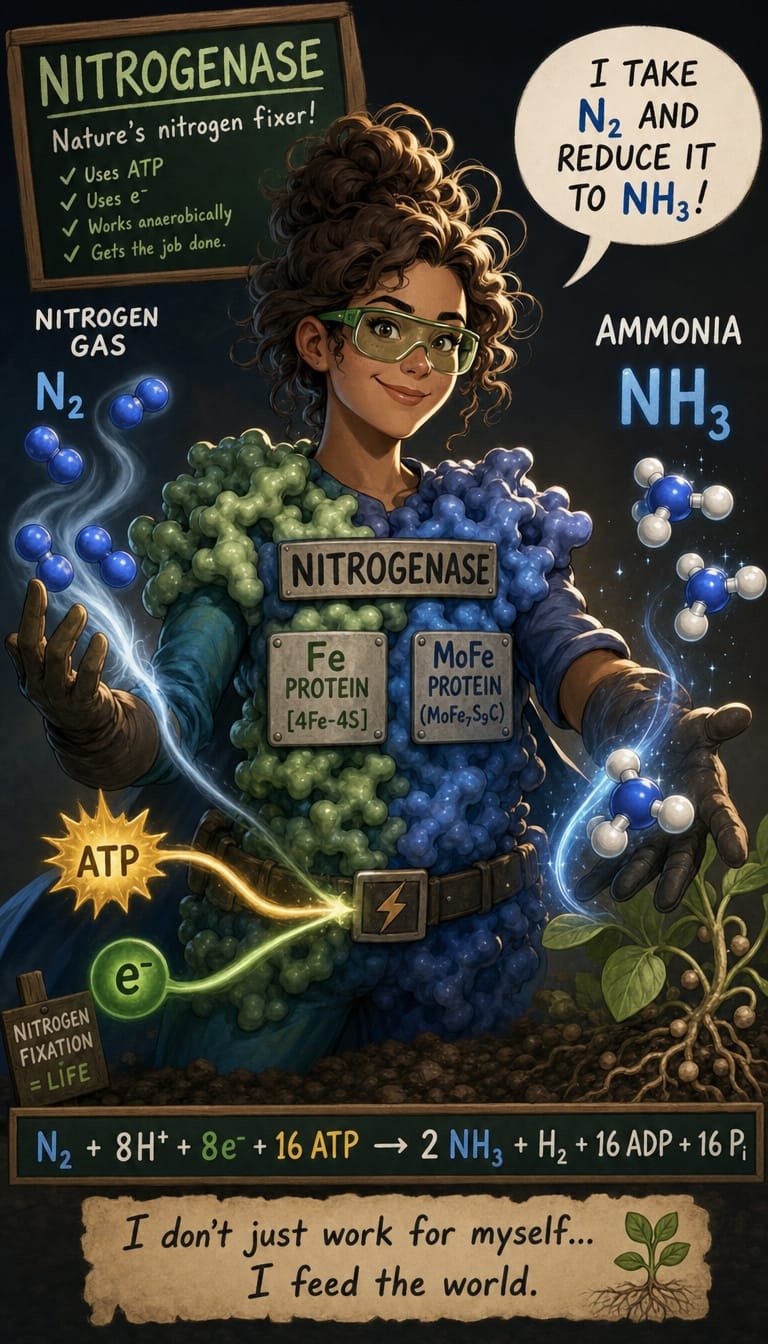
Nitrogenase is a massive, two-component metalloenzyme complex. The true anvil where the triple bond is shattered lies deep within the MoFe-protein component, at a site known as the Iron-Molybdenum cofactor (FeMo-co).
This is arguably the most complex and fascinating metal cluster in all of biology. It is formulated as [MoFe7S9C]. It consists of molybdenum and iron atoms bridged by inorganic sulfur, folding around a central, interstitial carbon atom (a carbide). This central carbon acts as the structural glue and the electronic tuner, maintaining the perfect geometric tension required for catalysis.
This cluster is nature's bespoke forge, designed specifically to trap inert gas and pump it full of electrons.
The Mechanism: The Thermodynamic Hammer
The catalytic cycle of nitrogenase is a brutal, energy-intensive process that pushes biological systems to their absolute limits.
The cycle requires a secondary protein (the Fe-protein) to act as a piston. Powered by the hydrolysis of ATP (the cellular energy currency we discussed in Installment 2), the Fe-protein docks with the MoFe-protein and physically forces an electron into the FeMo-cofactor. It then detaches, recharges, and repeats the process.
To break the N2 triple bond, the enzyme must accumulate multiple electrons and protons before the gas even binds. Following the Lowe-Thorneley kinetic model, the enzyme cycles through a series of increasingly reduced states, effectively winding up a thermodynamic spring, much like Photosystem II does in reverse.
The Strike: Obligatory Hydrogen Evolution
Once the cluster is highly reduced, N2 binds to the active site. The stored electrons and protons are violently unleashed. The overall stoichiometric equation of this strike is:
N2 + 8e- + 16ATP + 8H+ —> 2NH3 + H2 + 16ADP + 16Pi
There is a fascinating mechanical quirk here: the obligatory release of hydrogen gas. To fully reduce one molecule of nitrogen to two molecules of bioavailable ammonia (NH3), the enzyme must reduce two protons into a molecule of H2. This is not a mistake or a leaky reaction; it is a fundamental mechanistic requirement of the cluster's electron management, a necessary exhaust that allows the nitrogen to properly bind and break.
The Blueprint for the Retrofit
Why is the FeMo-cofactor the holy grail of bioinorganic chemistry? Because unlocking its secrets is the key to closing the planetary nitrogen loop.
Currently, our linear agricultural system is entirely dependent on the fossil-fuel-driven Haber-Bosch process. If we can successfully engineer synthetic, ambient-temperature catalysts that mimic the function of the FeMo-cofactor—perhaps utilizing similar transition metal sulfide clusters with interstitial tuners—we can decouple the global food supply from the fossil fuel industry.
Nitrogenase proves that creating abundance out of thin air does not require massive industrial foundries. It requires the perfect, dynamic coordination of iron, sulfur, and electrons. It is the engine that pulls life out of the sky.