The Glass Vault - The First Seal
(07/31/2026)
When we discuss the Planetary Retrofit—the effort to close the massive, broken loops of human industry—the scale can be paralyzing. It is difficult for the human mind to fully grasp the atmospheric carbon ledger or the global nitrogen cycle.
To truly understand how a closed-loop system operates, we have to scale it down. We have to strip away the noise of the global economy and look at the bare thermodynamic minimum required for life to sustain itself. We do this by building a microcosm. We put a forest inside a glass jar, and we seal the lid.
This is not just a botanical display; it is a physical proof of concept for Spaceship Earth.
The Physics of the Boundary
The moment you seal the lid on a terrarium, you fundamentally change the physics of the environment. You have created an isolated material system.
In a traditional garden, if the soil dries out, you add water. If the plants lack nitrogen, you add fertilizer. The system is open and relies on constant external subsidies. But inside the glass vault, the material ledger is instantly and permanently locked. Not a single atom of carbon, nitrogen, or oxygen will ever enter or leave that jar again.
The only thing that can cross the glass boundary is energy—specifically, the flux of photons from the sun or a grow light, and the ambient thermal energy of the room. The survival of the biological community inside now depends entirely on its ability to catch that incoming energy and use it to endlessly recycle the finite atoms it was locked in with.
The Rain Engine: The Hydrologic Loop
The most immediate and visible ledger in the glass vault is water.
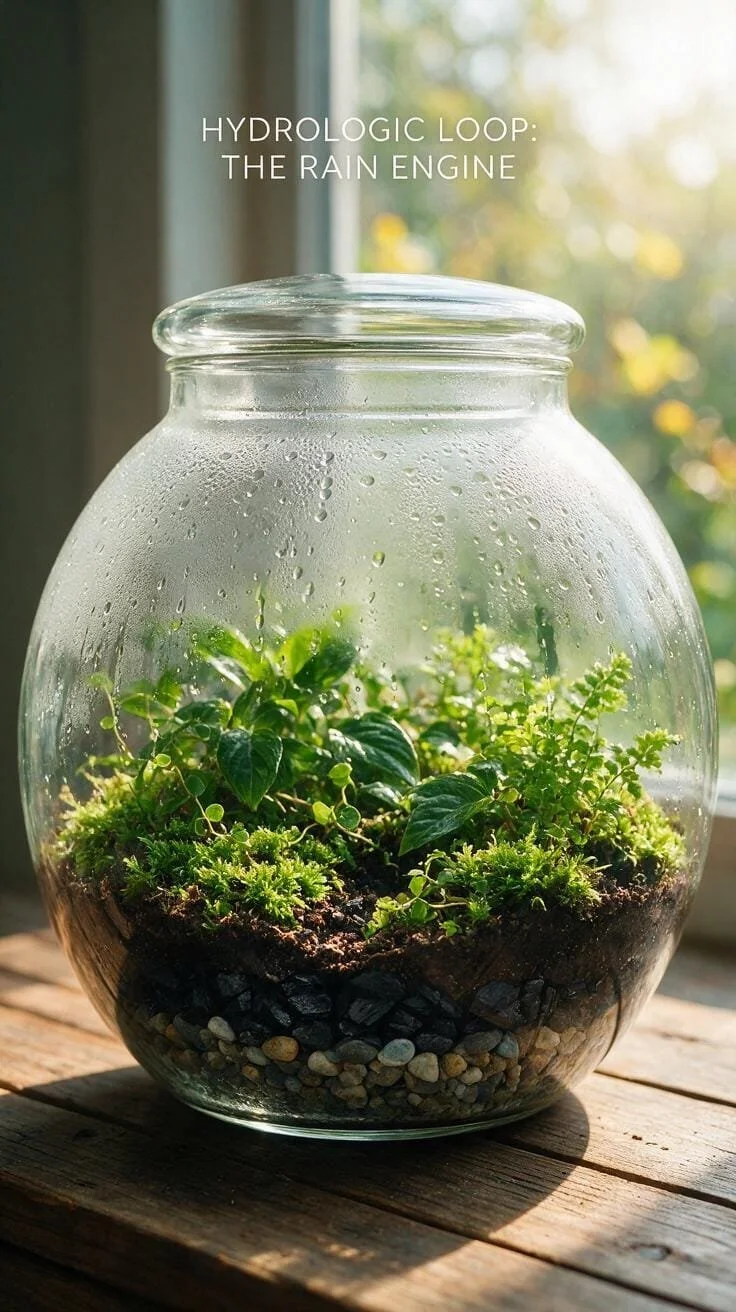
When you build a terrarium, the water you spray into the soil on day one is the only water the system will ever possess. If you were to watch the jar in a time-lapse, you would see it generating its own localized weather system.
The Draw: The root systems of the mosses and miniature ferns act as microscopic hydraulic pumps, drawing liquid H2O up from the substrate.
The Transpiration: Driven by the incoming light energy, the plants open their stomata. They use the water for photosynthesis and release the excess as water vapor into the trapped atmosphere of the jar.
The Condensation: Because the glass walls are slightly cooler than the biologically active interior, the vapor hits the boundary, loses its thermal energy, and condenses back into liquid droplets.
The Return: Gravity pulls the droplets down the glass, returning the liquid to the soil to be drawn up again.
This is the Rain Engine. It is a perfect, frictionless perpetual motion machine driven entirely by light and ambient temperature.
The Lesson of the Loop
The Rain Engine teaches us the first critical rule of a closed-loop civilization: There is no such thing as "consuming" water. Inside the jar, the water is never destroyed; it simply changes state and location. The exact same molecules of H2O are drawn up by the roots, evaporated into the air, and rained back down onto the soil, thousands of times over the lifespan of the terrarium.
This is exactly how Spaceship Earth operates. The water in our oceans and aquifers is finite. We do not destroy water when we use it in our cities or our industries; we merely alter its chemical state or its location. Our current linear crisis is simply a failure of our own municipal condensation and filtration systems.
The glass vault proves that if you establish a strict boundary, rely entirely on ambient energy, and allow the biological pumps to operate, absolute resource efficiency is not a theory. It is an inevitability.