The Engines of Negentropy: Installment 7 - The Hydrogen Horizon
(04/24/2026)
If you want to store renewable energy seamlessly and cleanly, the ultimate battery is hydrogen gas (H2). You use excess solar or wind power to split water into hydrogen, and when the sun goes down, you feed that hydrogen into a fuel cell to generate electricity, with pure water as the only exhaust. It is the perfect, zero-emission loop.
The roadblock to this utopia is the catalyst.
In human industry, the reversible oxidation of hydrogen requires platinum. Platinum is incredibly rare, astronomically expensive, and its mining is ecologically devastating. We cannot scale a global hydrogen economy if it requires paving the world in precious metals.
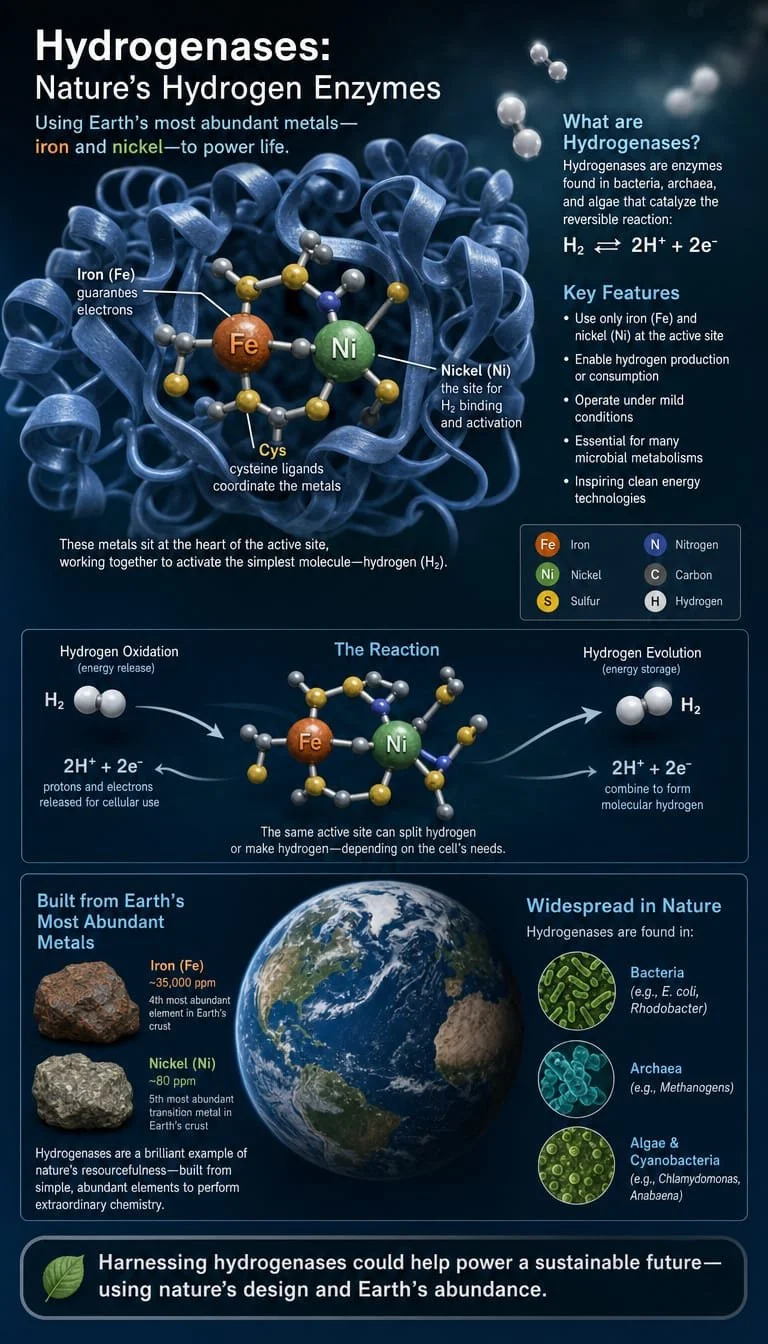
Nature, however, runs a massive, hidden hydrogen economy in the soil and the oceans without a single atom of platinum. It uses the most abundant metals on Earth—iron and nickel—housed within a class of enzymes known as the Hydrogenases.
The Engine: The Poisoned Cluster
There are two primary classes of these enzymes, named for the metals in their active sites: the [NiFe]-hydrogenases and the [FeFe]-hydrogenases.
If you look at the structure of these active sites, they seem to violate the fundamental rules of biology. The metals are coordinated by ligands that, to human cells, are deadly poisons: Carbon Monoxide (CO) and Cyanide (CN-).
In human biology, CO and CN- bind irreversibly to the hemoglobin in our blood and the cytochrome c oxidase in our mitochondria, suffocating the cell. But in the hydrogenase enzymes, these exact molecules are absolutely essential. They act as powerful electronic tuners. Because CO and CN- are strong-field pi-acceptor ligands, they pull electron density away from the iron centers, stabilizing the low oxidation states required to interact with hydrogen gas.
Nature took lethal poisons and repurposed them as the ultimate catalytic steering wheels.
The Mechanism: Heterolytic Cleavage and the Pendant Base
Let's look specifically at the [FeFe]-hydrogenase, which operates as nature's premiere hydrogen production facility.
The active site, known as the H-cluster, features a unique di-iron center bridged by a specialized dithiolate ligand (an azadithiolate). When the enzyme needs to produce hydrogen, it rapidly funnels electrons into the iron center.
But forming H2 requires more than just electrons; it requires protons (H+). This is where the geometric genius of the enzyme shines. The nitrogen atom situated in the bridging azadithiolate ligand hangs directly over the iron center. It acts as a "pendant base"—a microscopic, perfectly positioned claw that grabs a proton from the surrounding water and holds it directly above the metal.
The highly reduced iron center grabs a second proton to form an iron-hydride (FeH). The enzyme then forcefully pushes the hydride and the proton on the pendant base together. The heterolytic bond is forged, and H2 gas bubbles away. The entire reaction happens in milliseconds, rivaling or exceeding the turnover frequency of commercial platinum catalysts.
The Blueprint for the Retrofit
Why is the H-cluster the final key to our closed loop? Because it proves that we do not need rare earth metals to build a global energy grid.
Synthetic bioinorganic chemists are already using this exact blueprint to build the future. By designing synthetic complexes (like the DuBois catalysts) that mimic this bimetallic core and utilize synthetic pendant amines to manage proton flow, we are developing highly active, earth-abundant electrocatalysts for water splitting and fuel cells.
We can build the infrastructure for a global hydrogen economy using the dirt beneath our feet, provided we engineer the atomic geometry with the exact precision of a biological enzyme.