The Engines of Negentropy: Installment 6 - The Carbon Reversal
(07/10/2026)
In the linear economy, carbon dioxide (CO2) is the ultimate thermodynamic ash. It is the fully oxidized, low-energy exhaust of our power plants, our vehicles, and our own biological respiration. Once carbon reaches this state, human industry views it as a waste product to be vented or, at best, passively pumped into underground vaults.
To turn CO2 back into something useful—like a fuel or a polymer—requires pushing a massive boulder back up the thermodynamic hill. In the laboratory, this reduction is notoriously difficult, often requiring high overpotentials, extreme pressures, and rare, expensive electrocatalysts like palladium or ruthenium.
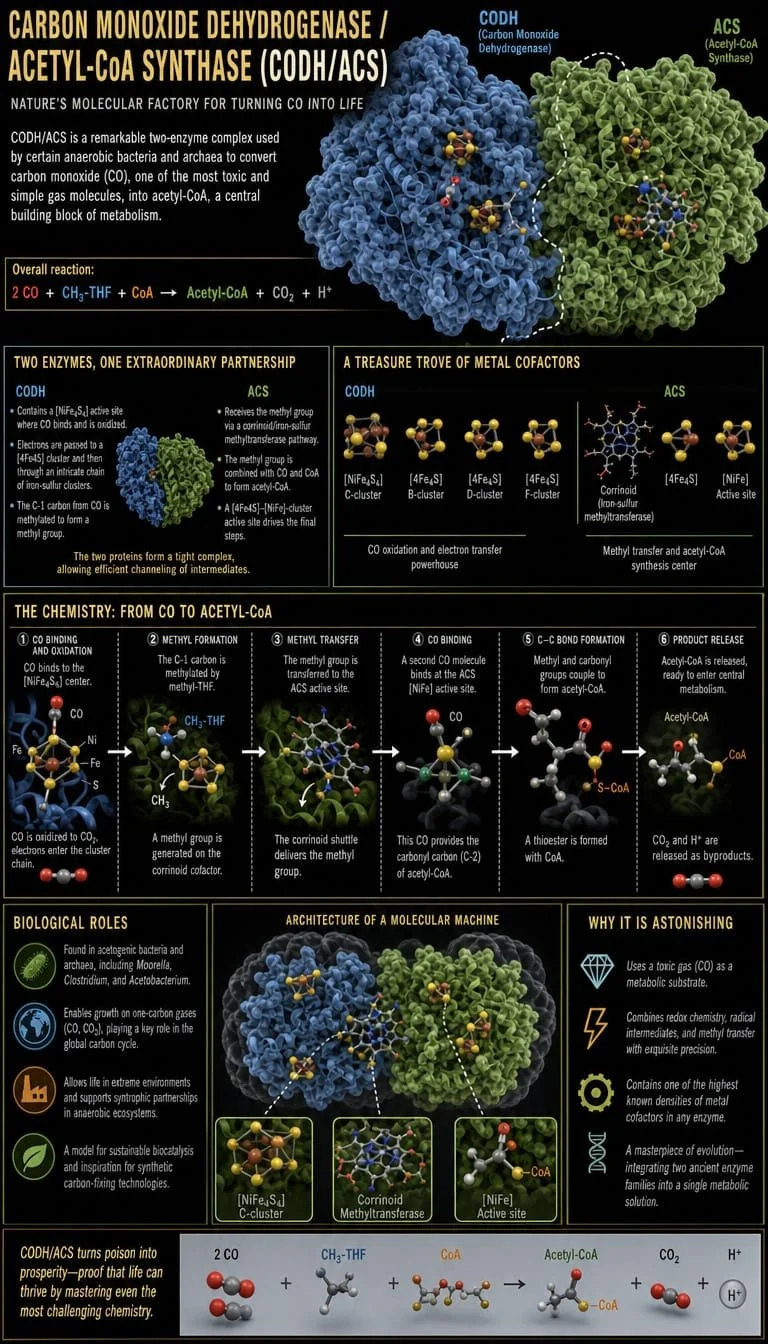
But billions of years ago, before the atmosphere was flooded with oxygen, anaerobic organisms mastered the art of living entirely on carbon dioxide and hydrogen. They didn't just survive; they thrived. They achieved this using one of the most astonishing pieces of bioinorganic machinery ever discovered: Carbon Monoxide Dehydrogenase / Acetyl-CoA Synthase (CODH/ACS).
The Engine: A Tale of Two Clusters
CODH/ACS is a massive, bifunctional enzyme complex that operates on the Wood-Ljungdahl pathway. It is nature's premiere carbon capture and utilization (CCU) technology. It does not use rare earth metals; it uses abundant iron and nickel, organized into two distinct, highly specialized active sites linked by a microscopic, internal gas channel.
1. The C-Cluster (The Reverser)
The primary challenge of CO2 reduction is the first step: stripping an oxygen atom away to create Carbon Monoxide (CO).
This occurs at the C-cluster, an asymmetrical Ni-Fe4S4 cubane structure. The geometry is heavily distorted, creating a highly specific binding pocket. When CO2 enters, it bridges the nickel and a specific iron atom. Through a finely tuned, two-electron reduction (often utilizing the exceptional charge-transfer capabilities and hyper-covalency of the metal-sulfur bonds), the enzyme cleanly cleaves a C-O bond.
Water is ejected, and the highly toxic, highly energetic CO molecule is generated at ambient temperature and pressure.
2. The A-Cluster (The Carbon Forge)
Carbon monoxide is a phenomenal building block, but releasing it into the cell would be lethal. Instead, the enzyme shuttles the CO molecule through a sealed, hydrophobic tunnel directly to the second active site: the A-cluster.
The A-cluster is a remarkable Ni-Ni-[Fe4S4] assembly. Here, the enzyme performs the ultimate act of negentropy: the formation of a carbon-carbon bond. The cluster binds the newly minted CO, accepts a methyl group (CH3) from a carrier protein, and grabs a molecule of Coenzyme A (CoA).
Acting as a microscopic organometallic foundry, the nickel centers orchestrate a precise insertion reaction, forging the three pieces together to eject Acetyl-CoA.
The Thermodynamic Triumph
Acetyl-CoA is the central hub of biological metabolism. It is the precursor to lipids, amino acids, and complex carbohydrates.
Through CODH/ACS, biology proves that it can reach into the air, grab the dead thermodynamic ash of CO2, and physically hammer it into the fundamental building blocks of life. It completely reverses the arrow of combustion.
The Blueprint for the Retrofit
Why must the architects of a closed-loop civilization study the C-cluster and the A-cluster? Because they are the ultimate proof of concept for synthetic carbon utilization.
If we are to retrofit Spaceship Earth, simply stopping emissions is insufficient. We must deploy Direct Air Capture systems that do not merely sequester CO2, but valorize it. By designing synthetic electrocatalysts that mimic the distorted geometry and hyper-covalent tuning of these Ni-Fe-S clusters, we can transform our exhaust into our primary industrial feedstock.
We can build systems that inhale CO2 and exhale synthetic aviation fuels, biodegradable plastics, and carbon-neutral concrete, entirely bypassing the need for fossil extraction.
CODH/ACS proves that carbon dioxide is not a poison; it is simply a resource waiting for the right transition metal catalyst to wake it up.