The Engines of Negentropy: Installment 5 - The Cobalt Scissor
(07/03/2026)
In Installment 3, we examined the extreme thermodynamic wall of the C-H bond. But human industry has manufactured bonds that are even stronger, more unnatural, and vastly more persistent. By linking carbon to halogens—specifically fluorine and chlorine—we created molecules that the Earth’s natural biogeochemical loops had never seen.
These are the "forever chemicals" (like PFAS) and halogenated solvents. The C-F bond is the strongest single bond in organic chemistry. Because these molecules are synthetically novel and thermodynamically fortified, biological systems generally cannot digest them. They accumulate in the water, in the soil, and in our blood.
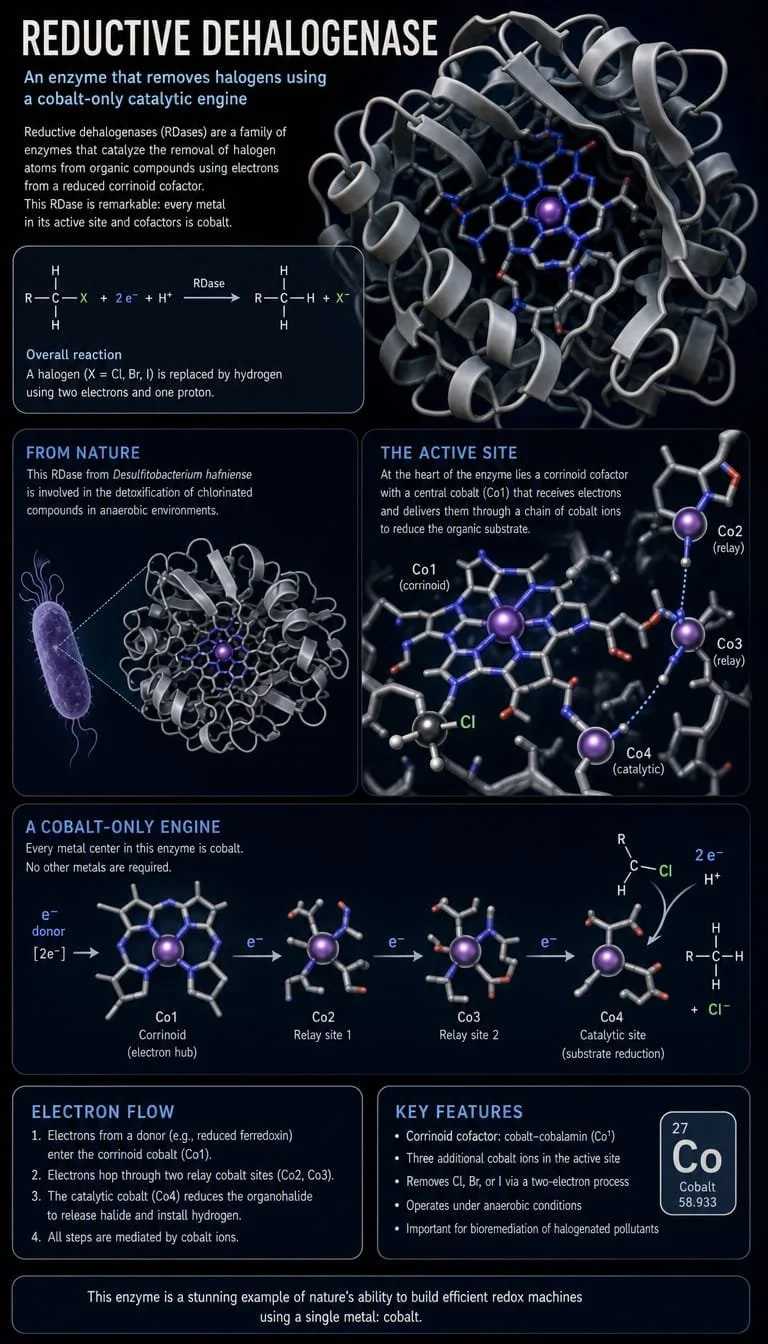
But biology is endlessly inventive. Deep in anaerobic environments, a specialized class of bacteria has evolved a metalloenzyme capable of doing the impossible: shattering the carbon-halogen bond. The enzyme is a reductive dehalogenase, and its engine is built entirely around cobalt.
The Engine: The Corrinoid Cofactor
The catalytic heart of these dehalogenases is a derivative of Vitamin B12 (cobalamin).
Unlike the di-iron center of sMMO or the manganese cluster of PSII, this active site features a single transition metal—cobalt—held securely within the equatorial grip of a tetradentate corrin ring. The corrin ring is slightly more flexible and contracted than a standard porphyrin (like the heme in our blood), which tunes the cobalt ion for extreme reactivity.
Cobalt is the perfect metal for this specific task because it possesses a vast, accessible redox landscape. In biology, it comfortably navigates between the Co(III), Co(II), and Co(I) oxidation states, acting as a highly precise, reversible electron shuttle.
The Mechanism: The Super-Nucleophile
To break a carbon-halogen bond, the enzyme relies on the unique electronic structure of the highly reduced $Co^I$ state.
The Co(I) species is notoriously unstable in the presence of oxygen, but in the anaerobic pockets where these bacteria thrive, it acts as a "super-nucleophile." Its d-orbitals are brimming with electron density, eager to attack.
When a toxic halogenated pollutant enters the active site, the Co(I) center strikes. In a classic biological pathway, it performs a targeted oxidative addition or an inner-sphere electron transfer, transferring an electron directly into the antibonding orbital of the carbon-halogen bond. The C-X bond snaps. The halogen is ejected as a harmless halide ion (like chloride or fluoride), and the enzyme rapidly replaces it with a hydrogen atom.
The toxic molecule is effectively stripped of its armor, rendering it digestible by standard biological processes.
Pushing the Boundary: High-Valent Cobalt and HAT
While biological systems typically rely on the Co(I)/Co(II) couple for reductive dehalogenation, closing the industrial loop requires pushing the chemistry even further.
To systematically digest the vast environmental liabilities of modern industry, synthetic bioinorganic chemists are isolating the principles of the corrin ring and pushing cobalt into extreme, high-valent territories. By engineering ligands that stabilize transient Cobalt(IV) species, it is possible to achieve highly aggressive Hydrogen Atom Transfer (HAT) mechanisms.
A well-tuned Co(IV) intermediate acts as a microscopic wrecking ball, capable of directly abstracting hydrogen atoms or activating notoriously inert bonds that even biological dehalogenases struggle with. It takes the thermodynamic elegance of Vitamin B12 and scales it into a weapon for total environmental remediation.
The Blueprint for the Retrofit
Why is the cobalt-corrinoid structure so critical for our future? Because it is the exact atomic blueprint for treating the world's most toxic waste.
Currently, destroying halogenated persistent pollutants requires incinerating them at temperatures exceeding 1,000°C, which is energetically crippling and often produces toxic secondary byproducts. By mimicking the active site of reductive dehalogenases—or engineering robust, synthetic cobalt macrocycles that utilize high-valent HAT chemistry—we can build bioreactors that chemically defang these molecules in water, at ambient temperature.
The cobalt scissor proves that we do not have to accept "forever chemicals" as a permanent scar on the biosphere. With the right transition metal tuning, the loop can always be closed.