The Glass Vault - The Annihilation Core
(08/14/2026)
We have established the water loop and witnessed the violent, daily metabolic swing of the carbon ledger. If a closed terrarium only contained water, air, and plants, it would survive for a short time, but it would inevitably crash.
The mechanism of that crash is simple: a leaf dies.
When a plant in the jar drops a leaf, it is not just shedding dead weight. That leaf contains a massive percentage of the jar's finite nitrogen, phosphorus, and complex carbon. If the dead leaves simply pile up on the glass floor, the soil is rapidly depleted of its bioavailable nutrients. The plants starve, not from a lack of light, but because all their building blocks are locked away in a thermodynamic vault of dead cellulose.
To keep the loop running, the microcosm requires a biological incinerator. It requires the Annihilation Core.
The Threat of the Fungal Bloom
Nature abhors a locked vault. When dead matter hits the moist soil, fungi and aggressive molds immediately attack it.
In an open forest, this is a healthy process. But in the constrained atmosphere of a sealed jar, a mold bloom is a death sentence. As the fungi rapidly break down the dead leaf, their respiration consumes massive amounts of oxygen and spikes the carbon dioxide levels. The metabolic swing we discussed in Installment 2 becomes unbalanced. The mold suffocates the plants, the air turns anaerobic, and the system collapses into a toxic swamp.
The Cleanup Crew: The Biological Lysosome
To prevent the mold from hijacking the nutrient loop, the architect of the glass vault must introduce a dedicated, specialized fauna. These are the detritivores—the microscopic cleanup crew.
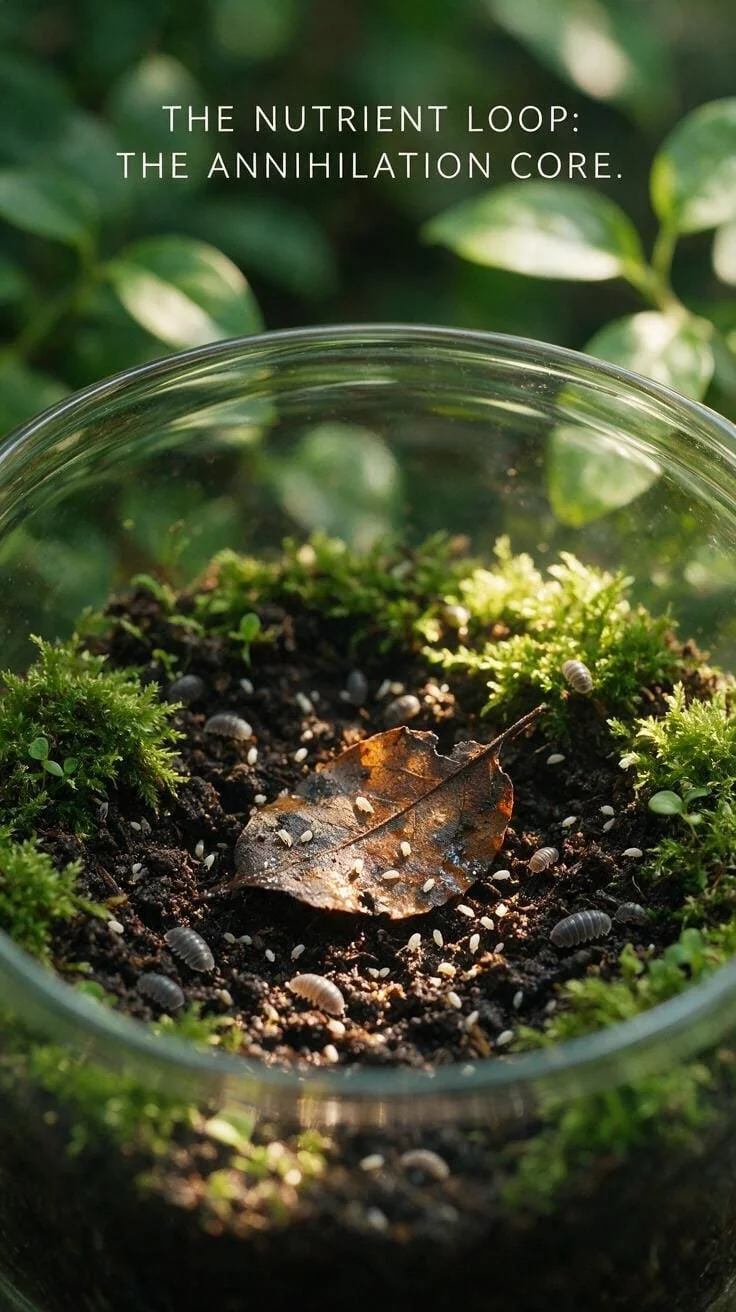
The Frontline (Springtails): Collembola, or springtails, are hexapods roughly the size of a pinhead. They do not eat the dead leaves directly; their primary diet is the mycelium of fungi. They act as the jar's immune system. As soon as a dead leaf begins to mold, the springtails swarm it, aggressively grazing on the fungal threads before the mold can sporulate or crash the oxygen ledger.
The Heavy Machinery (Isopods): For larger closed systems, dwarf white isopods (woodlice) act as the primary digesters. They consume the decaying plant matter directly. Their specialized digestive tracts break down the complex, locked cellulose and instantly return highly bioavailable nitrogen and phosphorus back to the soil through their waste.
They are roaming, microscopic bioreactors. They ensure that death in the jar is instantly translated back into usable life.
The Lesson of the Lysosome
This is the third rule of a closed-loop civilization: There can be no accumulation of waste.
In cell biology, the lysosome is an organelle that acts as the cell's waste disposal system, breaking down obsolete machinery and digesting complex molecules into simple building blocks. The springtails and isopods are the lysosomes of the glass vault.
On Spaceship Earth, our linear economy has completely ignored this rule. We extract virgin resources, manufacture products, and then discard the obsolete machinery into landfills. Our landfills are the equivalent of the dead leaves piling up on the floor of the jar—we are locking our finite critical minerals and complex polymers into dead vaults.
The glass vault proves that an architecture of abundance requires total resource recovery. We must build industrial lysosomes. Whether deploying advanced hydrometallurgical facilities to mine our own electronic waste, or engineering massive fungal bioreactors to perfectly digest our agricultural runoff, we must ensure that the exhaust of one industry is the exact, bioavailable feedstock of the next.
There is no "away." The loop must be closed, and the Annihilation Core must run constantly.