The Glass Vault - The Long Equilibrium
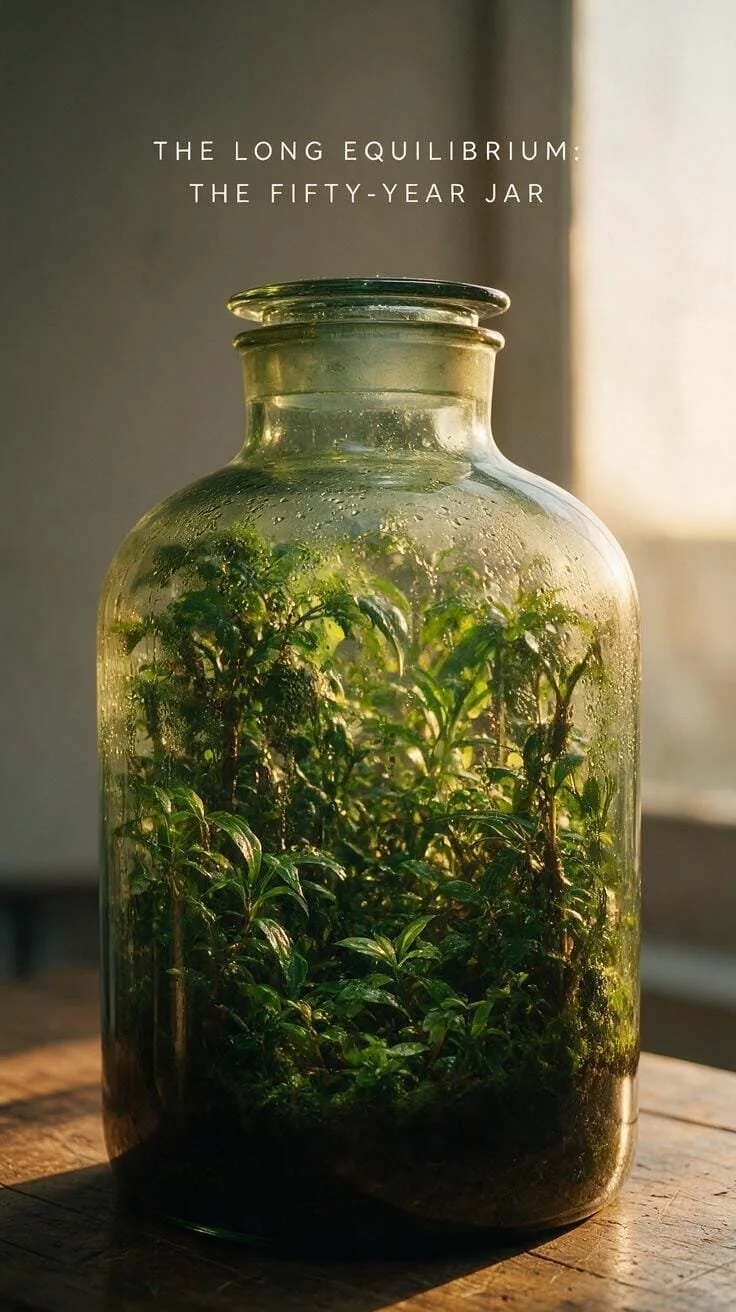
(08/21/2026)
When you build a terrarium, carefully placing the moss, the ferns, and the microscopic detritivores, the system looks perfect on day one. But the moment you seal the lid, the perfection ends. The system does not immediately settle into a quiet, harmonious loop. It enters a period of biological violence known as the "break-in."
Because the atmospheric boundary has suddenly shifted, the organisms inside must aggressively renegotiate their thermodynamic ledgers.
The Chaos of the Break-In
During the first few weeks of a sealed jar, chaos reigns.
Some plants, unable to adapt to the sudden spike in constant humidity, will simply melt into a pile of rot. The carbon dioxide levels may spike uncontrollably. White mold may rapidly bloom across the surface of the soil, threatening to choke out the remaining green life.
To an inexperienced observer, the terrarium looks like a failure. The instinct is to open the lid, vent the jar, and manually intervene. But if the architect has supplied the correct initial balance of organisms—the plants, the bacteria, and the springtails—opening the lid is the worst thing you can do. You must let the system fight it out.
The Calibration of the Loop
If left sealed, the biological engines engage.
The springtails, sensing the massive food supply of the mold bloom, trigger an explosive population growth. They swarm the fungi, beating back the white rot and consuming the dead leaves of the plants that failed to adapt. Through their digestion, they rapidly dump a concentrated spike of bioavailable nitrogen into the soil.
The surviving plants respond to this sudden nutrient spike. They stop trying to maintain their old, open-air foliage and begin aggressively growing new leaves—leaves that are structurally distinct, optimized perfectly for the high-humidity, low-airflow environment of the glass vault. The springtail population, having eaten all the excess mold, starves back down to a baseline, sustainable number.
The wild swings of oxygen and carbon dioxide begin to shallow out, finding a predictable, daily rhythm. The system self-tunes.
The Fifty-Year Jar
Once the break-in period is over, the terrarium crosses a threshold. It achieves a dynamic equilibrium.
The most famous example of this is a sealed glass carboy planted by David Latimer in 1960. Aside from a single watering in 1972, it has been permanently sealed. For over half a century, it has sat in the sunlight, perfectly balancing its own water, carbon, and nutrient ledgers. It is a thriving, vibrant forest inside a bottle, completely isolated from the Earth's atmosphere.
It survived the initial chaos to achieve immortality.
The Lesson of the Transition
This is the final rule of a closed-loop civilization: The transition will be chaotic, but the equilibrium is permanent.
As we begin the Planetary Retrofit—as we attempt to close the loops of our energy, agricultural, and industrial sectors—we are entering our own break-in period. The transition away from the linear economy is not going to be smooth. Old industries will fail. Supply chains will fracture. The economic and political ledgers will swing wildly as we attempt to negotiate the new thermodynamic boundaries of Spaceship Earth.
But we must not mistake the chaos of the break-in for a failure of the design.
We are currently building the biological and technological lysosomes—the synthetic enzymes, the fungal digesters, the carbon drawdown facilities. If we hold our nerve and trust the physics of total resource recovery, the chaos will eventually settle. We will push past the activation energy of the linear world and settle into the long equilibrium. We will achieve an architecture of true, sustainable abundance.