The Synthetic Metabolisms - The Urban Mine
(08/28/2026)
For thousands of years, human civilization has operated under a single, defining assumption about materials: wealth comes from the ground. We dig massive holes in the lithosphere to extract copper, silver, gold, and rare earth elements, refine them at immense energetic cost, and forge them into the architecture of our daily lives.
But the Earth’s crust is a finite ledger. The highest-grade ores were exhausted a century ago. Today, traditional mining operations must move mountains of dirt to extract a mere fraction of a percent of usable metal, leaving behind toxic tailings and scarred ecosystems. The linear model of extraction is reaching its thermodynamic limit.
Yet, we are not actually running out of metals. We have simply relocated them.
The New Veins of Ore
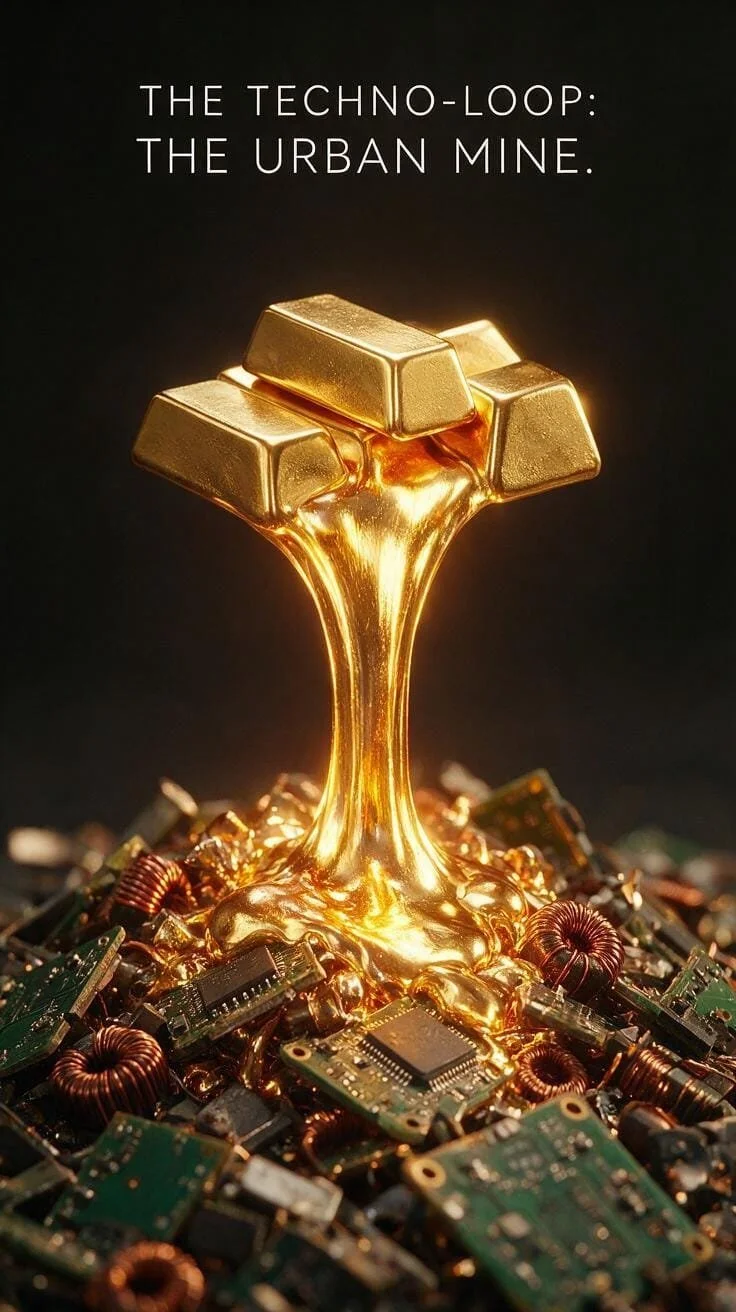
Look at a modern landfill, or the millions of tons of discarded smartphones, laptops, and solar panels piling up globally. In the linear economy, this is classified as electronic waste (e-waste)—a toxic liability.
In a closed-loop economy, this is a high-grade ore.
The concentration of gold, silver, and copper in a ton of discarded circuit boards is significantly higher than in a ton of virgin ore pulled from the best mines in the world. The transition metals required to build our renewable energy grid—the cobalt, the nickel, the lithium—are already sitting on the surface of the planet. They are just locked inside obsolete hardware.
The Hydrometallurgical Key
We cannot simply melt down a smartphone to recover its parts; the complex amalgamation of polymers, silicon, and layered metals would burn into a toxic slag. We need a precision scalpel, not a furnace.
The mechanism to close this loop is hydrometallurgy. Instead of brute-force thermal smelting, we use the precision of liquid chemistry.
By designing highly specific solvent extraction and precipitation pathways, we can dissolve complex electronic waste in aqueous solutions. We can engineer chemical environments that selectively target and pull individual metals out of the chaotic soup. A perfectly tuned hydrometallurgical loop strips the copper, isolates the rare earths, and leaves behind inert, manageable byproducts.
The Shift in Consciousness
This requires a profound shift in how we view the physical world.
Every printed circuit board, every battery, and every motor is just a temporary arrangement of atoms. When that arrangement is no longer useful, the atoms themselves do not lose their value. The urban mine treats the discarded technology of today as the exact, high-purity feedstock for the technology of tomorrow.
We no longer need to tear open the mountains. We simply have to deploy the chemical architecture required to digest our own cities.