

The Synthetic Metabolisms - The Phosphorus Bottleneck
(09/04/2026)
When we look at the agricultural ledger that feeds eight billion people, we often focus on nitrogen. But as we established in our study of Nitrogenase, nitrogen is abundant. It makes up 78% of the atmosphere. With enough energy and the right catalyst, we can pull an infinite supply of nitrogen directly out of the sky.
Phosphorus is entirely different. It is the structural backbone of DNA and the core of ATP, the energy currency of the cell. But unlike nitrogen, there is no atmospheric phosphorus. It is strictly terrestrial, and it is strictly finite.
The Linear Journey to the Sea
Currently, our global phosphorus supply relies on mining dwindling geological reserves of phosphate rock. We blast it out of the lithosphere, process it into fertilizer, and spread it across millions of acres of farmland.
Because plants only absorb a fraction of what is applied, the remainder washes away with the rain. It flows into agricultural drainage, municipal wastewater systems, and eventually out into the oceans, where it dilutes to a concentration so low that it crosses a thermodynamic event horizon. Once it hits the ocean, it is effectively unrecoverable. It is a perfectly linear, suicidal supply chain.
The Interception Point
To close the agricultural loop, we must sever this linear flow before the phosphorus escapes the terrestrial boundary. We must redefine municipal wastewater and agricultural runoff not as toxic liabilities, but as high-grade liquid ores.
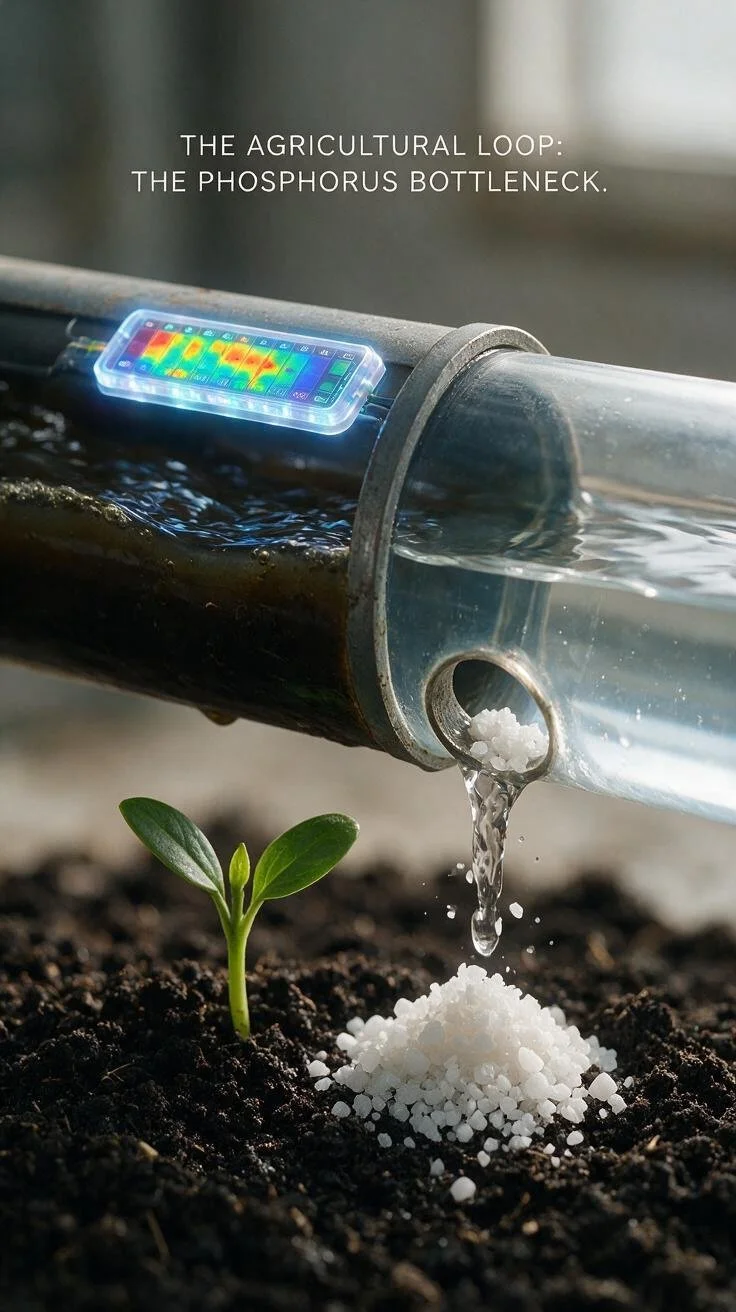
The first step in this recovery is visibility. We cannot capture what we cannot accurately measure in real-time. By deploying advanced sensor-based detection methods—such as highly tuned colorimetric sensor arrays integrated directly into agricultural outflow and municipal water treatment lines—we can map the exact concentrations and flow rates of these escaping nutrients.
Chemical Extraction and the Struvite Crystal
Once the phosphorus is located and quantified, we apply precision chemical extraction mechanisms to pull it out of solution.
The most elegant thermodynamic solution is the precipitation of struvite (MgNH4PO4*6H2O). By carefully managing the pH of the wastewater and introducing a magnesium source, we can force a chemical reaction that simultaneously traps the fugitive phosphorus and the ambient ammonium. The nutrients precipitate out of the liquid sewage as clean, white, perfectly formed crystals.
We have transmuted a liquid pollutant directly into a high-grade, slow-release solid fertilizer.
The Rotating Catalyst
This is the agricultural equivalent of urban mining. Closing the phosphorus loop means we stop treating this critical element as a single-use consumable. By mastering soil nutrient analysis, real-time sensor detection, and targeted chemical precipitation, we treat phosphorus as a rotating catalyst—moving from the bioreactor to the soil to the plant, and seamlessly back to the bioreactor.
We cap the drain, and the loop is closed.
