

The Synthetic Metabolisms - The Lithic Loop
(09/11/2026)
The Brutal Ledger of Concrete
Concrete is the second most consumed substance on Earth, trailing only water. It forms the physical foundation of modern civilization, but its thermodynamic ledger is devastating. The primary binder in concrete is Portland cement. To manufacture it, we dig up limestone (calcium carbonate) and subject it to immense heat, violently stripping away the carbon to leave behind reactive calcium oxide.
The chemical reaction is brutal and linear: CaCO3 → CaO + CO2.
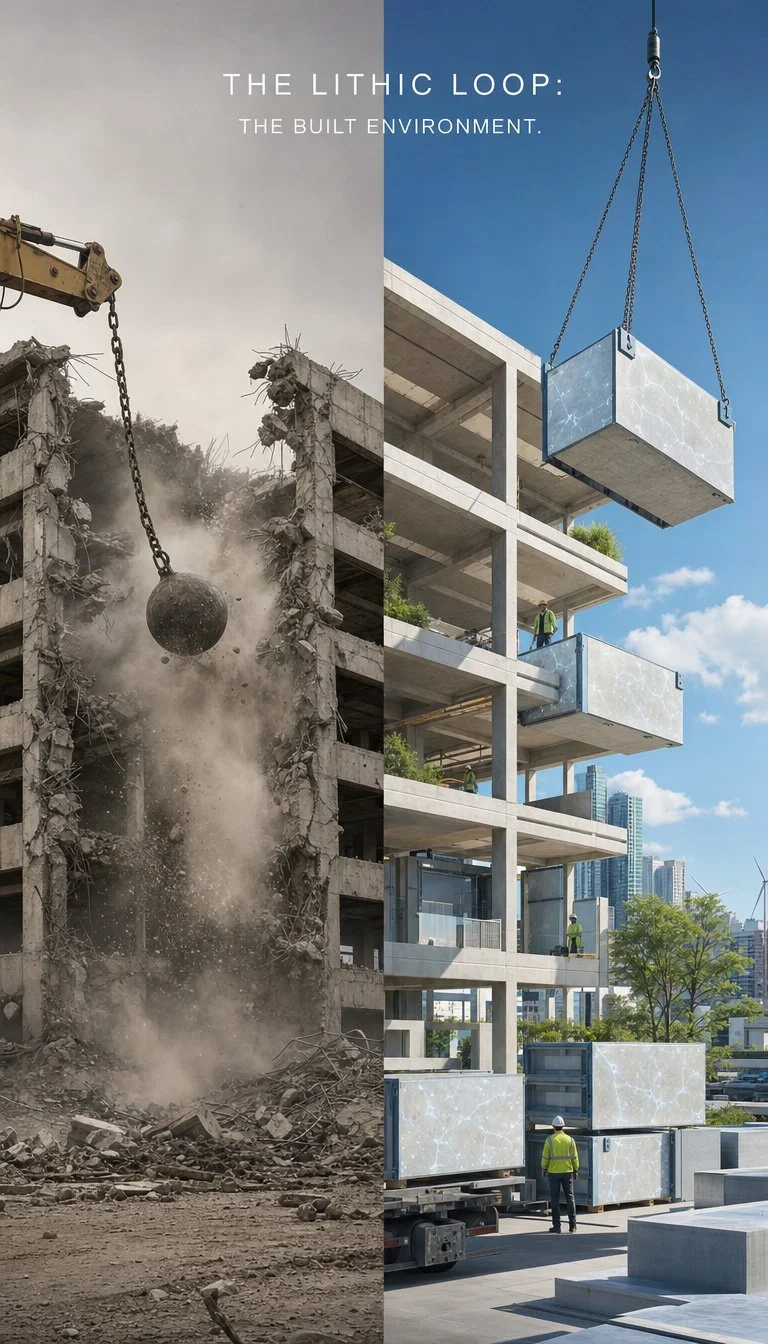
For every ton of cement produced, roughly a ton of carbon dioxide is blasted into the atmosphere. The built environment is essentially a massive, slow-motion carbon emitter. When a building reaches the end of its life, we demolish it with wrecking balls, turning that finite architecture into inert, unrecoverable rubble.
The Carbon Sponge
To close the lithic loop, we must reverse the thermodynamic arrow of the cement kiln. We must transform our cities from carbon emitters into massive, synthetic carbon sinks.
The mechanism for this reversal is mineralization. Instead of venting the CO2 captured from industrial exhaust or direct air capture systems, we can inject it directly into the wet concrete mix during the curing process. The carbon dioxide reacts with the calcium ions to forge perfectly stable, microscopic crystals of calcium carbonate (CaCO3) embedded throughout the matrix.
This process not only permanently locks the carbon away in an inert mineral state, but the resulting crystalline architecture actually increases the compressive strength of the material. The building itself becomes the vault.
Designing for Disassembly
Trapping carbon is only half the equation; we must also eliminate the wrecking ball. A closed-loop building cannot be a single-use object.
We must design our physical infrastructure for molecular disassembly. By engineering smart binders—chemical adhesives that hold strong for decades but can be specifically targeted and dissolved using specialized solvents or tuned thermodynamic triggers—we change the nature of demolition. When a structure is obsolete, we do not shatter it. We trigger the binder release, deconstruct the building into its fundamental modules, and instantly recover the high-grade aggregate and steel for the next project.
The city becomes a living, self-recycling organism. The lithic loop ensures that we never have to mine the Earth for stone again; we simply rearrange the stones we have already cut.
