

The Synthetic Metabolisms - The Information Loop
(09/18/2026)
The Physical Weight of the Cloud We refer to our global data infrastructure as "the cloud," implying it is ethereal, weightless, and infinitely scalable. The reality is that the digital realm is the most materially complex and energy-dense physical infrastructure ever constructed. To train massive artificial intelligence models and route global communications, we rely on data centers built with hardware forged from the rarest, most conflict-heavy, and toxic elements on the periodic table.
The current architecture of computing is a metallurgical trap. We dope silicon with highly specific, deeply entangled toxins, and we wire the logic gates together using tantalum, palladium, and dysprosium. Even with the advanced hydrometallurgical recovery of the urban mine, the thermodynamic cost of unweaving a modern microprocessor into pure elements is staggering.
The Iron Alternative To truly close the information loop, we must redesign the hardware from the atomic level up. We must move away from scarce rare-earth elements and toward the most abundant, easily recoverable metals in the Earth's crust.
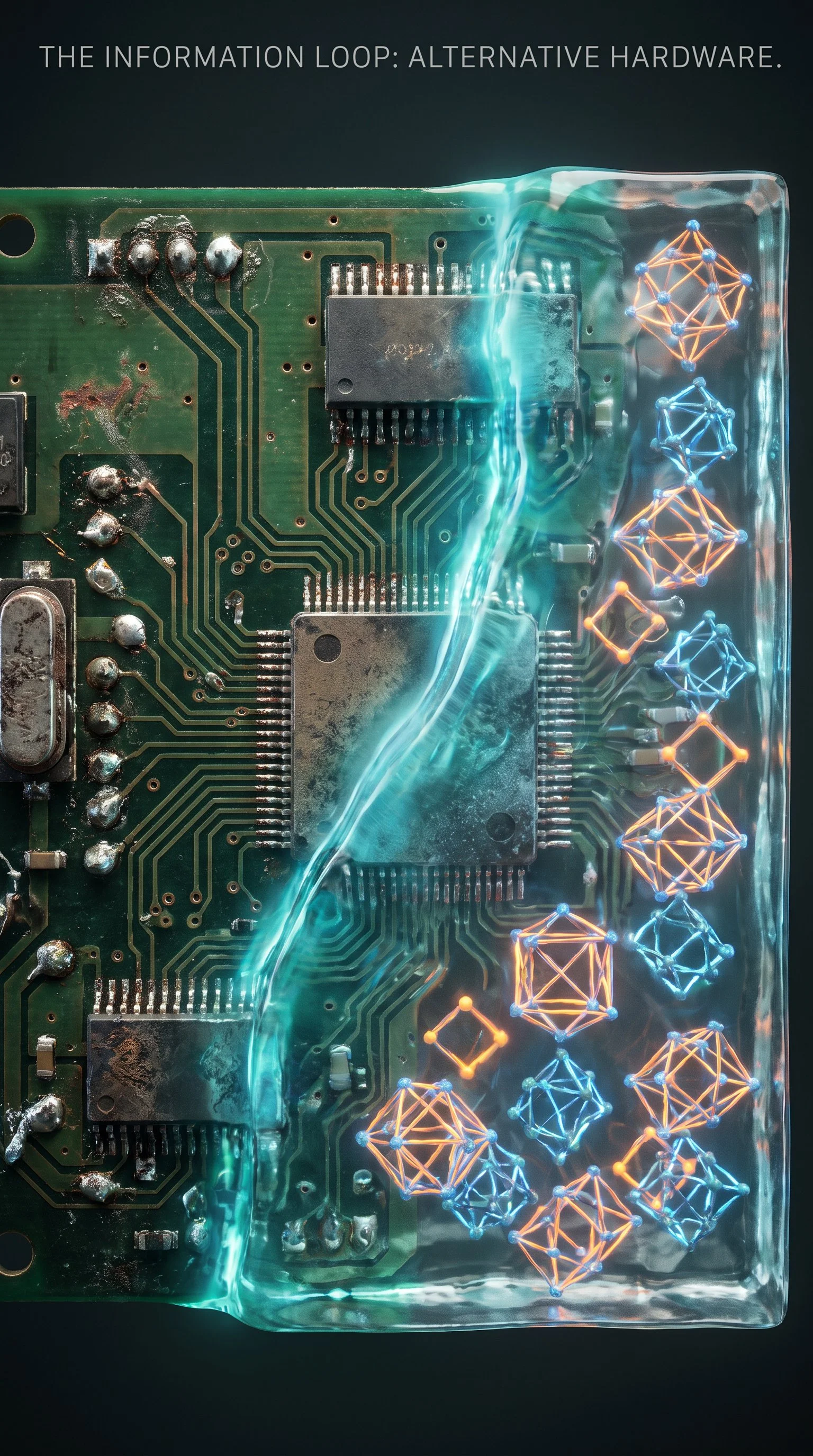
The future of sustainable computing lies in coordination chemistry and molecular spintronics. Instead of relying on the brute-force movement of electrical charge through rare metals, we can exploit the quantum spin state of electrons housed within precisely engineered transition metal frameworks. By synthesizing molecular magnets—bistable iron complexes that can switch between distinct spin states via small changes in temperature or light—we can store and process data using nothing but carbon, nitrogen, and iron.
We mimic the atomic precision of a metalloenzyme to process information, completely bypassing the need for heavy metal extraction.
The Dissolvable Substrate A truly closed loop demands that when a server rack reaches the end of its computational lifespan, it does not become a permanent liability. It must be designed for instant, flawless deconstruction.
We achieve this by replacing the rigid, thermoset epoxy resins of traditional circuit boards with transient organic polymers. These are engineered substrates built with highly specific thermodynamic trigger points. During active use, they are as robust as standard fiberglass. But when exposed to a specific chemical solvent or a targeted wavelength of UV light, the polymer backbone cleanly unzips back into its base monomers.
The board simply dissolves into a liquid pool, effortlessly releasing the pristine silicon and iron-based computational nodes to be harvested and immediately reassembled into the next generation of hardware.
The Infinite Processor The information loop proves that high technology does not require permanent planetary scarring. We can build the nervous system of tomorrow using the dirt beneath our feet, provided we engineer the molecular architecture to seamlessly assemble, compute, and gracefully dissolve on command.
