

The Urban Audit - The Mass Balance
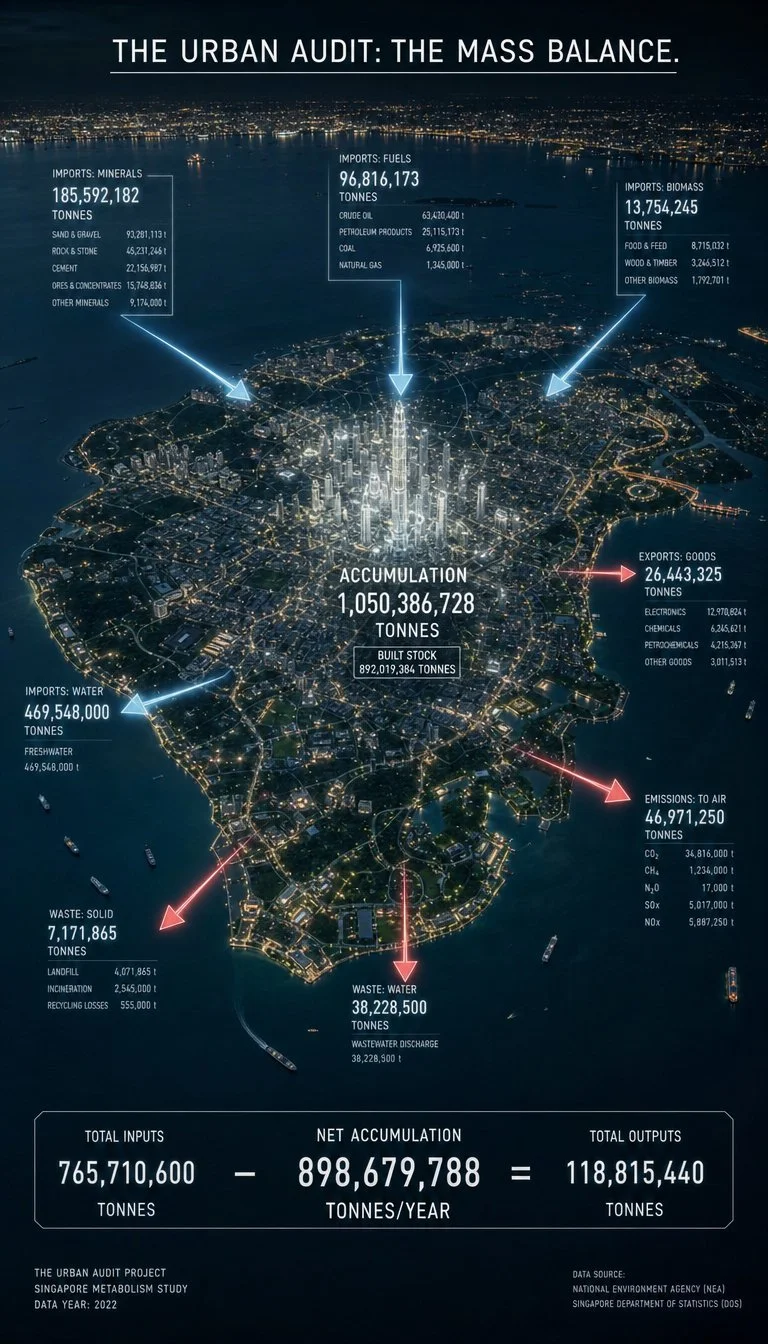
When engineers design life support systems for a space station, they do not think in terms of dollars; they think in terms of mass. Every kilogram of water, oxygen, and carbon that enters the hull must be strictly accounted for. If the mass balance is broken—if more waste is generated than can be scrubbed, or if essential elements are permanently locked into unusable states—the system eventually suffocates.
To understand why the global linear economy is failing, we must apply this exact mathematical rigor to a terrestrial city. We must stop looking at financial ledgers and start looking at the physical weight of human metabolism.
We use Singapore as our baseline. It is a highly advanced, geographically constrained island of roughly 734 square kilometers. It operates as a nearly perfect physical ledger.
The Input Matrix: The Weight of a City
A Material Flow Analysis (MFA) tracks Domestic Material Consumption (DMC)—the total weight of everything a society physically uses.
For a high-density, rapidly developing hub like Singapore, the DMC is staggering, historically operating in the realm of tens of millions of tonnes per year. This mass is not abstract; it arrives daily on cargo ships. We can categorize this input into four primary thermodynamic pillars:
Non-Metallic Minerals: This is the heaviest ledger. Millions of tonnes of sand, gravel, and limestone are imported annually. This is the raw mass required to physically expand the island through land reclamation and to pour the concrete for the lithic loop.
Fossil Fuels: The energy subsidy. Millions of tonnes of crude oil and natural gas cross the border. While much of this is refined and exported, a massive percentage is burned domestically to power the electric grid and desalinate the water supply.
Biomass: The biological fuel. Because Singapore has minimal agricultural land, virtually all food to support its population, alongside wood and paper products, must be imported.
Metal Ores and Advanced Materials: The smallest by weight, but the most complex by entropy. This includes the pure copper, rare earth elements, and highly refined silicon required to maintain the city's digital and physical infrastructure.
The Output Matrix: The Law of Conservation
The first law of thermodynamics dictates that mass cannot simply disappear. The tens of millions of tonnes entering Singapore's borders every year must go exactly one of three places: they are exported, they are emitted as waste, or they accumulate.
Once we subtract the exports (the refined fuels and manufactured goods shipped out), we are left with the domestic reality.
The Atmospheric Exhaust: The millions of tonnes of fossil fuels burned do not vanish. They are chemically converted and vented as carbon dioxide (CO2). The mass of the carbon physically leaves the city, but it accumulates in the global atmospheric ledger.
The Liquid Drain: The water loop, while highly engineered through reverse osmosis and reclamation (NEWater), still produces brine and treated effluent that must be physically managed or discharged.
The Solid Reality: The biomass (food waste), the obsolete advanced materials (e-waste), and the everyday detritus of millions of people pile up. Because Singapore lacks the landmass for traditional sprawling dumps, this solid waste must be incinerated.
The Accumulation: The Locked Vault
This leaves the final, most critical component of the Material Flow Analysis: Accumulation.
A massive percentage of the non-metallic minerals and advanced metals imported into the city never leave. They are poured into the concrete foundations of skyscrapers. They are wired into the subterranean subway grids. They are locked into the permanent architecture of the built environment.
The city is physically gaining weight every single year. It is a one-way accumulator of mass.
This is the baseline reality of modern civilization. We are pulling highly concentrated, low-entropy materials from the Earth, shipping them across the ocean, and locking them into permanent, mixed-state vaults. To understand why we cannot simply close this loop and recover our waste with current technology, we must move beyond the mass balance and look at the invisible tax levied on every single advanced material we create.
Next week, we will do the math on the Entropy of Mixing.
