

The Urban Audit - The Entropy Tax
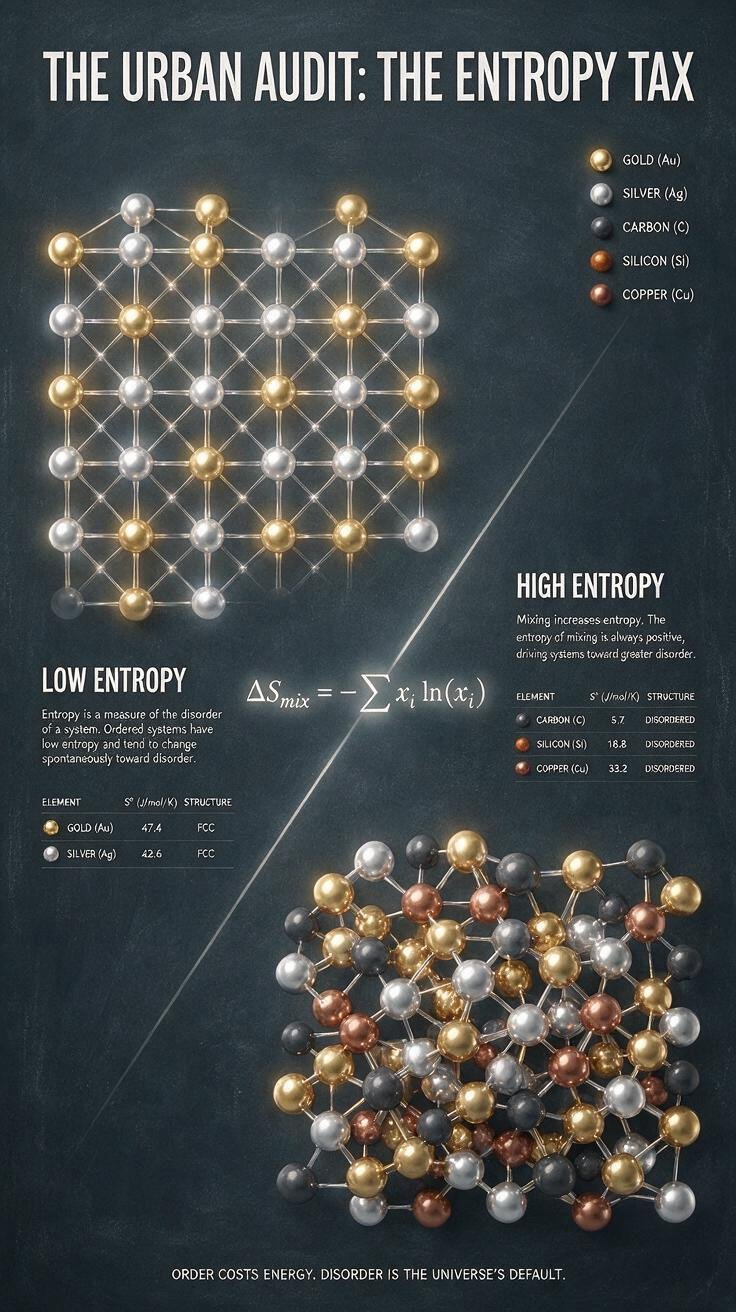
(10/02/2026)
When we look at a landfill or a pile of electronic waste, the common assumption is that our failure to recycle is a failure of policy, logistics, or funding. If we just tried harder, built better sorting facilities, or passed stricter laws, we could recover all of it.
This assumption ignores the fundamental physics of the universe.
The true barrier to a closed-loop civilization is not political; it is thermodynamic. It is defined by a mathematical constant known as the Entropy of Mixing.
The Mathematics of the Missing Link
In nature, the universe always favors a state of higher entropy (disorder). If you put a drop of ink into a glass of water, it will spontaneously disperse until the water is uniformly colored. The ink will never spontaneously gather itself back into a single, perfect drop. Un-mixing requires an input of energy.
When human industry extracts raw materials from the Earth, it is extracting relatively concentrated, low-entropy veins of ore. But to create the advanced materials required for a modern city—the smart glass, the high-strength concrete, the microprocessors—we do not use pure elements. We alloy, dope, coat, and fuse them. We mix them at the molecular level.
By taking pure, isolated elements and intimately mixing them into complex products, we dramatically increase the entropy of the system.
The minimum thermodynamic energy required to reverse this process—to un-mix a composite material back into pure elements—is governed by the Gibbs Free Energy of Mixing:
$$\Delta G_{mix} = \Delta H_{mix} - T\Delta S_{mix}$$
For an ideal mixture, the enthalpy of mixing ($\Delta H_{mix}$) is zero, leaving us with the pure entropy term: $\Delta G_{mix} = -T\Delta S_{mix}$.
The entropy of mixing itself ($\Delta S_{mix}$) for a multi-component system is calculated using the molar fractions ($x_i$) of the elements involved, multiplied by the ideal gas constant ($R$):
$$\Delta S_{mix} = -R \sum x_i \ln(x_i)$$
Because the natural log of a fraction is always negative, the overall entropy of mixing is always positive. The universe loves the alloy. It hates the pure element.
Paying the Tax
This equation is the invisible ledger of human industry. It is the Entropy Tax.
When you want to recycle an advanced material, you cannot just shred it and melt it down. To pull the rare-earth neodymium out of the magnetic alloy of a hard drive, or to strip the micro-layers of tantalum and palladium off a circuit board, you must pay the entropy tax. You must physically input at least the energy defined by $T\Delta S_{mix}$ to force the elements back apart.
In physical reality, because no industrial process is perfectly efficient, the actual energy required to un-mix a smartphone is vastly higher than the theoretical minimum.
This is the missing link. This is why the loop remains open. Currently, the energetic cost (measured in Joules) and the financial cost of paying the entropy tax to un-mix our advanced garbage is often vastly greater than the cost of simply digging fresh, low-entropy ore out of the ground.
The Molecular Scalpel
We cannot negotiate with the second law of thermodynamics, but we can change how we pay the tax.
Our current recycling infrastructure relies on brute force—mechanical shredders and high-temperature thermal smelters. We try to shatter the mixed materials apart, which is energetically crippling.
If we are to survive, we must look backward to the biological engines we studied earlier. Biology does not use brute force to un-mix its environment. It uses the molecular precision of transition metal catalysts to lower the activation energy of the extraction. To close the industrial loop, we must engineer synthetic chemical pathways—advanced solvent extractions, phase-divergent precipitation, and tailored ligands—that selectively bind to target metals, pulling the alloys apart with atomic surgical precision rather than thermal violence.
The math is brutal, but it gives us our exact target. We now know the height of the thermodynamic wall.
