

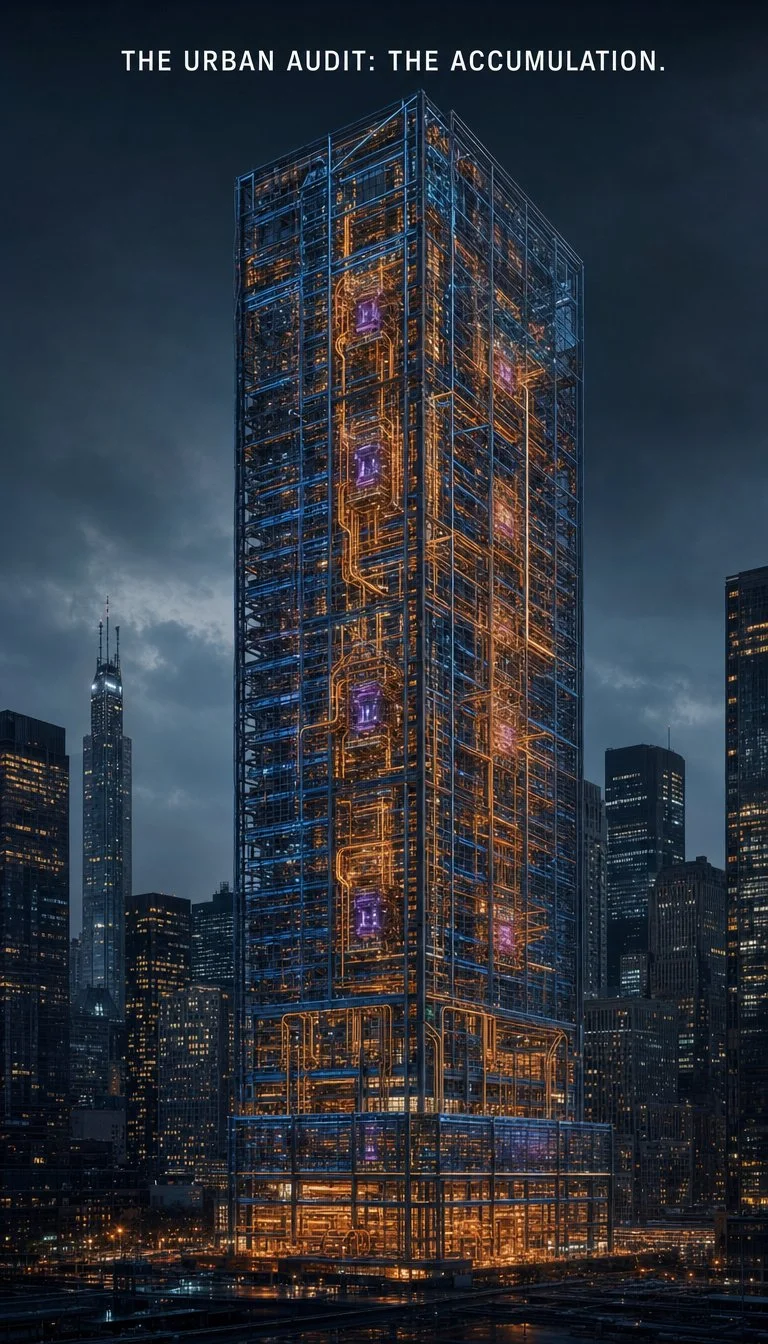
The Urban Audit - The Accumulation
(10/09/2026)
In the accounting of a Material Flow Analysis (MFA), the foundational equation is elegantly simple: $Input - Output = Accumulation$.
Whatever mass crosses the physical boundary of a city and does not subsequently leave as an export, an atmospheric emission, or a liquid effluent must, by the laws of physics, remain within the boundary. It accumulates.
When we look at a highly developed, geographically constrained space like Singapore, the visual evidence of this accumulation is obvious: it is the skyline. It is the built environment. But to truly understand the broken loop of the linear economy, we must look past the concrete and audit the atomic inventory paralyzed inside that architecture.
The Anatomy of the Vault
We tend to view buildings and infrastructure as permanent fixtures—the final resting place for extracted materials. In thermodynamic terms, a city is a massive, high-entropy vault.
While non-metallic minerals (sand, gravel, limestone) make up the overwhelming bulk of this accumulated mass, the true crisis lies in the transition metals and critical minerals. A modern city block is a localized, dense hoarding of the periodic table:
The Vascular System: Millions of tonnes of elemental copper ($Cu$) are woven through the subterranean grid and behind the drywall, acting as the conductive arteries for the city's power and data.
The Skeletal Armor: Iron ($Fe$) and carbon are alloyed into structural steel, which is then heavily galvanized with zinc ($Zn$) to prevent atmospheric oxidation.
The Rare-Earth Nodes: Neodymium ($Nd$) and dysprosium ($Dy$) are locked inside the high-torque magnetic motors of thousands of elevator shafts and HVAC turbines.
Every year, millions of tonnes of these elements enter the city limit. A fraction leaves as e-waste. The vast majority simply accumulates, trapped in the physical matrix of the island.
The Grade of the Urban Ore
This accumulation forces us to recalculate how we define a "resource."
Currently, the global mining industry will move millions of tonnes of earth in Chile or Australia to extract copper ore with a grade of less than 1%. They crush mountains to isolate trace amounts of metal.
Compare that to the urban vault. The concentration of copper, zinc, aluminum, and rare earth elements sitting above ground, paralyzed within a single square kilometer of a modern financial district, vastly exceeds the highest-grade geological veins left on Earth. The city is the richest mine on the planet.
The Paralysis of Entropy
If the city is a high-grade mine, why are we not extracting from it? We return to the Entropy Tax ($T\Delta S_{mix}$) established in Installment 2.
Because we did not design our cities for molecular disassembly, these elements are intimately bound. The copper is sheathed in cross-linked polymers. The steel is encased in cured calcium carbonate. The rare earths are fused into complex alloys. The energy required to mechanically shatter a skyscraper and thermally separate these metals back into pure elemental feedstocks currently exceeds the energy required to simply dig fresh ore out of the ground.
We have successfully extracted the Earth’s geological wealth, only to paralyze it in a state of high entropy above ground.
Unlocking the Ledger
A closed-loop civilization cannot afford to hoard its catalytic elements in static monuments.
To survive the future, we must stop viewing the built environment as permanent architecture. We must view it as a temporary, above-ground strategic reserve of elements. This requires a two-front war against entropy:
Prospective Design: We must engineer future infrastructure with reversible, phase-divergent binders—materials that hold their structural integrity for a century but instantly unzip when exposed to a specific chemical or thermal trigger.
Retrospective Extraction: We must aggressively scale the advanced hydrometallurgy and bioinorganic extraction systems capable of selectively leaching target metals out of our existing, high-entropy demolition waste.
The elements are already here. They are simply waiting to be unlocked.
