The Mathematics of the Bleed When the Sabatier reactor fires, it resolves the immediate crisis of human respiration, but it creates a secondary thermodynamic problem. The equation ($CO_2 + 4H_2 \rightarrow CH_4 + 2H_2O$) yields water, which is infinitely recyclable, and methane ($CH_4$), which currently is not.
On the International Space Station, this methane is vented into the vacuum of space.
If we look at the atomic mass of this vented gas, the severity of the leak becomes apparent. Methane has a molar mass of approximately 16 g/mol. Carbon accounts for 12 g/mol, and the four hydrogen atoms account for 4 g/mol. This means that by mass, every time we vent a kilogram of methane, we are throwing away 250 grams of elemental hydrogen.
Hydrogen is the single most valuable elemental currency in a closed-loop life support system. It is the necessary reactant to scrub the next breath of $CO_2$. If a spacecraft bleeds its hydrogen into the void, it will eventually asphyxiate, regardless of how much power its solar arrays generate.
The Thermodynamic Wall of Methane To achieve absolute mass retention, we must recover that hydrogen. We must un-mix the methane.
This brings us back to the Entropy Tax. The carbon-hydrogen ($C-H$) bond is one of the most stable, tightly locked formations in organic chemistry. It requires an immense activation energy to shatter. We cannot burn it, because introducing oxygen would simply yield water and $CO_2$, completely reversing the Sabatier reaction and putting us back at square one.
We must shatter the molecule in the absence of oxygen. We must use pyrolysis.
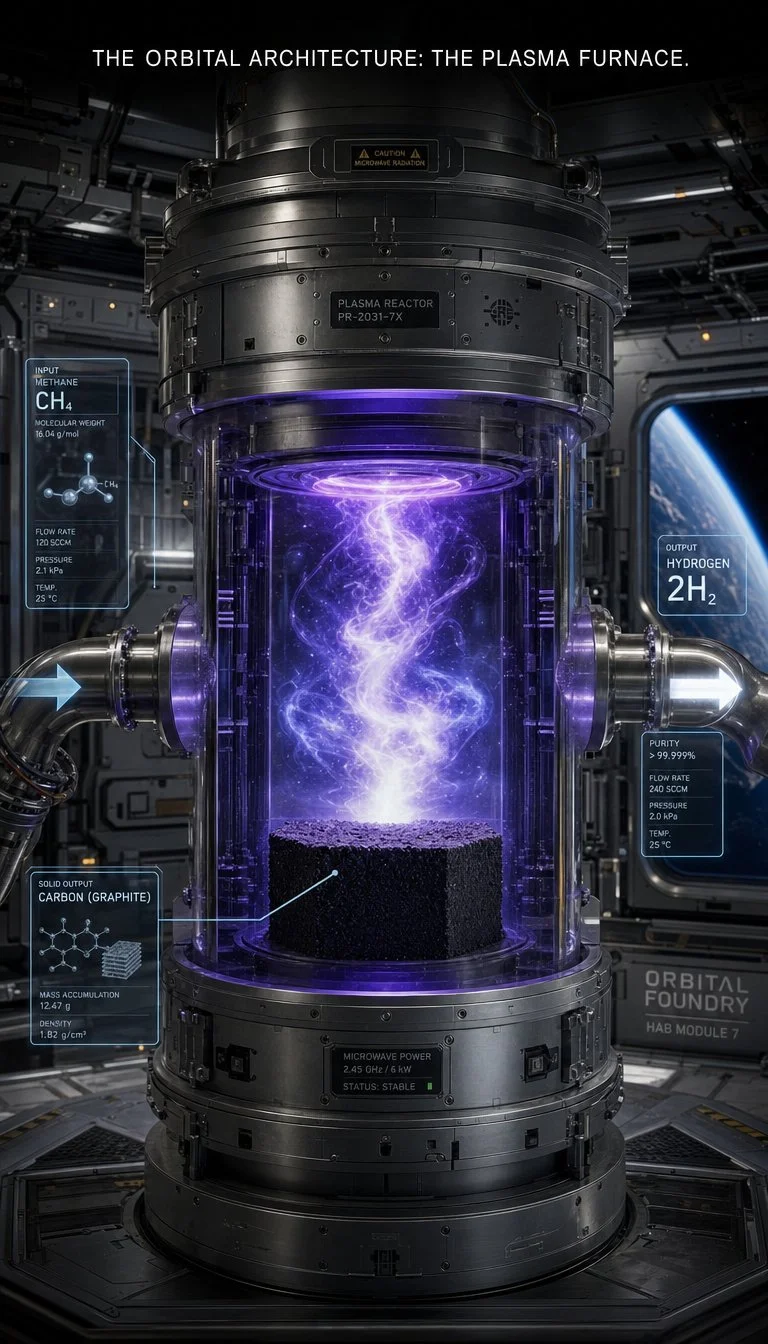
The Microwave Plasma Reactor To break the $C-H$ bonds without combustion, we introduce the gas to a fourth state of matter. We route the Sabatier exhaust into a specialized quartz chamber and bombard it with high-frequency microwaves, stripping the electrons from the gas and igniting a localized plasma field.
Inside this plasma furnace, temperatures locally exceed 2000°C. The thermodynamic violence is absolute. The methane molecule cannot maintain its structural integrity and rips apart:
$$CH_4 + \text{Microwave Plasma} \rightarrow C_{(solid)} + 2H_{2(gas)}$$
The Solid Carbon Vault The result of this reaction is the Holy Grail of closed-loop architecture.
The hydrogen instantly returns to a gaseous state ($2H_2$). It is captured, compressed, and fed directly back into the Sabatier reactor. The hydrogen loop is now completely closed. Not a single atom is lost to the vacuum.
But the true elegance of the plasma furnace lies in the carbon. Stripped of its hydrogen, the elemental carbon drops out of the plasma as a solid fine powder—graphite or carbon black.
By applying extreme localized energy, we have transmuted a volatile greenhouse gas into an inert, highly dense, stackable solid. We have taken the carbon that a human exhaled as a toxic vapor and turned it into a physical brick. In a generational spacecraft, this solid carbon is not waste; it is a high-grade, lightweight structural material that can be mixed into composites to reinforce the hull or 3D-print spare parts.
The Terrestrial Translation The physics of the orbital hull dictate the physics of the planet.
On Earth, we are currently losing the battle against atmospheric methane, a greenhouse gas significantly more potent than $CO_2$. If we scale the plasma furnace terrestrially, we do not just mitigate emissions; we create a localized, synthetic metabolism. We can pull fugitive methane from agricultural waste and industrial exhaust, run it through massive plasma arrays, and generate two perfect outputs: pure, emission-free hydrogen gas to power our electrical grids, and solid carbon to build the physical architecture of our cities.
We stop venting our exhaust, and we start mining our own breath.