The Orbital Architecture - The Sabatier Engine
The Lethality of the Linear Breath In the vacuum of space, a linear economy is a death sentence. There is no atmosphere to vent into, and no groundwater to dilute toxins. The physical boundary is the titanium hull of the spacecraft.
The most immediate thermodynamic crisis in a sealed hull is human respiration. A single astronaut consumes approximately 0.84 kilograms of oxygen ($O_2$) and exhales roughly 1.0 kilogram of carbon dioxide ($CO_2$) every day. If you treat this linearly—bringing oxygen tanks for supply and using lithium hydroxide canisters to trap the exhaled carbon—you are simply importing mass and accumulating waste. For a multi-year journey to Mars, the physical weight of those tanks and canisters would make the spacecraft too heavy to launch.
To survive, you cannot simply store the carbon exhaust. You must transmute it.
The Electrolysis and The Sabatier Reaction The current thermodynamic heart of the International Space Station's life support is a two-step chemical engine.
First, we must generate oxygen. We do this through the electrolysis of water. By applying a massive electrical current (generated by the solar arrays) to the station's water supply, we forcibly break the molecular bonds:
$$2H_2O + \text{Electrical Energy} \rightarrow 2H_2 + O_2$$
The crew breathes the oxygen ($O_2$). But this leaves us with a highly volatile byproduct: elemental hydrogen ($H_2$).
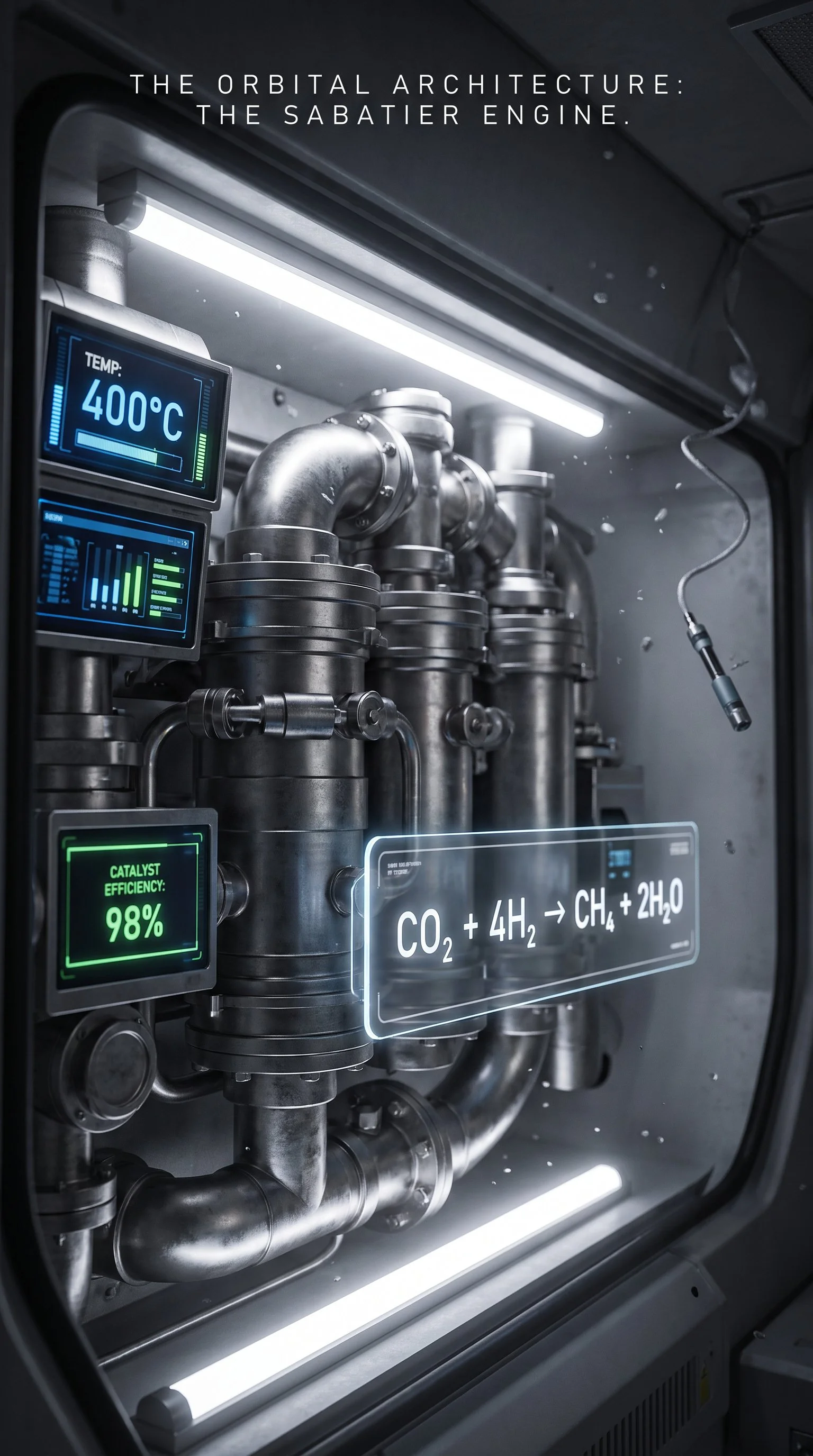
To close the loop, we deploy the Sabatier Engine. Discovered in the 1890s, this catalytic reaction is the foundation of space-faring architecture. We take the volatile hydrogen from the electrolysis machine and combine it directly with the toxic $CO_2$ exhaled by the crew. We force this mixture into a specialized reactor, passing it over a ruthenium or nickel catalyst heated to 400°C.
The thermodynamic math engages:
$$CO_2 + 4H_2 \rightarrow CH_4 + 2H_2O + \text{Thermal Energy}$$
By forcing the waste gases to react, we neutralize the toxic carbon dioxide, and we miraculously manufacture fresh, pure water ($H_2O$) to feed right back into the electrolysis machine. The crew is drinking their own chemically transmuted breath.
The Bleed: The Broken Orbital Loop However, if we look closely at the math, the loop is not perfectly closed.
The Sabatier reaction yields water, but it also yields methane ($CH_4$). Currently, the ISS does not have the architecture to process this methane, so it is vented out of the station and into the vacuum of space.
This is an orbital leak. With every kilogram of methane vented, the space station permanently bleeds precious carbon and hydrogen. Over time, the hull slowly loses mass, requiring periodic resupply shipments from Earth to top off the water and oxygen ledgers.
The Next Thermodynamic Hurdle Even our most advanced space-faring architecture is currently bleeding mass. To build a generational ship—or to build a perfectly circular terrestrial city—we must crack the methane problem. We must deploy advanced plasma pyrolysis ($CH_4 \rightarrow C + 2H_2$) to violently strip the hydrogen back out of the methane, yielding solid, stackable graphite.
The physics of the hull dictate the physics of the planet. If we can achieve absolute mass retention in orbit, we have the blueprint for absolute mass retention on Earth.