

The Urban Audit - The Ash and the Slag
(10/16/2026)
The Illusion of Disappearance
When a physically constrained system runs out of space to accumulate its mass, it must alter the volume of that mass. In Singapore, and increasingly in every major metropolis, the mechanism for this volume reduction is Waste-to-Energy (WtE) incineration.
Currently, thousands of tonnes of municipal solid waste are fed into massive thermal plants daily. By subjecting the city’s exhaust to temperatures exceeding 1000°C, the physical volume of the garbage is reduced by up to 90%. The process generates electricity, which powers the grid, creating the illusion of a closed loop.
But as established in the mass balance of Installment 1, the First Law of Thermodynamics is absolute. Mass is never destroyed. We merely change its state. The carbon and organic fractions are violently oxidized and vented into the atmosphere as $CO_2$ and water vapor. The remaining 10%—the inorganic mass, the heavy metals, the glass, and the unburnable detritus—drops out of the bottom of the furnace.
This is Incineration Bottom Ash (IBA). It is the absolute, thermodynamic end of the linear economy.
The Chemistry of the Slag
When we look at IBA, we are looking at the most chaotic, high-entropy material human beings produce.
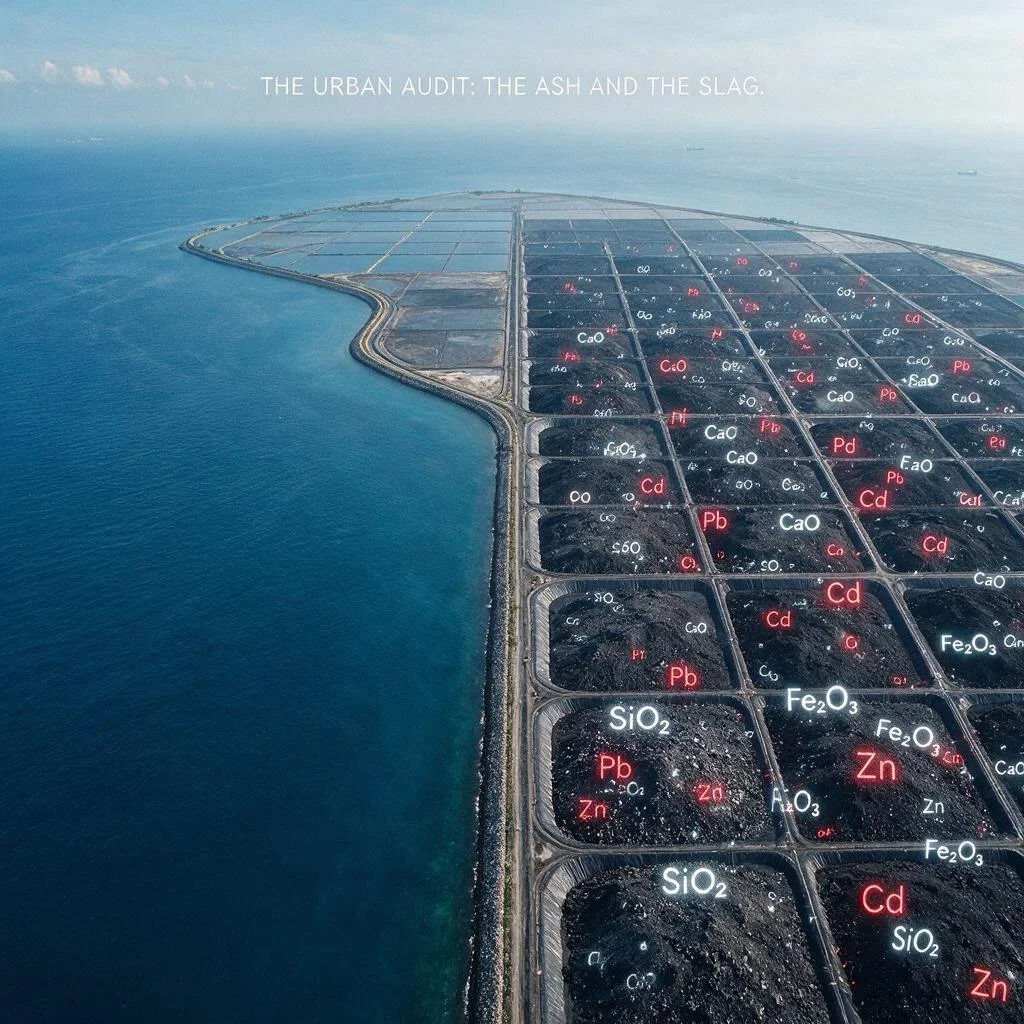
In a landfill, materials sit adjacent to one another. In an incinerator furnace, they are chemically fused. We take the transition metals—copper ($Cu$), zinc ($Zn$), lead ($Pb$), and cadmium ($Cd$)—from discarded electronics, batteries, and synthetic polymers, and we subject them to extreme thermal oxidation. These metals become locked into a complex, glassy silicate matrix composed primarily of silicon dioxide ($SiO_2$), calcium oxide ($CaO$), iron oxide ($Fe_2O_3$), and aluminum oxide ($Al_2O_3$).
By applying thermal brute force rather than chemical precision, we drive the Entropy of Mixing ($\Delta S_{mix}$) to its maximum possible value. We create a synthetic, highly toxic, ultra-low-grade ore. Because the metals are now oxidized and vitrified into a glass-like slag, the energy required to un-mix this material and recover the elemental copper or zinc is staggering. We have permanently paralyzed the elements.
The Artificial Stratum: Semakau Landfill
Because this highly toxic slag cannot be allowed to leach into the groundwater, it must be contained.
Singapore’s solution is a marvel of engineering born from absolute necessity: the Semakau Landfill. It is a man-made island located eight kilometers offshore, built entirely by enclosing a perimeter of ocean with a rock bund, lining it with an impermeable geomembrane, and systematically filling the cells with millions of tonnes of incineration ash.
Semakau is not a dump; it is an engineered, artificial geological stratum. It is an island built entirely out of the high-entropy exhaust of the urban metabolism.
The Thermodynamic Dead End
Semakau is currently projected to run out of physical space by 2035. This date is the mathematical wall of the linear economy.
When the offshore cells are full, there is nowhere else to put the ash. We cannot incinerate the ash to reduce it further. We have reached the bottom of the ledger. To survive past this deadline, a space-faring or closed-loop civilization has only two options, both requiring the bioinorganic and hydrometallurgical architectures we have designed.
First, we must stop making the ash. We must deploy the phase-divergent binders and targeted solvents at the beginning of the supply chain so that advanced materials are disassembled molecularly, never reaching the furnace.
Second, we must learn to mine the slag. We must engineer aggressive, highly specific biological or chemical leaching agents capable of infiltrating the $SiO_2$ matrix of the bottom ash to selectively pull the heavy metals back out of the vault. The linear line ends at Semakau; the loop must begin there.
