Series: Bioremediation | Difficulty: Intermediate | Estimated Time: 1.5 Hours (Active Build) + Continuous Operation
Introduction
Modern indoor air is often more polluted than outdoor air. Fresh paint, particleboard furniture, synthetic carpets, and cleaning supplies constantly off-gas Volatile Organic Compounds (VOCs) like formaldehyde, benzene, and toluene.
Standard air purifiers use activated carbon to absorb these gases. But carbon has a finite surface area. Once the microscopic pores are full, the filter is dead and must be thrown in a landfill.
In industrial waste-gas treatment, engineers use biofiltration. By passing contaminated air through a moist, microbially rich substrate, the toxins are not just trapped; they are biologically digested. In this module, we are shrinking that industrial process down to a desktop scale, using a PC cooling fan to drive polluted air through a living matrix of soil microbes and activated carbon. It is a filter that eats its own trapped toxins to stay permanently clean.
The Biology & Physics - Mass Transfer and Enzymatic Oxidation
A biofilter is a two-step engine. It relies on fluid dynamics (moving a gas into a liquid) and microbiology (oxidizing a carbon source).
Step 1: The Mass Transfer (Gas to Liquid)
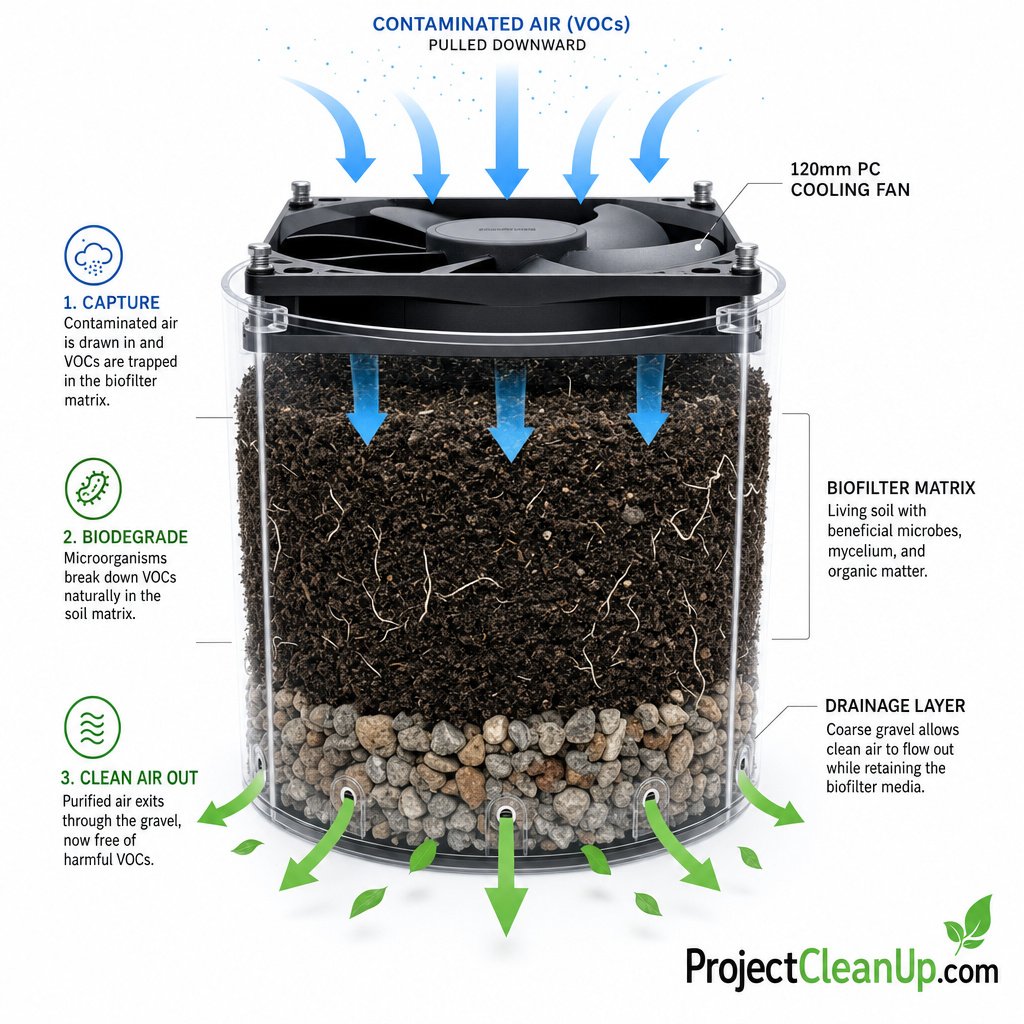
Microbes live in water, not air. For a bacterium to eat a VOC molecule, that molecule must first transfer out of the air and dissolve into a liquid. This is why our filter matrix must remain damp. As the PC fan pushes the contaminated air through the porous soil, the VOC molecules hit the thin microscopic film of water surrounding the soil particles and dissolve into it.
We add activated carbon to the soil matrix because it acts as a "buffer." If a massive spike of VOCs enters the system (e.g., you spray a household cleaner nearby), the carbon instantly absorbs the excess, holding it in place until the bacteria can catch up and digest it.
Step 2: Enzymatic Oxidation
Once the VOC is dissolved in the biofilm, a consortium of heterotrophic bacteria (like Pseudomonas and Bacillus, naturally present in healthy compost) go to work. Because VOCs are structurally made of carbon and hydrogen, the bacteria view them as food.
Using oxygen from the airflow, they enzymatically oxidize the toxic molecules, breaking their chemical bonds to harvest the energy.
The chemical equation for this biological digestion looks like this:
$\text{VOC} + O_2 + \text{Microbes} \rightarrow CO_2 + H_2O + \text{More Microbes}$
The toxic formaldehyde or benzene is transmuted entirely into harmless carbon dioxide, water vapor, and new bacterial cell mass.
Safety Framework: R.A.M.P.
Recognize hazards: We are working with basic 12V DC electronics (wiring a fan) and handling potentially dusty activated carbon and compost.
Assess risks: Short-circuiting the fan if water spills on the wiring. Inhaling carbon dust during the initial mixing phase.
Minimize risks: Wire and seal all electrical connections before adding the damp soil. Use a mask when mixing the dry carbon. Ensure the system is watered carefully (misted, not poured) to prevent water from pooling at the bottom and drowning the aerobic bacteria.
Prepare for emergencies: If the fan wiring shorts and stops spinning, simply unplug the 12V adapter. The biological system will survive for several days without active airflow.
Materials & Equipment
The Biological Matrix:
Active Compost/Worm Castings: 2 cups. (This provides the living bacterial consortium).
Activated Carbon Pellets: 1 cup. (Standard aquarium filter carbon works perfectly).
Perlite or Pumice Stone: 1 cup. (Provides rigid structure so the soil doesn't compact and block the airflow).
Coarse Gravel: 1 cup.
The Hardware:
The Vessel: A large, wide-mouth plastic or glass cylinder ($4\text{-}6\text{ inches}$ wide, at least $8\text{ inches}$ tall). A large protein powder tub or a section of 4-inch PVC pipe works well.
The Blower: One standard $120\text{mm}$ 12V DC PC cooling fan.
Power: A 12V DC wall adapter (an old router power cord works perfectly).
Wire Strippers and Electrical Tape.
Window screen mesh.
The Procedure: Building the Bio-Reactor
Phase 1: Preparing the Vessel
Air Exhaust: If using a solid container, drill several $\frac{1}{2}\text{-inch}$ holes around the very bottom perimeter to allow the clean air to escape.
The Drainage Layer: Place the coarse gravel in the bottom of the container (about 1 inch deep). Cover the gravel with a circle of window screen mesh. This prevents the soil from washing down and clogging the exhaust holes.
Phase 2: Mixing the Substrate
The Matrix: In a separate bowl, thoroughly mix the active compost, the activated carbon pellets, and the perlite.
Hydration: Lightly mist the mixture with unchlorinated water until it feels like a damp sponge. If you squeeze it, no water should drip out, but it should hold its shape. (Chlorinated tap water will kill the microbes; use distilled or let tap water sit out for 24 hours first).
Loading: Pour the damp matrix into the vessel on top of the screen mesh. Do not pack it down tightly—the air needs pathways to flow through.
Phase 3: Wiring the Blower
Strip the Wires: Cut the connector off the PC fan and the 12V wall adapter. Strip the ends to expose the bare wire.
The Splice: Connect the positive wire (usually red or solid black with a white stripe) from the adapter to the positive wire of the fan. Connect the negative (usually black) to the negative. Wrap the connections securely in electrical tape.
Mounting: Place the fan directly over the top opening of your vessel. Ensure the fan's directional arrows (printed on the side) are pointing DOWN into the soil. Use tape or silicone to seal the edges of the fan to the vessel so air cannot escape out the sides.
Phase 4: Activating the Loop
Plug the 12V adapter into the wall. The fan will spin up, pulling ambient room air down into the biological matrix.
Maintenance:
The bacteria are now hunting. To keep the reactor alive, you must maintain the moisture level. Every 3 to 4 days, briefly lift the fan and spray the top of the soil with a few squirts of unchlorinated water. If the soil dries out, the mass transfer of gas to liquid stops, and the microbes go dormant. As long as it is damp, this filter will silently strip VOCs from your room for years without ever needing a replacement cartridge.
The Digital Twin: AI Simulation Prompt
Want to understand the delicate balance between airflow and biological digestion? Copy and paste this prompt into your AI assistant to generate an interactive diagram of the mass transfer mechanism.
Prompt to copy/paste:
"I just built a biological air filter using compost and a PC fan to degrade VOCs. Please generate an interactive HTML/JS widget that models the biofiltration mechanism at the microscopic level using a step-by-step diagram format.
Use an interactive flowchart or structural diagram (not a standard numeric chart).
The structural nodes should represent: 'Air Flow (Gas Phase)' -> 'Biofilm Water Layer (Mass Transfer)' -> 'Microbial Community (Enzymatic Oxidation)' -> 'Clean Air Output (CO2 + H2O)'.
Provide interactive toggle controls for: 'Moisture Level (Dry vs. Damp)' and 'Airflow Speed (Slow vs. Fast)'.
When the user interacts with the toggles, visually update the flow efficiency. For example, if 'Dry' is selected, the 'Mass Transfer' node should show a bottleneck, explaining that VOCs cannot dissolve without the biofilm layer."