Series: Advanced Materials | Difficulty: Advanced | Estimated Time: 1.5 Hours
Introduction
In the 1960s, NASA engineers faced a unique thermodynamic and fluid dynamics problem: how do you pump liquid rocket fuel into an engine in the zero-gravity vacuum of space where there is no "down"? Their solution was to invent a ferrofluid—a liquid that could be pulled and directed by magnetic fields rather than gravity or mechanical pumps.
True ferrofluids are colloidal suspensions of nanoscale magnetic particles. Today, we are going to synthesize a "macro" version of this advanced material right on the kitchen counter. We will use a strong magnet to extract raw magnetite from ordinary black sand, crush it into micro-particles, and use applied chemistry (a surfactant) to suspend it in a carrier oil.
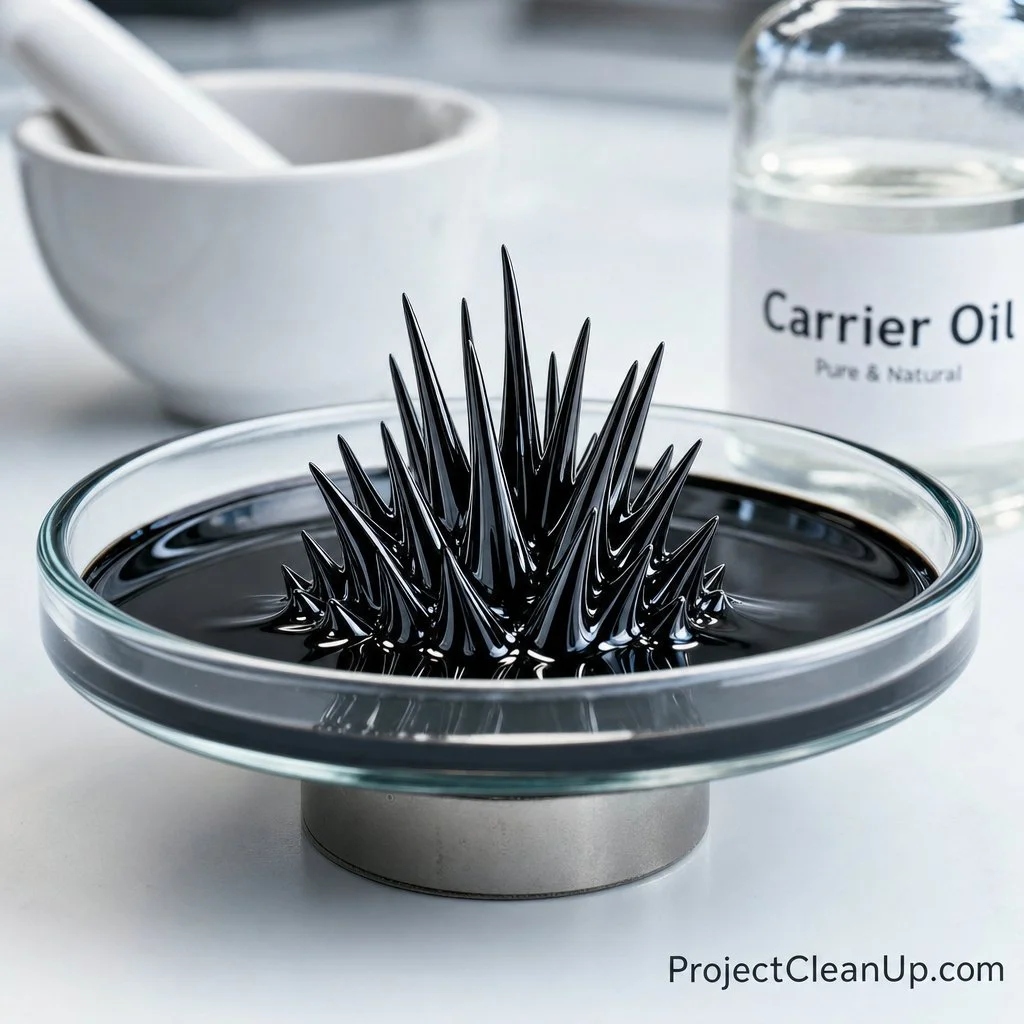
The result is a liquid that instantly snaps into highly organized, three-dimensional geometric spikes the moment it is exposed to a magnetic field.
The Chemistry & Physics - Steric Hindrance and Rosensweig Instability
Creating a magnetic liquid is incredibly difficult because of a fundamental law of physics: magnets attract each other. If you simply dump magnetic powder into water, the particles will instantly clump together into a solid lump at the bottom of the jar.
To keep the fluid liquid, we must fight Van der Waals forces and magnetic attraction using a chemical surfactant (Oleic Acid).
The Magnetic Core: We are extracting Magnetite ($Fe_3O_4$), a naturally occurring ferrimagnetic iron oxide.
The Surfactant Coating: Oleic acid is a fatty acid with a distinct molecular structure. It has a "polar" head that chemically bonds directly to the surface of the iron oxide particle, and a long "non-polar" hydrocarbon tail that sticks outward into the oil.
Steric Hindrance: Because every single microscopic iron particle is now wearing a thick, bristly coat of non-polar tails, the particles physically cannot get close enough to clump together. They bounce off each other. This keeps them permanently suspended in the liquid carrier oil.
Why does it spike?
When you bring a strong magnet near the fluid, the liquid undergoes Rosensweig instability. The magnetic field tries to pull the fluid directly toward the magnet. However, gravity is pulling it down, and surface tension is trying to keep the liquid flat. The fluid compromises by forming sharp, hexagonal peaks. The stronger the magnetic field, the sharper and more numerous the liquid spikes become.
Safety Framework: R.A.M.P.
Recognize hazards: We are handling fine iron dust, strong neodymium magnets, and oil. Ferrofluid is notoriously messy; if it gets on clothing or porous surfaces, it will permanently stain them black.
Assess risks: Inhalation of fine magnetite dust during the grinding phase. Blood blisters or pinched skin if two strong neodymium magnets snap together on your fingers.
Minimize risks: Wear an N95 dust mask and safety glasses while grinding the sand. Do the entire liquid mixing process on a disposable silicone mat or a layer of thick newspaper. Keep neodymium magnets far away from your phone, laptop, and credit cards.
Prepare for emergencies: If the oil mixture gets on your skin, do not use water first (it will just smear). Use standard dish soap directly on the dry skin to break the oil bond, then rinse with warm water.
Materials & Equipment
The Reagents:
Black Sand: 1 cup. (Found at many beaches, riverbeds, or sold cheaply online or at hardware stores. The darker the sand, the higher the iron content).
Carrier Fluid: $50\text{ mL}$ of light Mineral Oil. (Do not use motor oil or heavy cooking oils; they are too viscous).
The Surfactant: $10\text{ mL}$ of Oleic Acid. (Available online, or you can substitute with a heavy squirt of concentrated liquid dish soap in a pinch, though the spikes won't be as sharp).
The Hardware:
A heavy ceramic Mortar and Pestle.
A strong Neodymium (Rare Earth) magnet. (Standard refrigerator magnets are too weak).
A Ziploc plastic bag.
A small glass petri dish or shallow glass jar.
A glass stirring rod.
The Procedure: Engineering the Suspension
Phase 1: The Extraction (Mining the Magnetite)
The Shield: Place your neodymium magnet inside the Ziploc bag. Do not let the bare magnet touch the sand, or you will never get the iron dust off it.
The Sweep: Spread your black sand out on a piece of paper. Slowly sweep the bagged magnet over the sand. You will see dark, fine hairs of pure magnetite leap up and stick to the bag.
The Drop: Move the bag over a clean bowl, reach inside, and pull the magnet away from the plastic. The magnetite will fall cleanly into the bowl. Repeat until you have about 2 tablespoons of pure magnetite.
Phase 2: Pulverization (Increasing Surface Area)
For the fluid to act like a true liquid, the particles must be as small as physically possible.
The Grind: Place the extracted magnetite into your mortar and pestle.
Elbow Grease: Grind the dust vigorously for at least 15 to 20 minutes. It should transition from looking like fine sand to looking like incredibly fine, matte black powdered sugar. (Wear your mask!).
Phase 3: The Colloidal Suspension
The Carrier: Pour $20\text{ mL}$ of your mineral oil into the glass petri dish.
The Coating: Add $5\text{ mL}$ of the oleic acid to the oil and stir well to distribute the surfactant.
The Suspension: Very slowly, sprinkle your pulverized magnetite dust into the oil mixture while stirring continuously with the glass rod. Keep adding dust until the liquid turns completely opaque and pitch black, but is still fluid enough to slosh easily when you tilt the dish.
Phase 4: Magnetic Actuation
Clear the Area: Ensure your workspace is clean and your hands are free of oil.
The Approach: Bring your bare neodymium magnet up directly underneath the glass petri dish.
The Instability: As the magnetic field lines penetrate the glass, the flat black liquid will instantly erupt into a 3D topographic map of sharp, geometric spikes. Move the magnet around under the glass, and the spikes will travel with it, swirling and dancing along the magnetic flux lines.
You have successfully engineered an advanced aerospace material using localized geology and basic pantry chemistry.
The Digital Twin: AI Simulation Prompt
Want to see the invisible forces causing those spikes? Copy and paste this prompt into your AI assistant to generate an interactive physics simulation of the magnetic field and the Rosensweig instability.
Prompt to copy/paste:
"I just synthesized a DIY ferrofluid and I want to visualize the Rosensweig instability. Please generate an interactive HTML/JS widget using native Canvas that models this physics phenomenon.
Draw a 2D cross-section of a liquid pool on a canvas.
Create a slider labeled 'Magnetic Field Strength'.
When the slider is at 0, the liquid surface should be perfectly flat (representing gravity and surface tension dominating).
As the slider increases, the liquid surface should dynamically deform, drawing upward into sharp, triangular spikes. The stronger the field, the taller and closer together the spikes should become, mimicking the critical threshold of magnetic pressure."