Biological Urban Mining - Copper Biosorption Using Dead Yeast
Series: Bioremediation | Difficulty: Intermediate | Estimated Time: 1 Hour (Active) + 2 Hours (Settling)
Introduction
Heavy metal contamination in wastewater—whether from printed circuit board manufacturing, e-waste leaching, or industrial sludge—is traditionally treated with highly caustic chemical precipitation or expensive ion-exchange resins. But nature has already engineered a highly efficient, self-replicating filter: the fungal cell wall.
In this module, we are executing a process called biosorption. We will deliberately contaminate water with high concentrations of copper, and then deploy inactive Saccharomyces cerevisiae (common baker's yeast) to physically strip the dissolved heavy metals out of the liquid.
This isn't just remediation; it is the foundation of biological urban mining. By binding the heavy metals to a biological mass, we can filter them out, recover the clean water, and eventually incinerate or process the biomass to reclaim the raw copper.
The Chemistry & Physics: Electrostatic Scavengers
Unlike the oyster mushroom mycoremediation module—which relied on living fungi secreting enzymes to break chemical bonds—biosorption is a passive, physiochemical process. The yeast does not need to be alive. In fact, dead yeast often works better because it does not attempt to metabolize or ferment the solution.
Here is how the bio-filtration works at the molecular level:
The Contaminant: We will use Copper(II) sulfate ($CuSO_4$). When dissolved in water, it disassociates into copper ions ($Cu^{2+}$) and sulfate ions ($SO_4^{2-}$). The $Cu^{2+}$ ions are heavy, toxic to aquatic life, and carry a strong positive charge.
The Bio-Filter: The cell wall of a yeast cell is a complex matrix of polysaccharides, proteins, and lipids. Crucially, this matrix is rich in specific functional chemical groups—primarily carboxyl ($-COOH$), hydroxyl ($-OH$), and amine ($-NH_2$) groups.
The Electrostatic Bind: In a neutral or slightly acidic aqueous solution, these functional groups on the yeast cell wall become negatively charged. When the dead yeast is mixed into the copper solution, electrostatic attraction pulls the positively charged $Cu^{2+}$ ions out of the water and binds them permanently to the negatively charged cell walls.
The heavy metal transitions from being dissolved in the solvent to being chemically anchored to the solid biomass, making it trivial to filter out.
Safety Framework: R.A.M.P.
Recognize hazards: Copper(II) sulfate is highly toxic to aquatic life and can cause severe eye and skin irritation.
Assess risks: Splashing the copper solution into the eyes or accidentally ingesting it. Pouring untreated copper sulfate down the drain violates municipal water safety codes.
Minimize risks: Wear safety goggles and nitrile gloves. Conduct the experiment on a dedicated silicone mat to catch spills. Never use drinking glasses; use dedicated laboratory beakers or designated glass jars.
Prepare for emergencies: If copper sulfate contacts the skin, wash immediately with copious amounts of soap and water. If spilled on the counter, wipe up with paper towels and dispose of them in the solid waste bin.
Materials & Equipment
The Chemicals:
Active Dry Yeast (Saccharomyces cerevisiae): $15\text{ grams}$ (approx. 2 standard baking packets).
Copper(II) Sulfate Pentahydrate: $5\text{ grams}$. Easily sourced as pure copper sulfate root killer or algae control from hardware stores. Ensure the label says 99% Copper Sulfate.
Distilled Water: $500\text{ mL}$.
The Hardware:
Two $500\text{ mL}$ glass beakers (or large, clear glass jars).
A small saucepan and stove (for deactivating the yeast).
A glass stirring rod.
A plastic funnel and standard paper coffee filters.
A digital kitchen scale.
The Procedure: Executing the Biosorption
Phase 1: Preparation of the Sorbent (Biomass)
For biosorption, living yeast is unpredictable. We need to deactivate the biological functions while preserving the structural integrity of the cell walls.
The Thermal Kill: Boil $200\text{ mL}$ of distilled water in your saucepan.
Deactivation: Add the $15\text{ grams}$ of dry yeast to the boiling water. Let it boil vigorously for 5 minutes. This kills the yeast and actually increases the porosity of the cell walls, exposing more carboxyl groups for metal binding.
Cooling: Remove from heat and allow the yeast slurry to cool completely to room temperature.
Phase 2: Creating the Synthetic Leachate
The Solution: In your first glass beaker, pour $250\text{ mL}$ of room-temperature distilled water.
The Contamination: Weigh out exactly $5\text{ grams}$ of Copper(II) Sulfate crystals and add them to the water.
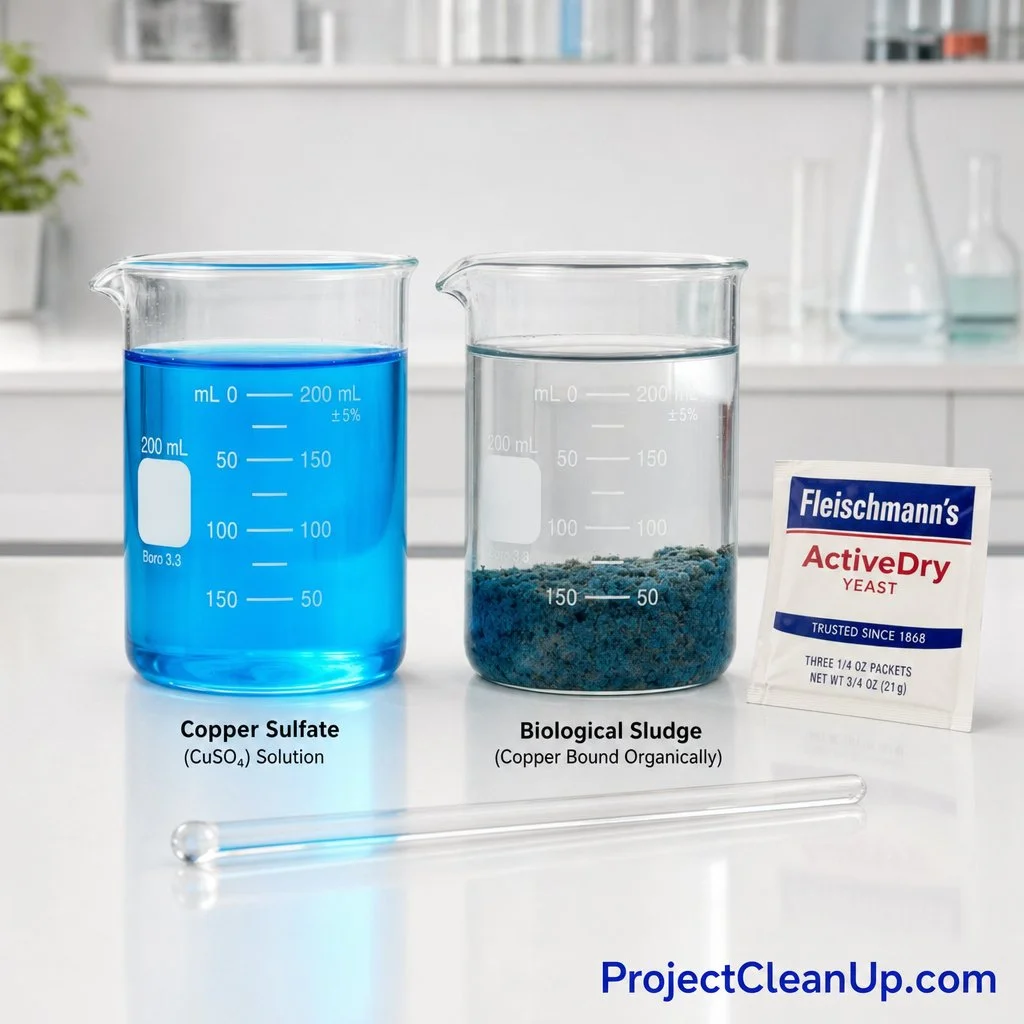
Dissolution: Stir continuously until the crystals are completely dissolved. You now have a synthetic industrial wastewater solution. It will be a distinct, vibrant, transparent blue.
Phase 3: The Biosorption Protocol
The Mix: Pour your cooled, dead yeast slurry directly into the blue copper solution.
Agitation: Stir the mixture vigorously for exactly 5 minutes. Biosorption is rapid; the majority of the copper ions will bind to the yeast cell walls within the first few minutes of contact. The liquid will look like muddy, brown-blue water.
The Settling Phase: Stop stirring and leave the beaker completely undisturbed for 2 hours.
Phase 4: Filtration and Verification
Observation: After two hours, the heavy, copper-laden yeast cells will have flocculated (clumped together) and sunk to the bottom of the beaker.
Filtration: Place a coffee filter into your funnel and place the funnel over the second, clean beaker. Carefully decant the liquid through the filter.
The Result: Examine the filtered water. The vibrant, toxic blue color will be drastically reduced or entirely gone, leaving clear water in the bottom beaker. Look at the filter paper—the yeast sludge will have taken on a distinct blue-green hue. You have successfully stripped a heavy metal out of a solution using nothing but cellular debris.
Disposal Note: Do not flush the blue-tinted yeast sludge down the drain. Let the filter paper dry completely, seal it in a plastic bag, and dispose of it in your municipal solid waste, where it is stable.
The Digital Twin: AI Simulation Prompt
Want to model exactly how fast the yeast cell walls strip the copper out of the water? Copy and paste the prompt below into your AI assistant to generate a Python data visualization of the chemical adsorption kinetics.
Prompt to copy/paste:
"I just conducted a DIY bioremediation experiment using dead Saccharomyces cerevisiae (yeast) to extract dissolved copper (Cu2+) from water via biosorption. Please write a Python script using the matplotlib and numpy libraries that generates a line graph modeling the 'Pseudo-second-order kinetics' of this reaction.
The X-axis should be Time (from 0 to 120 minutes).
The Y-axis should be 'Concentration of Dissolved Copper (mg/L)', starting high and dropping rapidly before leveling off.
Add a second line showing 'Copper Adsorbed to Biomass (mg/g)', starting at zero and rising rapidly before hitting an equilibrium plateau.
Make the graph clean, modern, and easily readable with clear legends."