Kitchen-Counter Electrophysics - Synthesizing Piezoelectric Rochelle Salt Crystals
Series: Advanced Materials | Difficulty: Advanced | Estimated Time: 1 Hour (Active) + 1-2 Weeks (Crystallization)
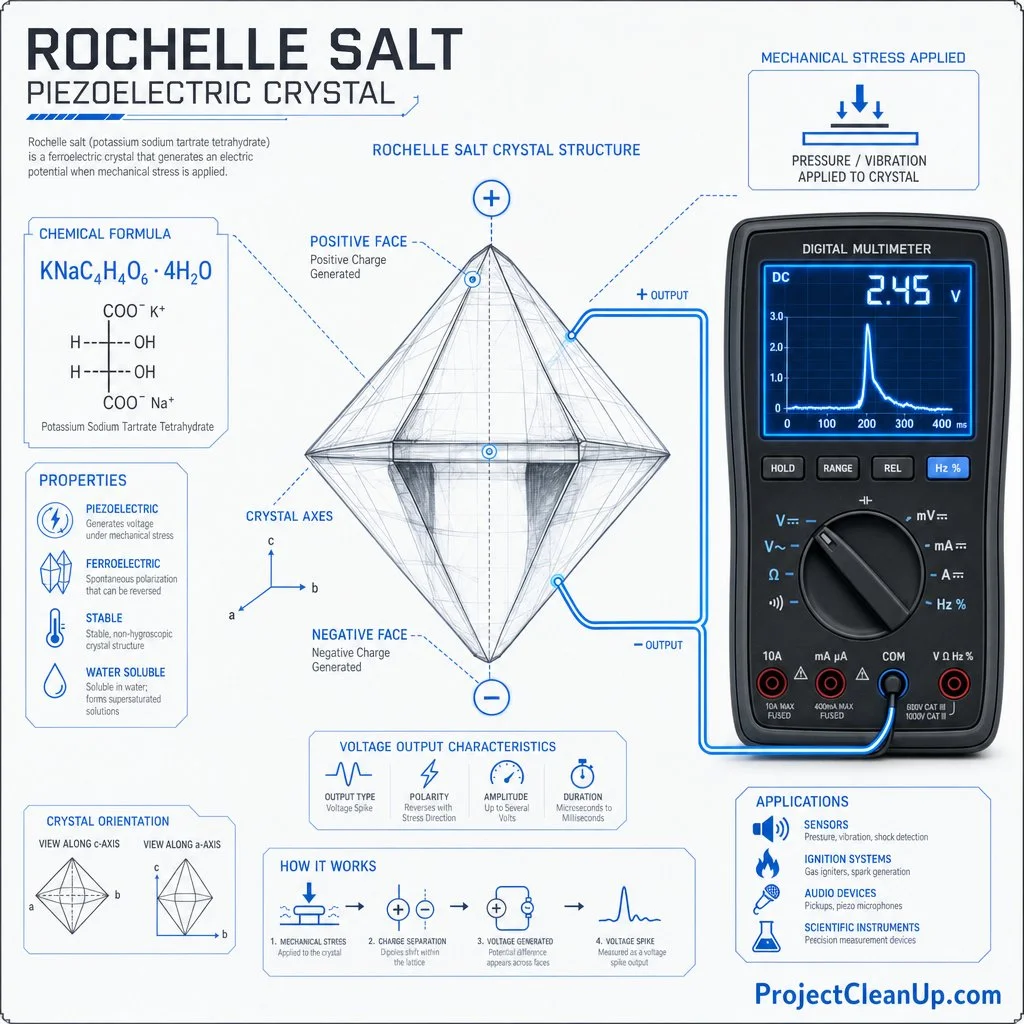
Introduction
Advanced materials are not just passive structures; some actively interface with energy. Piezoelectric materials are the literal bridge between mechanical kinetic energy and electrical energy. When you compress or strike them, they generate a voltage. When you apply a voltage to them, they physically deform.
In this module, we are going to synthesize Rochelle Salt (Potassium Sodium Tartrate Tetrahydrate)—one of the very first synthetic piezoelectric materials discovered, and the exact material used in early sonar arrays, microphones, and phonograph pickups.
This is not a standard crystal-growing craft. We are going to execute a precise acid-base neutralization reaction to build a non-centrosymmetric crystal lattice, and then we are going to wire it up to a multimeter to prove that we have created a solid-state, mechanical-to-electrical transducer.
The Chemistry & Physics: Asymmetric Charge Shifting
We will synthesize this advanced ceramic using two common pantry ingredients: Potassium bitartrate (cream of tartar, a weak acid) and Sodium bicarbonate (baking soda, a weak base).
When heated in water, they undergo a neutralization reaction:
$\text{KHC}_4\text{H}_4\text{O}_6 + \text{NaHCO}_3 \rightarrow \text{KNaC}_4\text{H}_4\text{O}_6\cdot 4\text{H}_2\text{O} + \text{CO}_2\uparrow$
The reaction yields water, carbon dioxide gas (which bubbles out), and our target compound: Potassium Sodium Tartrate.
Why does it generate electricity?
Most crystals (like table salt) have a perfectly symmetrical molecular lattice. If you squeeze them, the internal electrical charges remain balanced. Rochelle salt, however, forms a non-centrosymmetric crystal lattice.
When mechanical stress (like a tap from a hammer) compresses the crystal, the internal atomic structure physically warps. Because the structure is asymmetrical, this warping displaces the positive and negative ions unevenly. This internal charge separation creates a net dipole moment across the crystal, generating a measurable electrical voltage on its surface. You are literally squeezing electricity out of chemical bonds.
Safety Framework: R.A.M.P.
Recognize hazards: We are heating water to near-boiling temperatures and creating a chemical reaction that rapidly releases carbon dioxide gas.
Assess risks: Thermal burns from hot glass or boiling liquid. The rapid $CO_2$ evolution can easily cause the hot, sticky solution to foam up and violently boil over the sides of the beaker.
Minimize risks: Use a beaker or glass jar that is at least three times larger than the liquid volume. Add the sodium bicarbonate very slowly—a tiny pinch at a time—to strictly control the rate of gas evolution.
Prepare for emergencies: Wear heat-resistant silicone gloves. Execute the reaction on a spill-proof, heat-safe silicone mat. Have cold water nearby in case of skin contact with the hot solution.
Materials & Equipment
The Chemicals:
Potassium Bitartrate (Cream of Tartar): $50\text{ grams}$. Must be 100% pure, check the spice aisle.
Sodium Bicarbonate (Baking Soda): $20\text{ grams}$. Plus a little extra on standby.
Distilled Water: $50\text{ mL}$. Tap water contains heavy metals and chlorine that will severely disrupt the crystal lattice formation.
The Hardware:
$250\text{ mL}$ or $500\text{ mL}$ heat-safe glass beaker (or a large Pyrex measuring cup).
A portable induction burner or stovetop water bath.
A glass stirring rod or stainless steel spoon.
Unbleached coffee filters and a funnel.
Nylon fishing line (do not use cotton thread; the liquid will wick up and crystallize outside the jar).
A digital multimeter with test leads.
Small squares of aluminum foil.
The Procedure: Synthesizing the Transducer
Phase 1: Acid-Base Neutralization
The Acid Suspension: Heat $50\text{ mL}$ of distilled water in your beaker to roughly $80^\circ\text{C}$ (hot, but not rapidly boiling). Add the $50\text{ g}$ of Cream of Tartar and stir. It will not fully dissolve; it will remain a milky, cloudy suspension. Keep the heat steady.
The Base Titration: Very slowly, add a small pinch of Baking Soda. The solution will instantly violently fizz as $CO_2$ is liberated.
The Visual Indicator: Stir until the fizzing stops, then add another pinch. Continue this slow titration. As the acid is neutralized into Rochelle salt, the cloudy liquid will begin to turn clear.
Stoichiometric Balance: Stop adding Baking Soda the exact moment a pinch no longer causes any fizzing, and the liquid is completely transparent. You have achieved stoichiometric neutralization. Remove from heat.
Phase 2: Filtration and Seeding
Hot Filtration: While the liquid is still hot, pour it through a coffee filter into a clean glass jar. This removes any unreacted impurities or dust that would cause malformed crystals.
The Drop: Place the open jar in a dark, undisturbed cabinet. As the liquid cools to room temperature and slightly evaporates, it becomes supersaturated.
Seed Selection: After 2 to 3 days, inspect the bottom of the jar. You will see several small, clear, faceted seed crystals. Carefully pour the remaining liquid into a new jar (save it!) and use tweezers to extract the single most perfect, geometrically flawless seed crystal.
Phase 3: Growing the Monocrystal
The Rig: Tie your nylon fishing line securely around the seed crystal. Tie the other end to a pencil resting across the top of your jar, suspending the seed crystal in the center.
The Feed: Take the liquid you saved, heat it slightly to ensure no microscopic crystals remain, and let it cool completely to room temperature.
The Growth Phase: Pour the cooled liquid over the suspended seed crystal. Place it back in the dark cabinet. Over the next 1 to 2 weeks, the lattice will organize, pulling molecules out of the solution to grow a massive, diamond-shaped monocrystal.
Phase 4: The Electrophysics Test
Extraction: Once the crystal is large enough (at least an inch long), remove it and gently pat it dry with a paper towel.
The Electrodes: Wrap two opposite, flat facets of the crystal tightly in small squares of aluminum foil. These will act as your conductive electrodes.
The Circuit: Turn your digital multimeter on and set it to read direct current millivolts ($\text{mV}$). Press the red and black test leads firmly against the two aluminum foil pads.
The Mechanical Stress: While watching the multimeter screen, use the rubber handle of a screwdriver to give the crystal a sharp, firm tap.
Result: You will see the voltage immediately spike on the screen. You have successfully engineered a chemical lattice capable of transmuting kinetic energy into an electrical charge.
The Digital Twin: AI Simulation Prompt
Want to see the piezoelectric effect without waiting two weeks for the crystal to grow? Copy and paste the prompt below into Gemini (or your preferred AI) to generate an interactive 3D simulation of the crystal lattice right in your browser.
Prompt to copy/paste: "I am conducting a chemistry experiment synthesizing Piezoelectric Rochelle Salt crystals. I need an interactive 3D web simulation to visualize how the piezoelectric effect works at the molecular level. Please write a complete, single-file HTML document using the Three.js library (loaded via CDN) that does the following:
Renders a simplified, non-centrosymmetric 3D unit cell (using blue and red spheres for ions connected by lines).
Includes a UI slider at the bottom labeled 'Apply Mechanical Stress'.
When the slider is moved, physically compress the 3D lattice, forcing the central ion to shift asymmetrically.
Include a real-time 'Dipole Voltage (mV)' readout on the screen that spikes proportionally to the mechanical deformation applied by the slider."