Series: Advanced Materials | Difficulty: Beginner/Intermediate | Estimated Time: 45 Minutes (Active) + 2-3 Weeks (Polymerization & Curing)
Introduction
The global textile industry—specifically the production of synthetic fabrics and the tanning of animal leather—is one of the most chemically toxic and water-intensive sectors on Earth. But nature manufactures structural fibers at ambient temperatures using nothing but sugar and water.
In this module, we are bypassing the agricultural supply chain entirely to grow a high-performance textile on a kitchen counter. We will utilize a Symbiotic Culture of Bacteria and Yeast (SCOBY)—commonly used to brew kombucha—to weave a dense, macroscopic mat of pure nanocellulose.
Once grown, we will harvest, wash, and plasticize this biological polymer, transforming a wet microbial mat into a strong, flexible, and completely biodegradable "bio-leather."
The Biology & Polymer Chemistry: Extracellular Weaving
To understand why this works, we must look at the biochemical engine driving the process.
Part 1: The Dual-Action Microbiome
A SCOBY is a symbiotic ecosystem. First, the yeast species (like Saccharomyces) consume sucrose (table sugar) and break it down into fructose and glucose, producing trace amounts of ethanol. Second, specific bacteria—primarily Komagataeibacter xylinus—consume that glucose and ethanol.
Part 2: Nanocellulose Polymerization
As K. xylinus metabolizes the glucose, it performs a remarkable feat of microscopic engineering. It secretes long, linear chains of pure cellulose directly into the surrounding liquid. Because the bacteria need oxygen to survive, they swim to the surface of the liquid and weave these cellulose chains together into a dense, buoyant, three-dimensional nanoscale matrix. This matrix acts as a raft, keeping the colony at the oxygen-rich surface.
Unlike plant cellulose (which must be chemically separated from tough lignin and hemicellulose in a highly polluting process to make paper or fabric), bacterial cellulose is 100% pure. It possesses extremely high crystallinity, immense tensile strength, and incredible water-holding capacity.
Part 3: The Plasticization Mechanism
When harvested and dried naturally, bacterial cellulose becomes hard and brittle—like a thick piece of dried parchment. To convert it into a flexible "leather," we re-introduce vegetable glycerin. Just as we did in the Thermoplastic Starch module, the glycerin acts as a molecular lubricant. Its small molecules embed themselves between the dense cellulose fibers, preventing them from hydrogen-bonding too tightly during the drying phase, thereby permanently granting the material flexibility.
Safety Framework: R.A.M.P.
Recognize hazards: We are cultivating a live microbial ecosystem in a warm, nutrient-rich broth. The primary hazard is contamination by pathogenic molds (like Aspergillus) or wild, harmful bacteria.
Assess risks: Accidental cultivation of toxic mold spores.
Minimize risks: We rely on pH engineering. By adding unpasteurized vinegar or acidic starter tea to the initial batch, we drop the pH of the liquid below 4.0. This highly acidic environment is perfectly safe for our SCOBY but completely inhospitable to invasive molds. Always sterilize your glass containers with boiling water before beginning.
Prepare for emergencies: If fuzzy, dry, brightly colored (green, black, or blue) mold appears on the surface of your cellulose mat, the batch is compromised. Do not attempt to salvage it. Dispose of the liquid and the mat in the compost, wash everything with hot soapy water, and start over.
Materials & Equipment
The Biological & Chemical Inputs:
Live SCOBY & Starter Tea: 1 piece of live SCOBY and $1\text{ cup}$ of strong starter liquid. (Can be purchased online, or grown from a bottle of unpasteurized, raw, unflavored commercial kombucha).
Sucrose (White Table Sugar): $200\text{ grams}$ (roughly 1 cup).
Black Tea: 4 to 6 standard tea bags. (Provides essential nitrogen and tannins for the bacteria).
Distilled Water: $3\text{ Liters}$.
Vegetable Glycerin: For the post-processing phase.
Coconut Oil or Beeswax: For sealing the final material.
The Hardware:
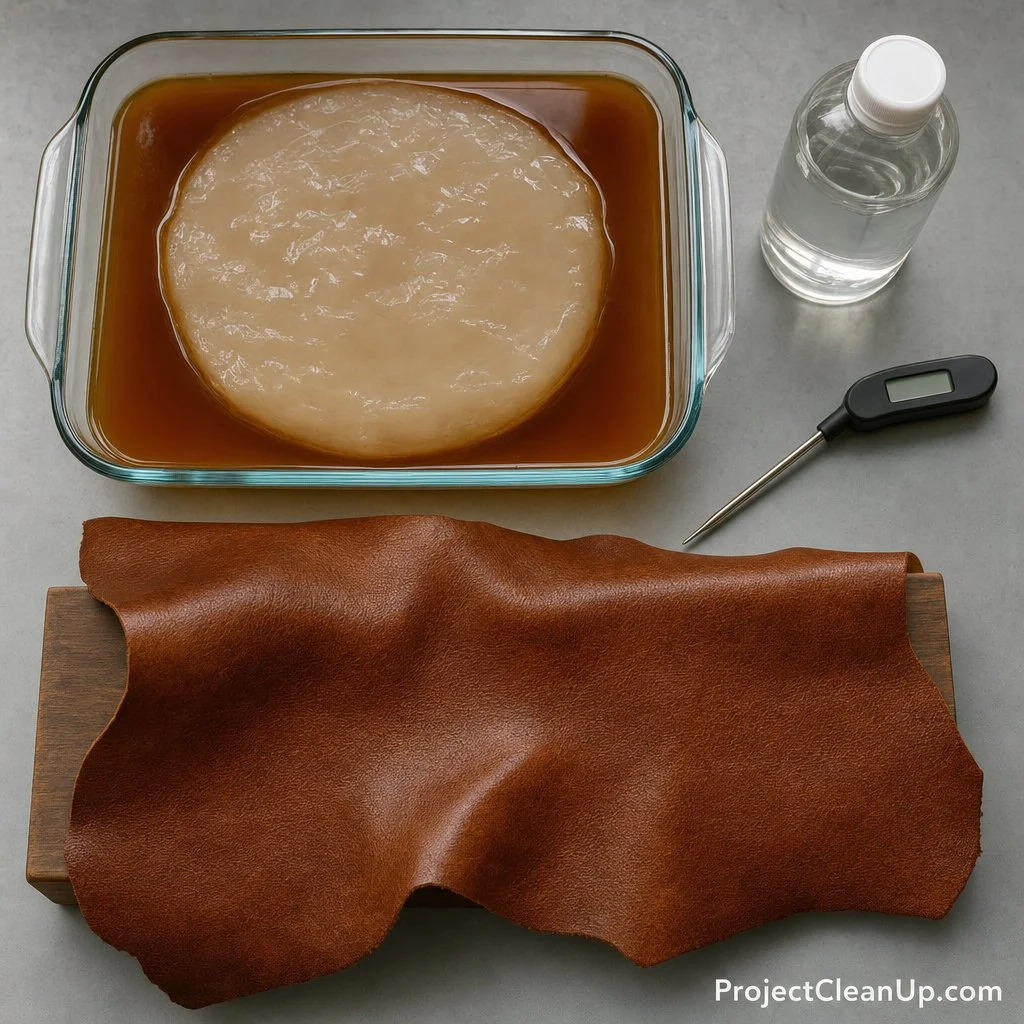
A large, wide, shallow glass or food-grade plastic container. (The surface area determines the size of your final leather sheet. A 9x13 glass baking dish works perfectly).
A breathable cloth cover (like tight-weave muslin or multiple layers of cheesecloth) and a large rubber band.
A smooth wooden board or flat acrylic sheet (for drying).
The Procedure: Growing the Textile
Phase 1: Brewing the Nutrient Broth
The Extraction: Boil $1\text{ Liter}$ of the distilled water. Add the black tea bags and let them steep for 15 minutes to extract maximum nitrogen. Remove the bags.
The Carbon Source: While the tea is still hot, stir in the $200\text{ grams}$ of sugar until completely dissolved.
Temperature Shock Prevention: Add the remaining $2\text{ Liters}$ of cold distilled water to bring the temperature down. Crucial: The liquid must be below $85^\circ\text{F}$ ($29^\circ\text{C}$) before proceeding. Heat destroys the microbes.
Phase 2: Inoculation and Polymerization
The Setup: Pour the cooled, sweet tea into your large, wide growing vessel.
Inoculate: Gently slide your SCOBY into the liquid and pour in the $1\text{ cup}$ of acidic starter tea.
The Shield: Cover the vessel tightly with the breathable cloth and secure it with a rubber band to keep out dust and fruit flies, while allowing oxygen exchange.
Incubation: Place the vessel in a warm ($70^\circ\text{F} - 80^\circ\text{F}$), dark, undisturbed location. Do not move or jostle the container. Within 4 to 7 days, a thin, clear film will form on the surface. Over the next 2 to 3 weeks, this film will polymerize into a thick, dense, rubbery mat ($1\text{ to }2\text{ cm}$ thick).
Phase 3: Harvesting and Plasticization
The Harvest: Once the mat is at least $1\text{ cm}$ thick, remove it from the liquid. Wash it thoroughly in the sink with warm water and a mild dish soap to kill the active bacteria and strip away the sticky yeast residue. It will feel like heavy, wet silicone.
The Emulsion Bath: In a separate bowl, create a mixture of 50% water and 50% vegetable glycerin. Submerge the washed cellulose mat in this bath and let it soak for 24 hours. The glycerin will physically displace the water inside the nanocellulose matrix.
Curing: Remove the mat from the glycerin bath, gently squeegee off the excess liquid, and stretch it flat across your wooden board.
Drying: Place the board in a warm, dry place with good airflow. Over the next 3 to 5 days, the remaining water will evaporate, causing the mat to shrink significantly in thickness.
Phase 4: Finishing
Once fully dry, the material will be flexible and have the distinct texture of raw rawhide. To waterproof and finish the bio-leather, rub a generous coat of coconut oil or melted beeswax into the surface.
You have successfully grown a sustainable, vegan, biodegradable textile using nothing but bacterial architecture and applied chemistry.
The Digital Twin: AI Simulation Prompt
Want to understand the mathematics of how fast your bio-leather will grow? Biological populations and the polymers they secrete follow a distinct mathematical curve. Copy and paste this prompt into your AI assistant to model the growth of your cellulose mat.
Prompt to copy/paste:
"I am growing bacterial nanocellulose (a SCOBY) in a 9x13 inch vessel to create bio-leather. Please write a Python script using the numpy and matplotlib libraries to model the thickness of the cellulose mat over a 21-day period using a Logistic Growth Equation.
Set the carrying capacity (maximum thickness) to 15 mm.
Set the initial thickness to 0.1 mm (the starting film).
Use a growth rate constant ($k$) that simulates rapid exponential growth between days 5 and 14, before leveling off as the sugar is depleted.
Plot the curve on a clean line graph. The X-axis should be 'Days (0-21)' and the Y-axis should be 'Mat Thickness (mm)'. Include a dashed horizontal line indicating the target harvest thickness of 10 mm."