Domestic Alchemy - Synthesizing Solid Cooking Fuel from Waste Eggshells
Series: Closed-Loop Systems | Difficulty: Intermediate | Estimated Time: 1 Hour (Active) + 12 Hours (Passive Reaction)
Introduction
A hallmark of a closed-loop system is the elimination of the concept of "waste." In industrial chemistry, the byproduct of one reaction must become the feedstock for the next.
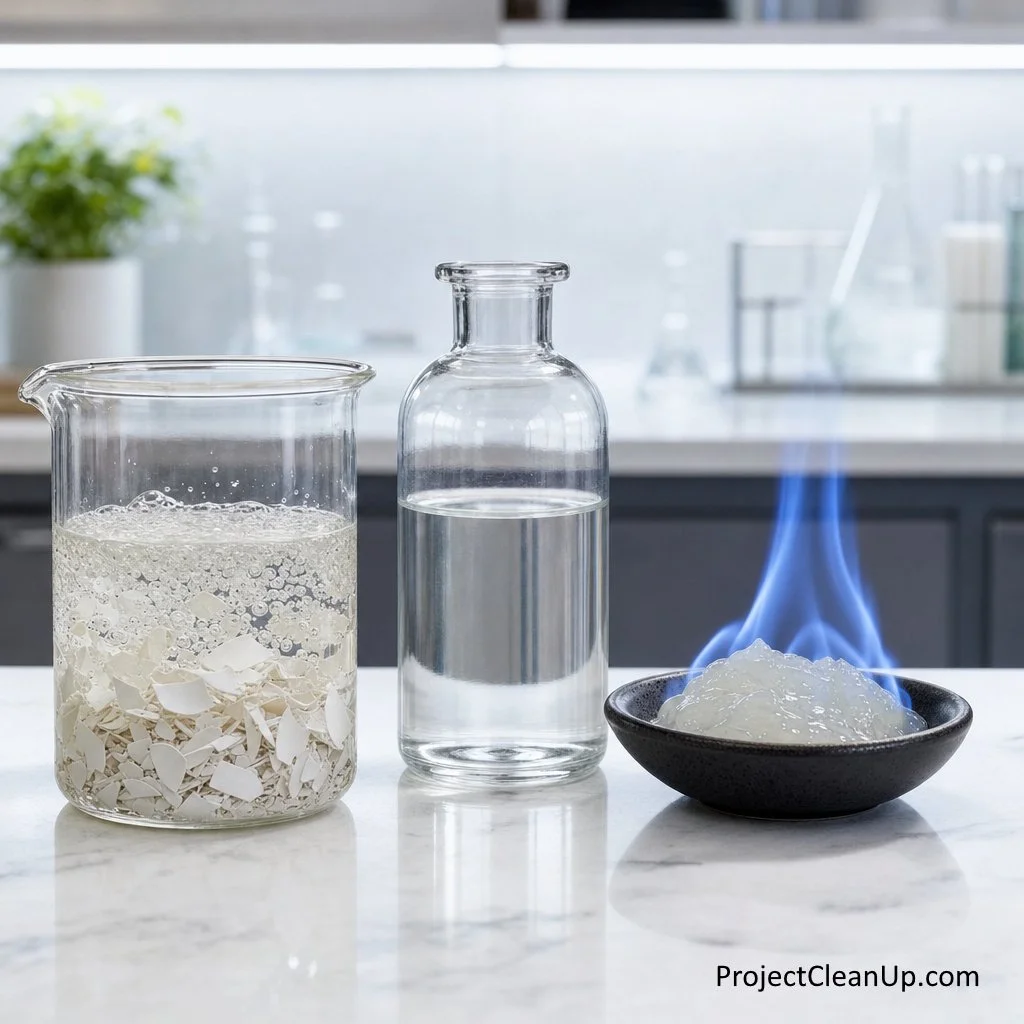
In this module, we are applying that principle to the kitchen counter. We will take discarded eggshells—which are typically thrown into a landfill where their chemical potential is wasted—and process them using a mild household acid. The resulting compound will be used to entrap a liquid alcohol, synthesizing a semi-solid, smokeless colloidal gel fuel.
You are taking food waste and engineering it into thermal energy, creating a fuel source that can then be used to cook your next meal. The loop is closed.
For more Alchemy get the book!
The Chemistry & Thermodynamics - Insoluble Colloidal Matrices
How do eggshells become flammable? The eggshell itself does not burn; it acts as the structural scaffold for the fuel.
Part 1: The Acid-Base Extraction
Eggshells are roughly 95% Calcium Carbonate ($CaCO_3$). By submerging them in white vinegar—which is a 5% solution of Acetic Acid ($CH_3COOH$)—we force a chemical reaction:
$CaCO_3 + 2CH_3COOH \rightarrow Ca(CH_3COO)_2 + H_2O + CO_2\uparrow$
The calcium carbonate is broken down, releasing carbon dioxide gas and leaving behind Calcium Acetate dissolved in water.
Part 2: The Colloidal Gelation
Calcium acetate has a unique chemical property: it is highly soluble in water, but insoluble in alcohol.
Once we concentrate our aqueous calcium acetate solution, we pour it into high-proof isopropyl alcohol. Because the calcium acetate cannot dissolve in the alcohol, it instantly crashes out of the solution, precipitating into a solid network of calcium fibers. This rapid precipitation traps the liquid alcohol inside a microscopic, sponge-like solid matrix.
You have created a colloidal gel. When ignited, the structural matrix remains stationary while the trapped alcohol vapors burn off with a clean, smokeless blue flame.
Safety Framework: R.A.M.P.
Recognize hazards: We are handling a highly flammable liquid (isopropyl alcohol) and generating an open flame.
Assess risks: The blue flame produced by this gel burns very hot and can be nearly invisible in bright, sunlit rooms. Liquid alcohol can easily ignite if poured near an active flame.
Minimize risks: Execute the burning phase on a heat-safe silicone mat, concrete, or stone surface—never on wood or near paper. Do not use plastic containers to hold the burning gel; use only ceramic or thick metal. Never attempt to pour more liquid alcohol onto a gel that is currently burning.
Prepare for emergencies: Have a heavy metal pot lid or a ceramic plate ready. To extinguish the fuel, do not blow on it or pour water on it—simply place the metal lid over the dish to instantly smother the flame by starving it of oxygen.
Materials & Equipment
The Reagents:
Waste Eggshells: From 4 to 6 large eggs.
White Vinegar (5% Acetic Acid): $500\text{ mL}$ (about 2 cups).
Isopropyl Alcohol: Must be 90% concentration or higher. 70% rubbing alcohol contains too much water and will prevent the gel from forming properly.
The Hardware:
A large glass jar or beaker ($1000\text{ mL}$).
A small stainless steel saucepan.
Coffee filters and a funnel.
A small, heat-safe ceramic dish or metal tin (for burning).
The Procedure: Synthesizing the Fuel
Phase 1: Preparation of the Feedstock
Clean the Carbonate: Rinse the eggshells under warm water, rubbing the inside to remove the thin biological membrane.
Increase Surface Area: Let the shells dry completely, then crush them into a fine powder. The smaller the pieces, the faster the chemical reaction will occur due to increased surface area.
Phase 2: The Extraction Reaction
The Submersion: Place the crushed eggshells into your large glass jar. Pour $500\text{ mL}$ of white vinegar over them.
The Evolution: The mixture will immediately begin to fizz and foam aggressively as $CO_2$ gas is liberated. Leave the jar uncovered in a well-ventilated area.
The Wait: Allow the reaction to proceed until the bubbling completely stops (usually 12 to 24 hours). The liquid now contains your dissolved calcium acetate.
Phase 3: Filtration and Concentration
Filter: Pour the liquid through a coffee filter into your saucepan to remove the leftover, unreacted shell fragments.
Boil Down (Crucial Step): Place the saucepan on a stove over medium heat. We must boil off the excess water to create a supersaturated solution. Boil the liquid down until only about $20\%$ to $25\%$ of the original volume remains.
The Visual Cue: You will know it is concentrated enough when a thin, white, crystalline film begins to form on the surface and the edges of the liquid. Remove from heat immediately and let it cool to room temperature.
Phase 4: Gelation and Ignition
The Mix: In your heat-safe ceramic dish, pour $10\text{ mL}$ of your concentrated calcium acetate solution.
The Crash: Quickly pour $30\text{ mL}$ of the 90% isopropyl alcohol into the dish. Do not stir heavily—just gently swirl the dish once or twice.
The Matrix Forms: Within 10 to 30 seconds, the clear liquid will instantly turn opaque and solidify into a dense, white gel. You can turn the dish upside down, and the solid fuel will stay in place.
Ignition: Use a long lighter to ignite the surface of the gel.
Observation: You now have a stable, controllable, smokeless heat source. The alcohol will burn off cleanly, leaving behind only a small amount of white, powdery calcium carbonate—which can technically be recycled back into the start of the process, proving the ultimate efficiency of a closed loop.
The Digital Twin: AI Simulation Prompt
Want to scale this up? In chemical engineering, precise mass balancing prevents wasted reagents. Copy and paste the prompt below into your AI assistant to generate a Python stoichiometric calculator for this exact reaction.
Prompt to copy/paste:
"I am synthesizing calcium acetate from waste eggshells ($CaCO_3$) and 5% white vinegar ($CH_3COOH$) to create a colloidal gel fuel. Please write a Python script using the sympy and pandas libraries that calculates the exact stoichiometric ratios needed.
The script should ask the user to input the mass of their crushed eggshells in grams.
It should calculate the exact volume of 5% acetic acid (in mL) required to achieve complete neutralization without wasting vinegar.
It should calculate the theoretical yield of anhydrous calcium acetate in grams.
Print the results in a clean, formatted terminal output."