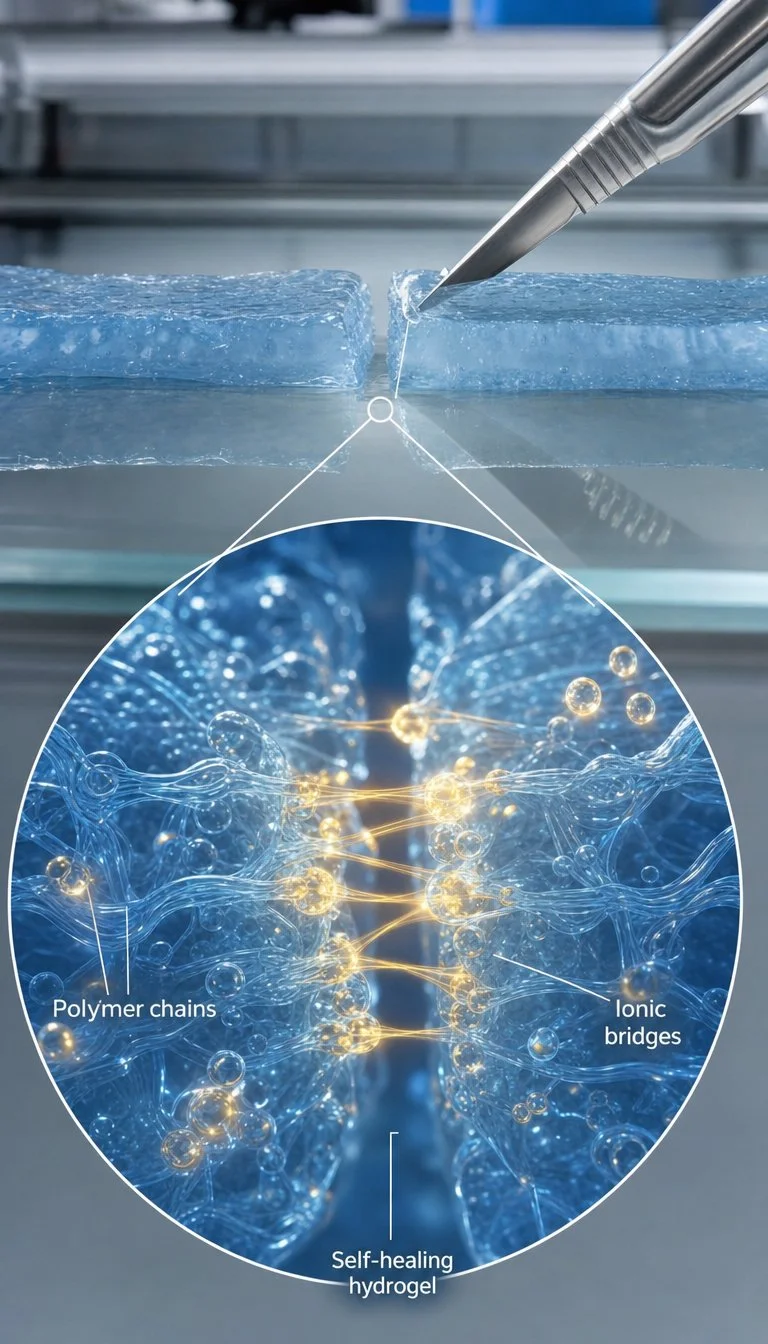
The Living Seal: Self-Healing Hydrogels and the End of Planned Obsolescence
Welcome back to the Project Clean Up (PCU) weekly newsletter! Last week, we looked to the forest floor to replace unrecyclable carbon fiber with Cellulose Nanocrystals—proving that rigid, aerospace-grade strength can be harvested from wood pulp.
Today, we move to the exact opposite end of the physical spectrum: soft, wet, living-style matter.
Human skin is a marvel of materials engineering. If you scrape your knee or slice your finger, you do not throw your body away and buy a new one; your tissue autonomously closes the gap and restores its structural integrity. Yet, almost every synthetic soft material we manufacture—from rubber gaskets and medical tubing to silicone seals—is fundamentally dead. The moment it suffers a micro-tear or a puncture, the damage spreads, the part fails, and it is thrown into a landfill.
This week, we explore how materials science is borrowing nature's most enviable superpower: regeneration. We are diving into Self-Healing Hydrogels—polymer networks heavily saturated with water that chemically re-bond when sliced, redefining biocompatible implants and soft robotics.