From the Laboratories of Project Clean Up (11/24/2027)
A hydrogel is a three-dimensional network of hydrophilic (water-loving) polymer chains capable of holding up to 90% or more of its weight in $H_2O$ while maintaining a solid, elastic shape. You encounter simple hydrogels in soft contact lenses, and your own body is full of them—human cartilage is essentially a high-performance biological hydrogel.
Historically, synthetic hydrogels were fragile; once torn, they stayed torn. In 2026, by redesigning the bonds that hold these wet networks together, chemists have given them the ability to self-repair.
1. Dynamic Bonds in a Sea of Water
Conventional plastics and rubbers rely on permanent, rigid covalent bonds. Once those bonds snap, they are gone forever. Self-healing hydrogels take a radically different approach by utilizing reversible, dynamic cross-links.
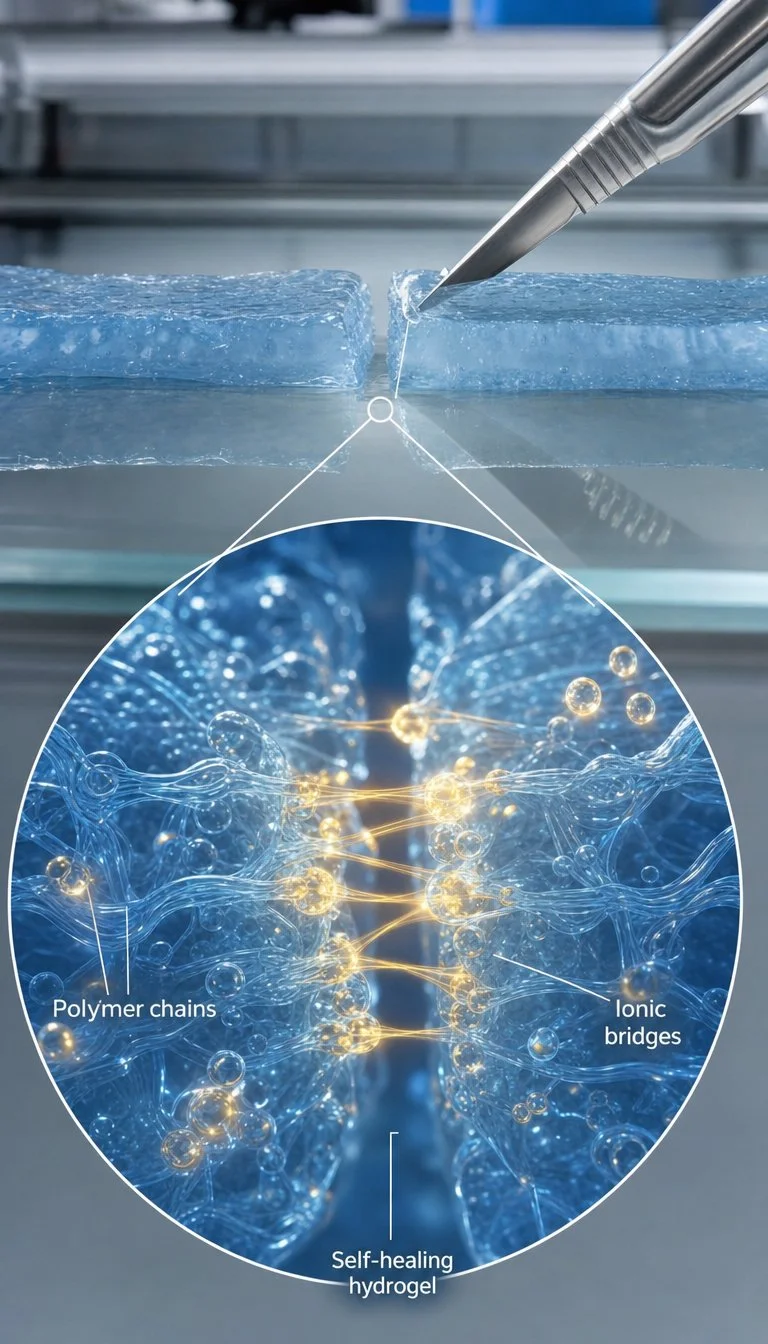
Instead of permanent glue, the polymer chains are stitched together using non-covalent interactions—such as dense networks of hydrogen bonds, supramolecular "host-guest" rings, or ionic bridges (for example, positively charged calcium ions, $Ca^{2+}$, linking negatively charged biopolymer strands).
Because the hydrogel is mostly water, the polymer chains retain microscopic mobility. When a scalpel slices a self-healing hydrogel in half and the two edges are brought back into contact, the severed chains rapidly wiggle across the boundary. Within minutes—at room temperature and with zero external heat or glue—the hydrogen bonds and ionic bridges snap back together, restoring nearly 100% of the material's original tensile strength.
2. From Artificial Cartilage to Soft Robotics
Because self-healing hydrogels mirror the exact softness, elasticity, and water content of biological tissue, they are unlocking breakthroughs across two major frontiers:
Biocompatible Implants: Traditional metal or rigid plastic medical implants often trigger immune rejection or scar-tissue buildup because they are far stiffer than human organs. Self-healing hydrogels can be engineered to match the exact mechanical softness of human cartilage, nerve sheaths, or cardiac tissue—serving as regenerative scaffolds and smart, long-lasting wound dressings that flex and heal right alongside the patient.
Armoring Soft Robotics: In Issue 67, we introduced Liquid Crystal Elastomers (LCEs)—the synthetic muscles replacing heavy mechanical motors. Pairing LCE muscles with a self-healing hydrogel "skin" solves the biggest vulnerability of soft robots: punctures. A search-and-rescue soft robot can squeeze through jagged concrete rubble, take a gash to its outer hull, and seal its own skin before dirt or moisture ever damages its internal sensors.
3. The Lifecycle Standard: Dissolving the Synthetic Gel
Under the PCU Lifecycle Standard, replacing disposable rubbers and medical plastics with hydrogels only works if the polymers themselves do not become a new source of persistent chemical waste.
The Legacy Flaw: First-generation industrial hydrogels relied on petrochemical backbones like polyacrylamide or synthetic silicones. Not only are these materials derived from fossil fuels, but they can also leach toxic, unreacted monomers into the environment and linger in landfills without degrading.
The PCU Solution: Marine Biopolymers and Triggered Un-Crosslinking.
PCU-standard self-healing hydrogels abandon petrochemical monomers entirely. Instead, they are synthesized from abundant, bio-derived polysaccharides—such as alginate (harvested from brown seaweed) and chitosan (refined from crustacean shells or fungal cell walls).
When a hydrogel robotic skin or industrial liner finally reaches the end of its operational life, it does not need to be burned or buried. It is simply bathed in a mild, benign chelating solution (such as food-grade sodium citrate). The citrate gently pulls the $Ca^{2+}$ ionic bridges out of the network. Instantly, the solid, tough hydrogel "unzips" back into a clean, harmless liquid slurry. The raw biopolymers can be filtered out and re-cast into brand-new gels, or routed to an industrial composter where microbes safely metabolize them back into water and organic soil nutrients.
The 2026 Vision: The Regenerative Economy
At Project Clean Up (PCU), we are dismantling the throwaway mindset at the molecular level. Planned obsolescence relies on materials that are designed to break and stay broken. By harnessing the dynamic, reversible chemistry of self-healing hydrogels, we are ushering in an era of regenerative products—medical devices, industrial seals, and soft machines that repair their own wounds in the field and dissolve harmlessly back into nature when their work is done.
Want to learn more about Aerogels? Read Aerogels – Capturing the Void for Extreme Performance.
Learn more about Self-Healing Polymers – Materials That Mend Themselves, Self-Healing Electronic Circuits – A Solution for the E-Waste Crisis, or Self-Healing Concrete – The Future of Durable and Sustainable Infrastructure!
Would you like to try making your own polymer? Try our DIY Kitchen-Counter Polymers - Synthesizing Thermoplastic Starch (TPS) Bioplastics!