From the Laboratories of Project Clean Up (11/20/2026)
Consider a 300-foot redwood tree. It stands for millennia, shrugging off hurricane-force winds and supporting hundreds of tons of weight, built entirely from sunlight, water, and atmospheric $CO_2$. The secret to its structural miracle is cellulose—the most abundant organic polymer on Earth.
In its natural state, wood is a mixture of strong fibers and soft, flexible binders. In 2026, materials scientists are stripping away the soft parts to unlock the hidden super-material inside.
1. Isolating the Nanorod
If you zoom into a single microscopic wood fiber, you will see that it is composed of alternating regions: disorganized, soft "amorphous" zones and hyper-dense, tightly packed "crystalline" zones.
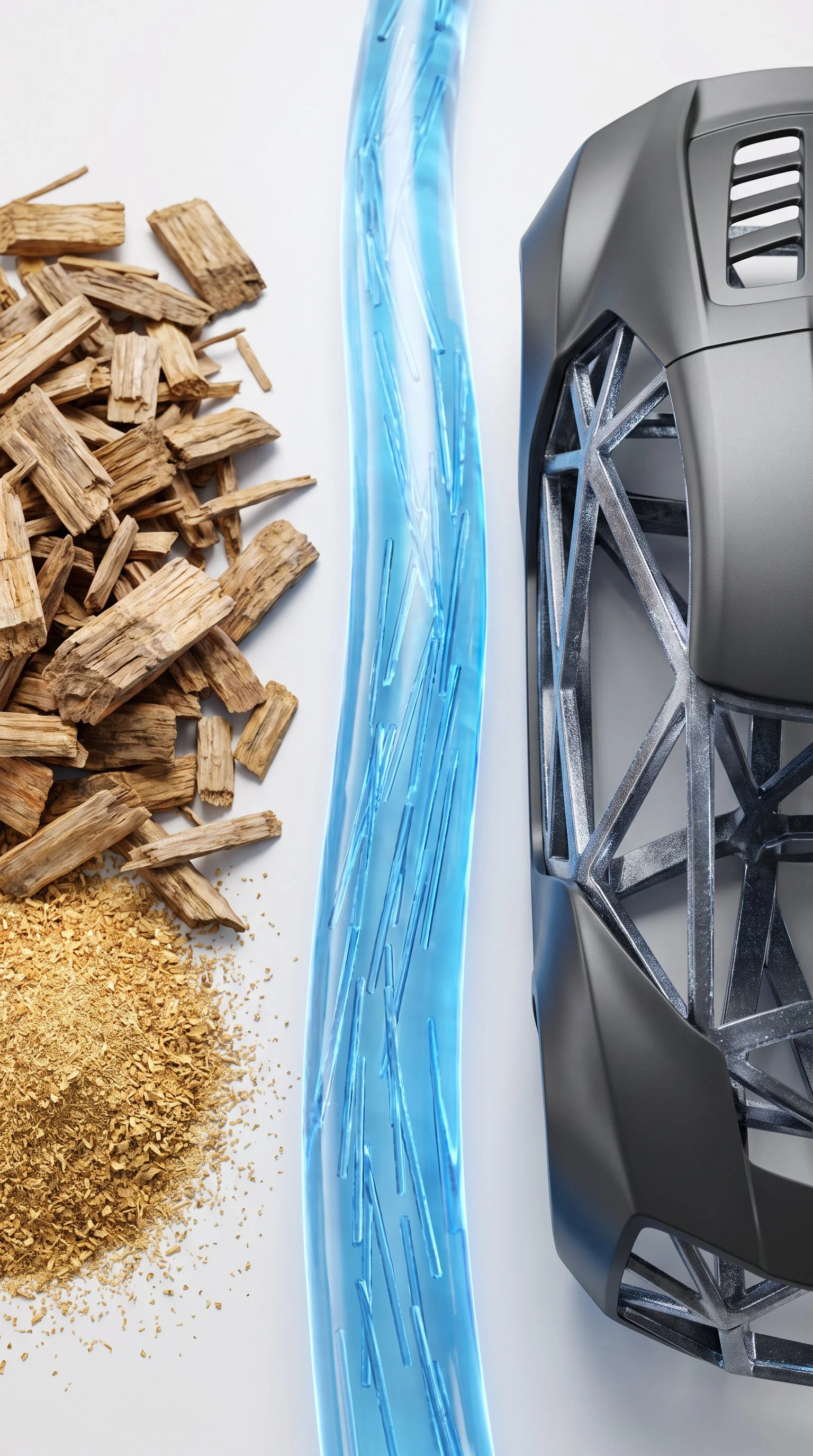
To harvest Cellulose Nanocrystals (CNCs), we take raw wood pulp or agricultural waste (like rice husks or hemp stalks) and subject it to a targeted enzymatic or mild acid hydrolysis bath. The bath selectively dissolves away the soft amorphous regions, leaving behind pure, whisker-like crystalline nanorods—each roughly 5 nanometers wide and 100 nanometers long.
Once isolated and aligned, these nanorods possess staggering mechanical properties. Weight-for-weight, CNCs boast a tensile strength greater than Kevlar and an elastic modulus comparable to structural steel, all at a fraction of the density of aluminum.
2. Dethroning Carbon Fiber
The economic and environmental contrast between legacy carbon fiber and 2026 CNC composites is dramatic.
The Energy Cliff: Producing a single kilogram of carbon fiber generates roughly 20 to 30 kilograms of $CO_2$ due to the extreme heat required to carbonize petroleum polymers. CNCs are synthesized at ambient or low temperatures using waste biomass that has already sequestered carbon from the atmosphere.
Urban Mobility & Energy: Because CNCs can be suspended in water-based slurries and molded or 3D-printed into complex curves, they are rapidly replacing carbon fiber and fiberglass in our lightweight solid-state transit pods (Issue 59) and next-generation wind turbine blades. Because the crystals are smaller than the wavelength of visible light, dense CNC films can even be engineered to be optically transparent—creating shatterproof, flexible substrates for next-gen electronics.
3. The Lifecycle Standard: Escaping the Composite Graveyard
Under the PCU Lifecycle Standard, the true failure of legacy composites like fiberglass and carbon fiber happens when the product breaks.
The Legacy Flaw: Carbon fiber and fiberglass rely on "thermoset" petroleum epoxies to hold their fibers together. Once cured, these resins cannot be melted or dissolved. When a wind turbine blade reaches the end of its 20-year life, crews literally saw it into pieces and bury it in a landfill, where it will remain intact for thousands of years.
The PCU Solution: Lignin Binders and Enzymatic Re-Pulping.
To ensure CNC composites never become landfill monuments, PCU-standard manufacturing replaces petroleum epoxies with Lignin-Derived Bio-Resins—using the natural "glue" that holds trees together (another massive byproduct of the paper industry).
When a CNC transit pod panel or turbine blade reaches the end of its life, it enters a clean, closed-loop recovery cycle. A mild, water-based alkaline wash cleanly dissolves the lignin resin, releasing the pristine, undamaged Cellulose Nanocrystals so they can be filtered out and re-cast into brand-new structural parts. And if a part is ever too contaminated to reuse, natural cellulase enzymes can completely digest the entire composite back into simple, harmless glucose sugars.
The 2026 Vision: The Timber-Tech Skyline
At Project Clean Up (PCU), we are proving that high-tech does not have to mean high-carbon. By refining the most common biological waste stream on the planet down to the nanoscale, we are replacing the heavy, toxic composites of the 20th century with materials that are lighter, cleaner, and completely circular. The aerospace hulls, transit vehicles, and industrial armor of the future won't be forged in oil-burning kilns—they will be harvested from the natural brilliance of the forest.
Would you like to try building your own polymers? Try our DIY Kitchen-Counter Polymers - Synthesizing Thermoplastic Starch (TPS) Bioplastics!