Cationic Biopolymers – Catching the Invisible Waste
From the Laboratories of Project Clean Up (05/08/2026)
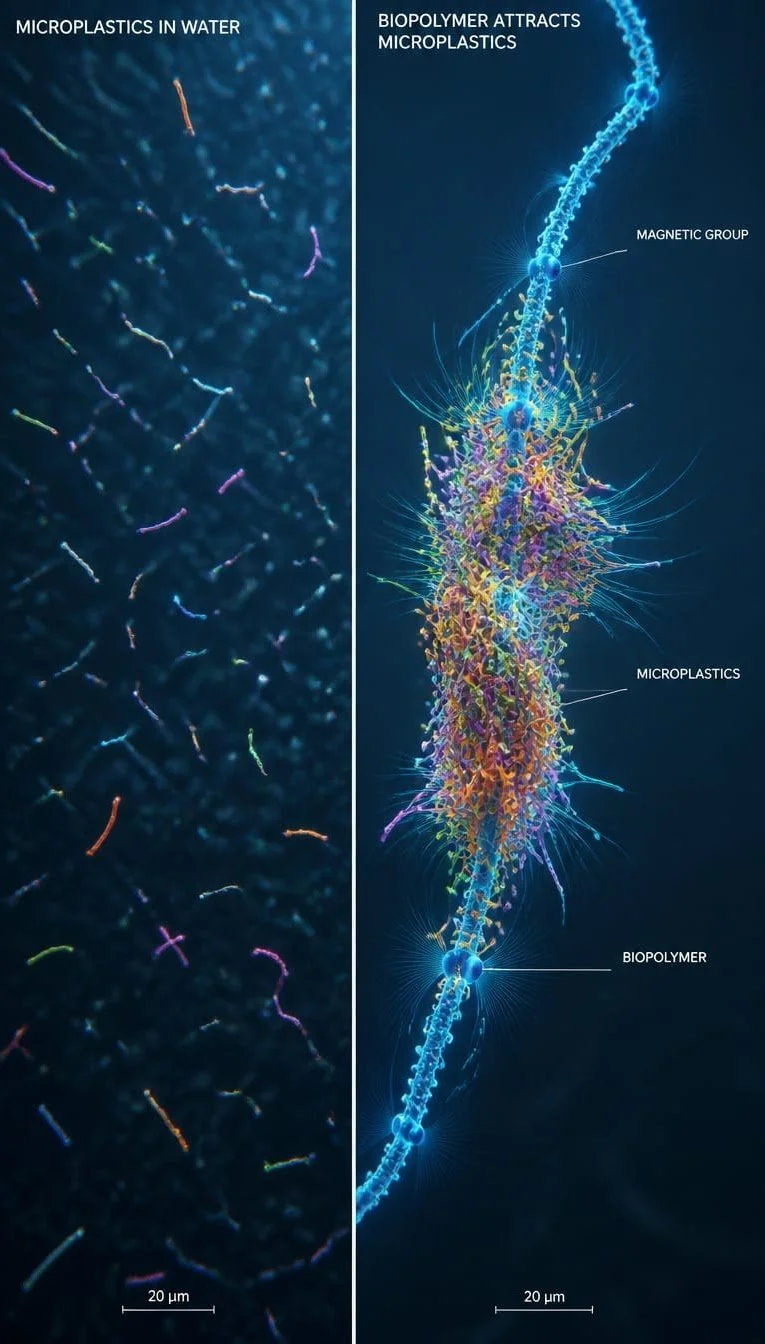
To intercept microplastics and chemical residues at the Point-of-Origin, we must exploit a fundamental law of physics: opposites attract. Most micro-contaminants suspended in domestic greywater carry a negative electrical charge. They repel each other, which is why they stay suspended in the water and easily slip through standard plumbing traps.
To catch them without a massive mechanical filter, we must introduce a Cationic Biopolymer—a long, chain-like molecule with a strong positive charge.
The Biomimetic Solution: From Sea Shells to Sinks
In 2026, the most promising cationic polymers are derived from nature, such as heavily modified Chitosan (derived from crustacean shells) or engineered proteins mimicking the coagulant properties of the Moringa oleifera tree seed.
In our envisioned Point-of-Origin system, this is not an appliance; it is a passive consumable. A small dispenser integrated into the washing machine line or the kitchen P-trap automatically releases a few drops of this liquid biopolymer as the water drains.
As the positively charged polymer hits the water, it acts like a molecular magnet. The microscopic, negatively charged plastic fibers and chemical residues instantly snap onto the polymer chain. This process—called coagulation and flocculation—rapidly builds microscopic waste into macroscopic clumps.
The Lifecycle Standard: The Solid Export
Under the PCU Lifecycle Standard, we transform a complex liquid problem into a simple solid one.
The Challenge: Microplastics in water are impossible to filter passively.
The PCU Solution: Phase Shift Filtration. By using the biopolymer to clump the invisible waste into visible, heavy "flocs," we change the rules of engagement.
Once the waste is clumped, it is easily caught by a standard, passive mesh filter already present in the drain line. The water that passes through and enters the municipal system is virtually free of micro-synthetic waste.
The tenant simply empties the mesh filter once a month. Because the biopolymer effectively stabilized the waste into an inert solid, it can be safely dropped into the Metastable Polymer drawer (Issue 47) or the nano-desiccant bin (Issue 46), ensuring it remains trapped in the controlled solid waste stream rather than poisoning our oceans.
The 2026 Vision: The Closed Plumbing Loop
At Project Clean Up (PCU), we believe the modern apartment should act as an environmental filter, not a funnel. By using ambient chemistry to dry our organics, collapse our packaging, and coagulate our greywater, the apartment tenant goes from being a passive consumer to an active participant in global remediation. We have removed the friction, silenced the machinery, and fundamentally changed the chemistry of daily life.