Photocatalytic Coatings – The End of the HEPA Fan
From the Laboratories of Project Clean Up (05/15/2026)
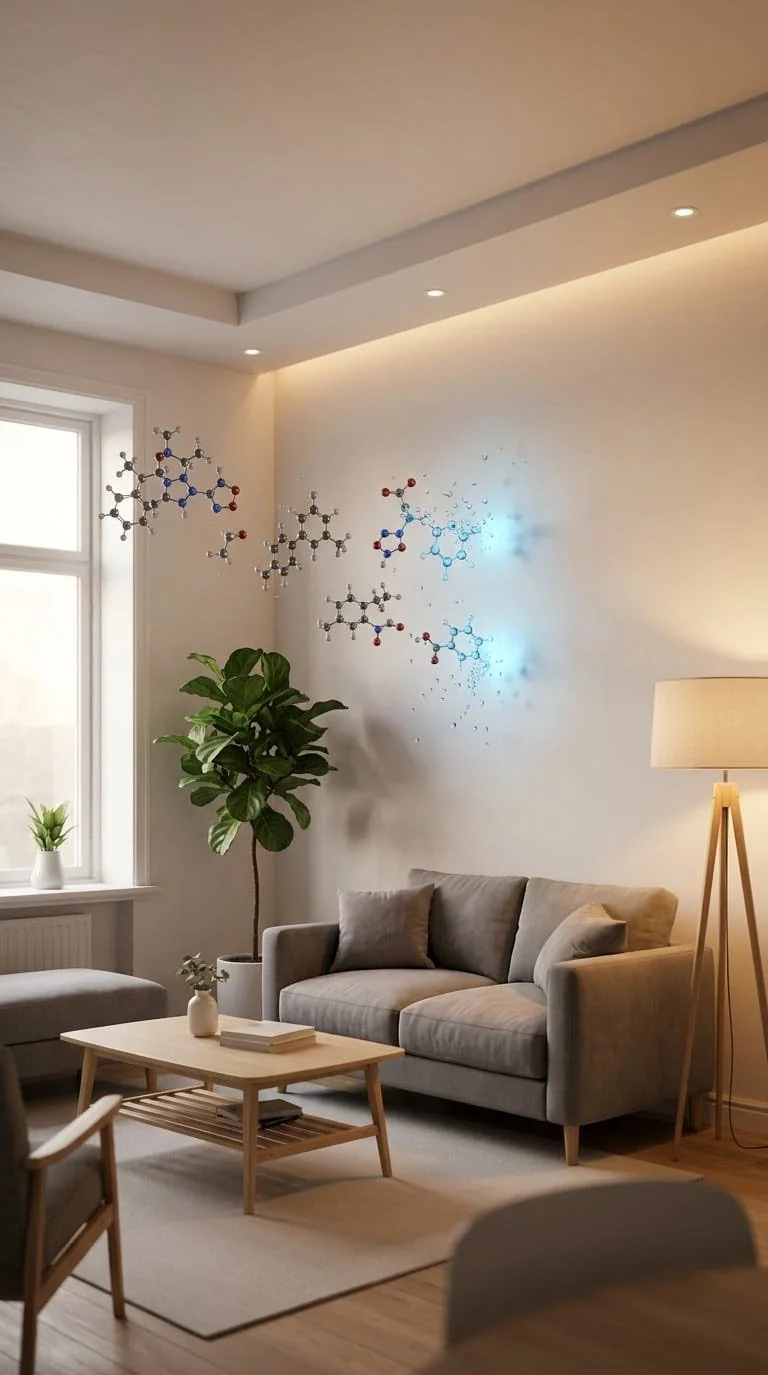
To eliminate the bulky air purifier from the apartment, we must make the surface area of the apartment work for us. Every wall, ceiling, and cabinet face is an opportunity for ambient chemistry.
The mechanism here is Photocatalysis. When certain semiconductor materials are exposed to light, they generate highly reactive electron-hole pairs. These react with ambient humidity to form hydroxyl radicals—nature's ultimate scrubbers. When a VOC molecule (like formaldehyde from a new bookshelf) drifts against the wall, these radicals instantly tear it apart, reducing the toxic gas into trace, harmless amounts of water vapor and carbon dioxide.
The MOF Enhancement: Working in the Dark
Historically, photocatalytic paints required intense ultraviolet (UV) light to function, making them useless inside a standard living room. However, by doping the coating with specifically engineered Metal-Organic Frameworks (MOFs), we have lowered the activation energy required.
These advanced 2026 coatings now operate perfectly under standard indoor LED lighting. Furthermore, the high porosity of the MOFs acts as a chemical sponge. When the lights go out at night, the photocatalysis stops, but the MOF matrix continues to passively absorb and trap VOCs. When the sun comes up or the kitchen lights are turned on the next morning, the trapped pollutants are systematically destroyed.
The Lifecycle Standard: The Permanent Application
Under the PCU Lifecycle Standard, we evaluate the maintenance and disposal of the system.
The Challenge: Traditional air purifiers require replacing non-recyclable plastic and carbon filter cartridges every few months, adding to the municipal waste stream.
The PCU Solution: Catalytic Immortality. Because a catalyst is not consumed in the reaction it facilitates, a photocatalytic wall coating never "fills up."
There are no cartridges to replace, no motors to burn out, and no plastic waste generated. The coating is applied once, like standard interior paint, and functions continuously for the life of the surface.
The 2026 Vision: The Autonomous Apartment
At Project Clean Up (PCU), we have answered the Point-of-Origin Challenge. Imagine the apartment of the future: The food scraps silently dehydrate into odorless husks in the drawer. The delivery boxes chemically melt into flat sheets. The drain magnetically catches its own microplastics. And the walls themselves breathe in the toxins and breathe out clean air.
We have successfully engineered a completely passive, invisible, and frictionless closed-loop system for the most restrictive living spaces on earth. This is the new standard of domestic architecture.