Metastable Polymers – Erasing the Spatial Footprint
From the Laboratories of Project Clean Up (05/01/2026)
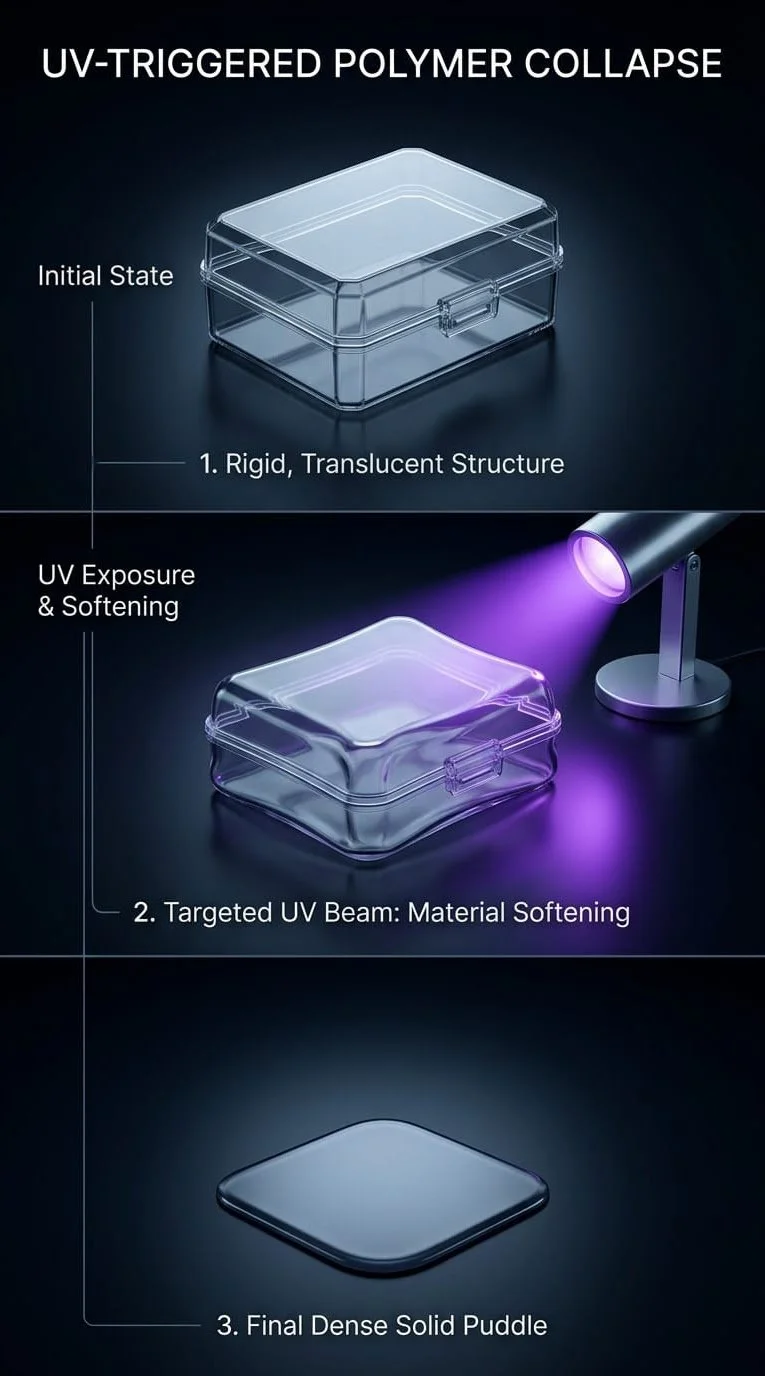
To eliminate the mechanical trash compactor, we must engineer packaging that wants to fall apart, but is temporarily held in a "metastable" state. A metastable polymer is a material trapped in an energy valley; it is perfectly strong and functional for its intended use, but it is chemically primed to degrade the moment it receives a specific activation energy.
This is the key to solving the spatial footprint of synthetic packaging in a small apartment. We do not crush the box; we command the box to let go of its structure.
The Trigger Mechanism: Light, pH, and Enzymatic Wash
The innovation lies in the "locks" holding the polymer chains together. In our envisioned Point-of-Origin system, the tenant places an empty biopolymer delivery box or food container into an integrated kitchen drawer. Closing the drawer activates a silent trigger.
Photolytic Triggers: Certain advanced polymers incorporate light-sensitive bonds (like coumarin dimers). A brief, intense flash of specific UV-C light inside the sealed drawer breaks these bonds.
pH or Enzymatic Triggers: Alternatively, a light mist of a mild household acid (like citric acid) or a specific benign enzyme is sprayed inside the chamber.
Upon activation, the rigid structural backbone of the packaging rapidly depolymerizes. A bulky, rigid clamshell instantly loses its mechanical strength, collapsing like a deflated balloon into a dense, flat, inert film or a fine powder at the bottom of the drawer.
The Lifecycle Standard: Volume Reduction and Safe Export
Under the PCU Lifecycle Standard, this process solves the friction of apartment living without compromising the environment.
The Challenge: A tenant generating high-volume packaging waste loses living space rapidly and is forced into daily, inconvenient trips to the communal dumpster.
The PCU Solution: Chemical Compaction. By utilizing triggered structural collapse, a week's worth of bulky packaging is reduced to a single, dense handful of inert material.
Because the resulting material is made of benign, depolymerized monomers, it can be safely and easily transported to the municipal dumpster at the end of the month, taking up a fraction of the space. In future iterations, if the starting material is a water-soluble biopolymer (like the circuit boards we discussed in Issue 37), the triggered collapse could result in a liquid that is safely routed directly into the apartment's plumbing, bypassing the dumpster entirely.
The 2026 Vision: The Static Kitchen
At Project Clean Up (PCU), we are redefining domestic entropy. The tenant consumes the product, places the packaging in the drawer, and closes it. There is no grinding motor. A silent chemical trigger is applied. When the drawer is opened the next day, the volume has vanished. This is the ultimate expression of the Point-of-Origin Challenge: using advanced materials science to give humans their space back.