From the Laboratories of Project Clean Up (11/06/2026)
The cookware industry has historically forced consumers to choose between convenience and biological safety. In 2026, as our understanding of micro-toxicity has deepened, both of the 20th-century legacy options have failed the PCU Lifecycle Standard.
1. The Flaws of Teflon and Steel
The PFAS Pan: Teflon (PTFE) is the most famous non-stick coating on Earth. It is also a member of the PFAS family—the exact "forever chemicals" our Nexus reactors were built to destroy. When a Teflon pan is heated above 500°F (easily reached on a standard gas stove), the coating begins to invisibly off-gas toxic fluoropolymers. As the pan ages, the coating chips, sending micro-plastics directly into your eggs and vegetables.
The Heavy Metal Leech: Many consumers pivoted to standard 18/10 Stainless Steel to avoid PFAS. However, the "18/10" refers to 18% chromium and 10% nickel—heavy metals used to prevent rust. When you simmer highly acidic foods, like a tomato sauce or a citrus reduction, the acid chemically attacks the steel, leaching measurable doses of nickel and chromium directly into your meal. Over a lifetime, this heavy metal accumulation burdens the human immune and filtration systems.
2. The Solid-State Ceramic Solution
The PCU solution is Advanced Technical Ceramics.
It is vital to distinguish this from the cheap "ceramic-coated" aluminum pans of the 2010s, which used thin sol-gel sprays that lost their non-stick properties in months and scratched easily.
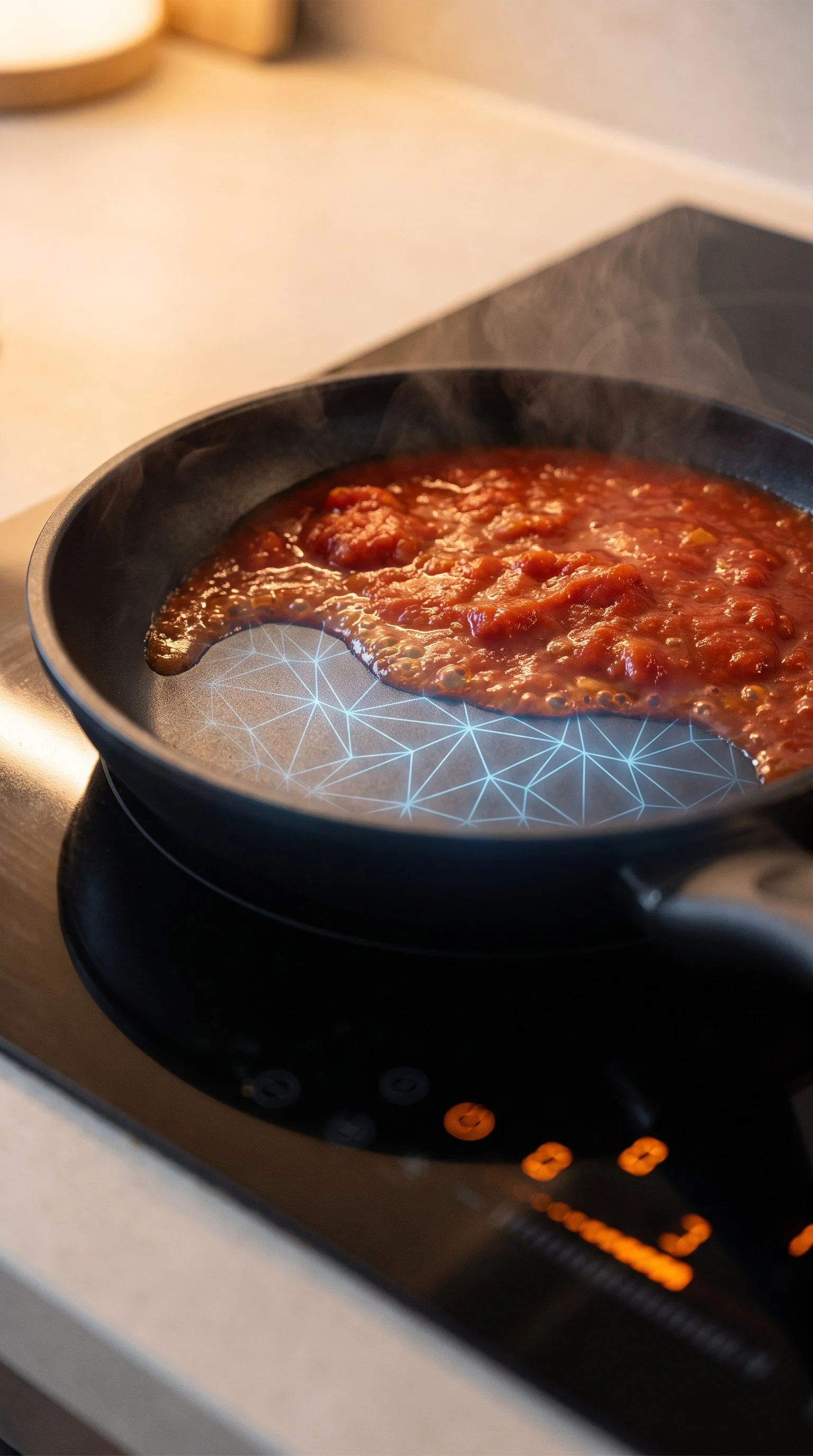
We are talking about solid, forged technical ceramics—specifically highly purified Silicon Carbide ($SiC$) and Zirconia ($ZrO_2$). These materials are synthesized at the atomic level and fired at extreme temperatures, forming a crystal lattice that is harder than steel, completely non-porous, and entirely devoid of synthetic polymers or heavy metal alloys.
Because the atomic bonds in a technical ceramic are fully satisfied and locked in place, the material is perfectly inert. You can boil a highly acidic tomato sauce in a pure zirconia pot for a week, and not a single molecule of the pot will transfer into the food. Furthermore, these materials boast extreme thermal shock resistance—they can be taken directly from a freezing refrigerator to a blazing stovetop without cracking.
3. The Lifecycle Standard: The Ultimate Aggregate
Under the PCU Lifecycle Standard, a product must not only be safe to use, but safe to destroy.
The Legacy Flaw: A scratched Teflon pan is a multi-material nightmare. The toxic PFAS coating cannot be safely burned, and the aluminum base cannot be easily recycled without chemically stripping the forever chemicals first. They pile up in landfills.
The PCU Solution: Mechanical Pulverization into Bio-Cement.
Solid technical ceramics are essentially highly refined, pure stone. When a solid ceramic pan finally reaches the end of its multi-generational lifespan, it requires zero complex chemical recycling.
The pan is simply routed to a PCU recovery facility where it is mechanically crushed into a fine aggregate. Because the material is exceptionally hard and chemically inert, this crushed ceramic dust is immediately sold back into the construction supply chain. It becomes the high-strength aggregate used to grow the Biogenic Concrete we designed for our eco-apartments in Bio-Cement and Mycelium – Turning Buildings into Carbon Sinks.
The pan that cooked your food safely returns to the earth to build the walls of the city, leaving absolutely zero toxic legacy behind.
The 2026 Vision: Reclaiming the Hearth
At Project Clean Up (PCU), we believe that the purity of our food supply must be defended at the very last inch before consumption. By moving away from cheap metallic alloys and synthetic toxic coatings, we are utilizing the extreme durability of technical ceramics to guarantee a zero-contamination diet. We are proving that the most advanced materials in the world belong not just in fusion reactors and aerospace, but right on your kitchen stove.