

Living Sensors: Lighting Up the Invisible
(10/02/2026)
The Concept: Before we can clean up a massive environmental disaster—like an underground plume of arsenic or a groundwater aquifer contaminated with heavy metals—we have to know exactly where the pollution is.
Historically, this has been a slow, expensive process. Environmental engineers have to drill dozens of test wells, pull physical water samples, ship them to a laboratory, and wait days or weeks for complex mass spectrometry results. By the time the map is drawn, the toxic plume has already moved.
We need a way to see the invisible, in real-time, out in the field. To do this, synthetic biologists have stopped building chemical testing kits and started programming living biological sensors.
The Science: The Genetic Circuit In our last series, we looked at how AI can design a single enzyme. Now, we are looking at whole-cell engineering. We are treating a living bacterium (like standard E. coli) as a microscopic computer, and we are writing new software for it using "genetic circuits."
A genetic circuit works almost exactly like an electrical circuit. It requires a sensor (a switch) and an output (a lightbulb).
The Switch (The Promoter): Bacteria naturally possess DNA sequences called promoters that turn certain genes on or off based on their environment. Scientists can isolate a promoter that specifically reacts to a toxic target, such as lead, arsenic, or mercury.
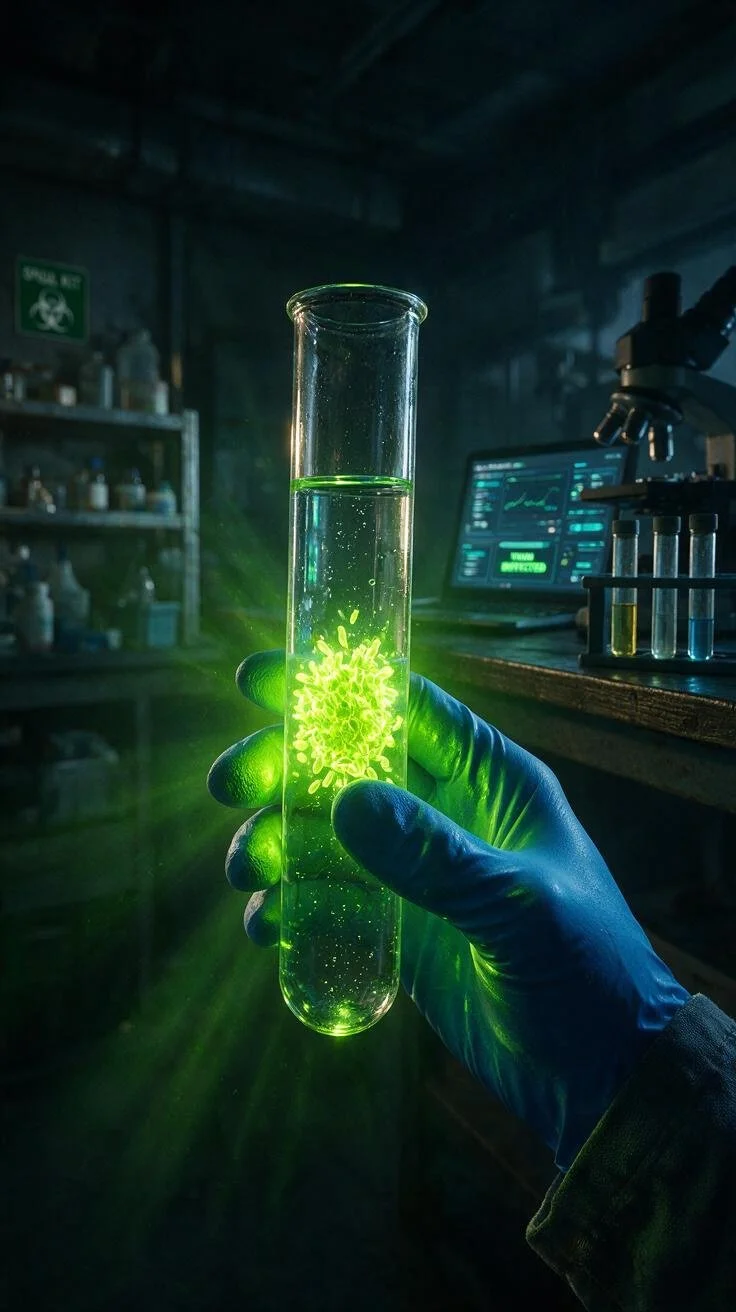
The Lightbulb (The Reporter Gene): Scientists take that toxic-sensing switch and physically wire it to a "reporter gene." Often, this is the genetic code for Green Fluorescent Protein (GFP)—the exact same protein that makes certain jellyfish glow in the dark.
The Boot-Up: This custom genetic circuit is inserted into a living bacterium. The microbe's new programming is incredibly simple: If you detect arsenic, glow green.
The Application: A Microscopic Canary These programmed microbes are revolutionizing field testing and environmental mapping.
Instead of waiting weeks for lab results, field engineers can carry vials of these freeze-dried, engineered bacteria. When they reach a contaminated site, they rehydrate the microbes and drop them directly into a water sample.
If the water is clean, the bacteria remain dormant and invisible. But if even trace amounts of the target toxin touch the bacteria's cellular membrane, the genetic switch flips. Within minutes, the bacteria begin manufacturing fluorescent proteins, causing the entire vial of water to radiate a bright, unmistakable neon glow under a handheld UV light.
By taking multiple samples across a landscape, engineers can watch these microscopic canaries light up, creating a highly accurate, real-time map of an underground toxic spill for pennies on the dollar. We are programming life to make the invisible visible.
