The Plastic Eaters: The Hunt for a Biological Eraser
(03/27/2026)
The Concept: For decades, the environmental narrative around plastic has been a story of permanence. Because synthetic plastics like PET (polyethylene terephthalate—the clear stuff used for water bottles) were invented in a laboratory, nature had never seen them before. The assumption was that since microbes hadn't evolved alongside plastic, they had no biological tools to digest it. Every piece of plastic ever made, we thought, would exist forever.
But biology is infinitely adaptable. In 2016, a team of scientists sifting through the sludge outside a plastic bottle recycling facility in Sakai, Japan, discovered something impossible: a bacterium that was actively eating the plastic.
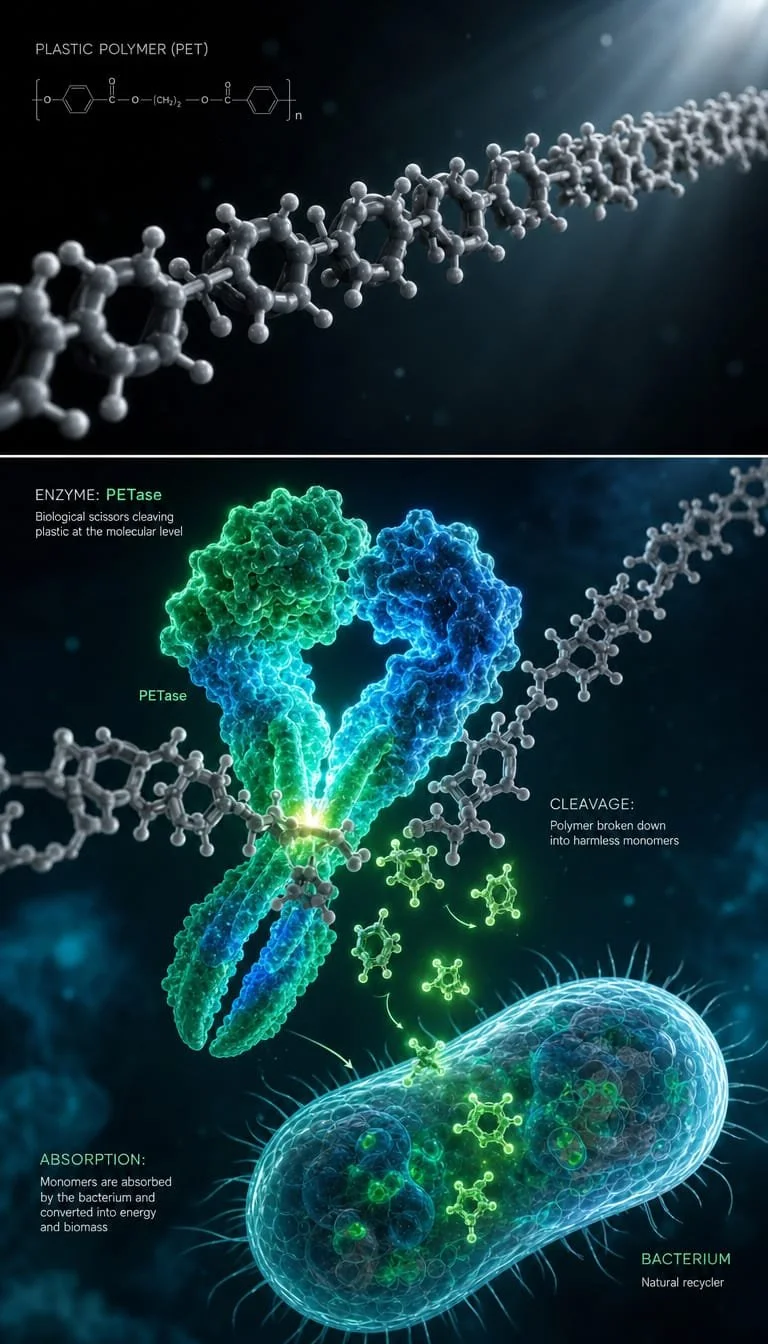
The Science: Molecular Scissors The microbe, named Ideonella sakaiensis, didn't just survive on the plastic; it used it as its primary food source. To do this, it evolved a highly specialized two-step enzymatic attack.
Think of a plastic polymer like a long, incredibly strong pearl necklace.
The First Cut (PETase): The bacterium secretes an enzyme called PETase. This enzyme acts like a pair of molecular scissors, locking onto the long plastic polymer chain and snipping it into smaller, manageable chunks (called MHET).
The Breakdown (MHETase): The bacterium then deploys a second enzyme, MHETase, which takes those smaller chunks and breaks them down into their two foundational building blocks: ethylene glycol and terephthalic acid.
These resulting chemicals are environmentally benign. The bacterium absorbs them for energy, completely erasing the plastic.
The Reality Check and the Future: While the discovery of Ideonella sakaiensis was a massive paradigm shift, it is not a silver bullet—yet. The natural degradation process is incredibly slow. It took the bacteria weeks to eat through a thin film of low-grade plastic. It cannot keep up with the millions of tons of waste we produce daily.
However, scientists are not waiting around. Using the exact same principles of genetic engineering we've discussed in previous series, researchers are mapping the DNA of these enzymes and tweaking them. By combining PETase and MHETase into synthetic "super-enzymes," laboratories have already increased the speed of plastic degradation by up to six times. The ultimate goal is to build industrial bioreactors where our plastic waste is dissolved back into pure chemical building blocks in a matter of days, creating an infinite, biological recycling loop.