

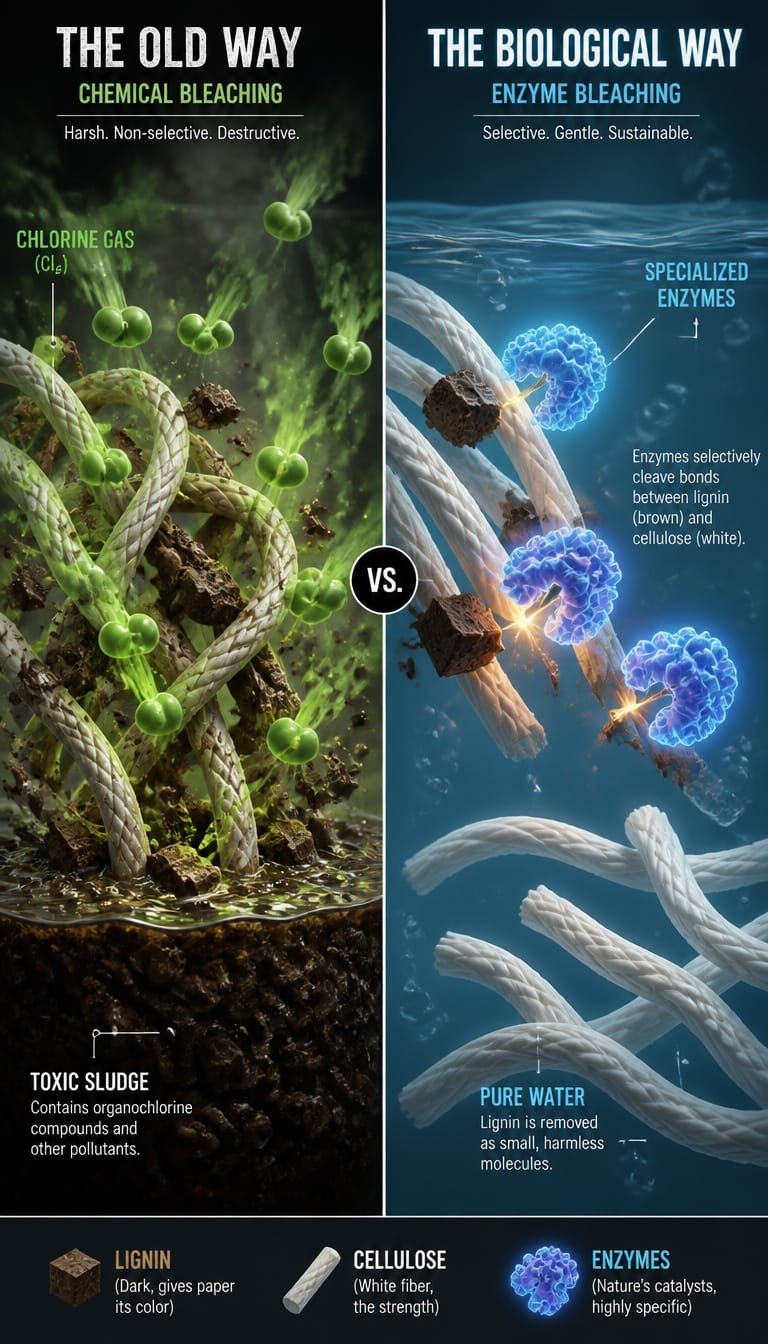
The End of Chlorine: Enzymatic Paper Bleaching
The Concept: Take a look at a piece of standard printer paper. It is perfectly, brilliantly white. But paper comes from wood, and wood is brown. To get from a brown tree to a white sheet of paper, the pulp must be bleached.
Historically, the pulp and paper industry relied heavily on elemental chlorine gas to achieve this. While chlorine is an incredibly effective bleach, it comes with a devastating environmental cost. When chlorine reacts with the organic compounds in wood pulp, it creates highly toxic byproducts, including dioxins. For decades, paper mills dumped millions of gallons of this chlorinated wastewater into rivers, causing massive dead zones and severe mutations in aquatic ecosystems. We needed a way to whiten paper without poisoning the water.

Growing Our Cities: The Rise of Bio-Concrete
The Concept: Concrete is the most widely used human-made material on Earth. It is the backbone of our bridges, dams, skyscrapers, and sidewalks. But traditional concrete has two massive problems: it is responsible for roughly 8% of global carbon dioxide emissions, and eventually, no matter how well it is poured, it cracks.
Water inevitably finds its way into these microscopic cracks. When that water freezes, it expands, widening the crack. If the water reaches the inner steel rebar, it causes rust, which expands and literally blows the concrete apart from the inside. Traditionally, the only solution to failing concrete is to tear it down and pour more concrete, restarting the massive carbon emission cycle.
But what if concrete could bleed, scab, and heal itself, just like human skin?

The Chemistry of Cleaning: Defeating the Unbeatable Toilet Ring
The Soul of the Science: Environmental remediation isn't just about massive oil spills, deploying complex ligand systems, or treating industrial Superfund sites; it’s a fundamental mindset. It is the understanding that every environment—from a polluted groundwater aquifer to the porcelain bowl in your apartment—is governed by the strict laws of chemistry. When we blindly scrub a stubborn mineral stain with brute force and the wrong cleaner, we are fighting nature and losing. But when we pause, analyze the chemical composition of the contaminant, and apply the precise molecular key to unlock it, we aren't just doing chores. We are practicing targeted chemical remediation. It is about working smarter, not harder, by letting the electrons do the heavy lifting.