(11/20/2026)
The Death of Dilution In our last series, we closed the hull. Using the Sabatier engine, microwave plasma pyrolysis, photobioreactors, and additive manufacturing, we balanced the major ledgers of carbon, oxygen, hydrogen, and nitrogen. On paper, the loop is sealed and self-sustaining.
In physical reality, sealing the loop immediately destroys the oldest, most invisible subsidy in human engineering: dilution.
In an open, linear environment, trace chemical errors are forgiven by sheer volume. If an adhesive off-gasses a few milligrams of formaldehyde in a warehouse, or if a factory releases parts-per-billion of a synthetic plasticizer into a river, the surrounding atmosphere and hydrosphere absorb it. The volume of the receiving sink is so vast that the resulting concentration approaches zero.
When you close a system—whether it is a spacecraft hull, a tightly sealed urban water loop, or an industrial bioreactor—the volume ($V$) becomes small and fixed. Nothing leaves. Every trace molecule that slips past your primary filters does not vanish; it comes back around on the next pass, joined by a fresh dose.
The Mathematics of Accumulation We can model the behavior of any trace contaminant inside a closed loop using a basic mass-balance differential equation. Consider a sealed system of fixed volume $V$ (measured in cubic meters or liters). A contaminant enters the loop at a constant mass generation rate $\dot{m}$ (from structural off-gassing, material wear, or human metabolism). The system's filtration loop processes the volume at flow rate $Q$, with a fractional capture efficiency $\eta$ (ranging from $0$ to $1$) for that specific molecule:
$$V \frac{dC}{dt} = \dot{m} - \eta Q C$$
Where $C$ is the concentration of the contaminant at time $t$.
If the filtration architecture is designed to capture that specific molecule ($\eta > 0$), the system eventually reaches a steady-state concentration ($C_{ss}$) where removal matches generation:
$$C_{ss} = \frac{\dot{m}}{\eta Q}$$
For the primary ledgers we intentionally engineer around—like carbon dioxide or urea—$\eta$ is high, and $C_{ss}$ remains safely below toxic thresholds.
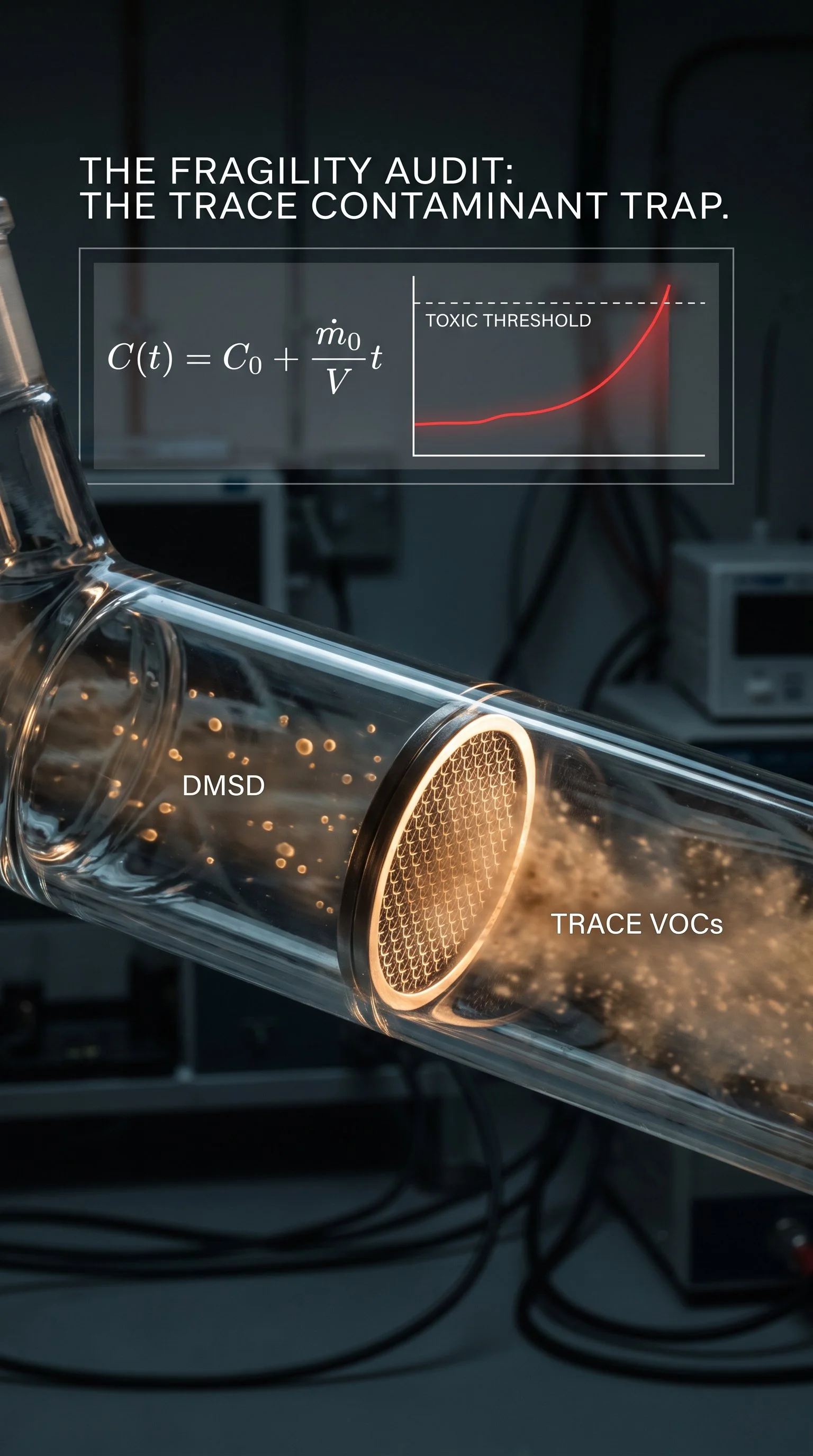
The trap lies in the unknown variables. Every real-world material leaks trace compounds that primary filters were never built to catch. Look at what happens to the equation when a trace molecule has a capture efficiency approaching zero ($\eta \to 0$). The steady-state ceiling disappears entirely, and the differential equation collapses into linear, unbounded accumulation:
$$C(t) = C_0 + \frac{\dot{m}}{V} t$$
The rate $\dot{m}$ can be microscopic—parts per billion per day. It does not matter. In a closed volume with $\eta = 0$, concentration is strictly a function of time. Given enough cycles, even an imperceptible leak inevitably crosses the lethal threshold ($C_{lethal}$) for either the biology or the hardware.
The Siloxane Ghost This is not a theoretical edge case; it has already ambushed our most advanced closed-loop hardware.
Aboard the International Space Station, engineers designed the Water Recovery System to scrub heavy biological loads—urea, salts, and standard organic wastes—with extreme efficiency. Yet over time, the system’s Total Organic Carbon (TOC) sensors began creeping upward, threatening the potability of the water loop.
The culprit was dimethylsilanediol (DMSD), a tiny, water-soluble organosilicon compound. Its source was mundane: trace outgassing from silicone sealants, electronics, and crew personal care products. Because DMSD is electrically neutral and chemically stubborn, it slipped straight through the ion-exchange resins and activated carbon beds ($\eta \approx 0$). Every time the water was distilled and recycled, the DMSD rode along with the condensate and compounded.
The same mathematical trap stalks terrestrial closed-loop water recycling (Direct Potable Reuse) and sealed indoor agriculture. Monovalent salts, trace pharmaceuticals, endocrine disruptors, and volatile organic compounds leached from the very polymers used to build the pipes accumulate with every pass. Even the 3D-printed biopolymers from our Molecular Forge release trace monomers and thermal breakdown products that steadily poison an unvented cabin.
The Purge Paradox In terrestrial chemical engineering, there is a standard, blunt solution to trace accumulation: the purge stream.
When an industrial refinery recycles a solvent or gas loop, engineers intentionally bleed off a small percentage (often 1% to 5%) of the flow on every cycle, dumping it as waste and replacing it with fresh feedstock. That intentional leak sets an artificial cap on trace buildup.
Here lies the brutal paradox of circular design. If you rely on a purge stream, your loop is no longer closed—you are permanently bleeding mass and importing fresh inputs to survive. Yet if you eliminate the purge stream to achieve 100% mass retention, selective filtration is no longer enough. You cannot design a bespoke filter for every possible trace molecule that might leach out of a complex city or spacecraft.
To defeat the Trace Contaminant Trap without bleeding mass, a closed loop must incorporate a non-selective mineralization gate—a thermodynamic reset button. Systems like high-temperature catalytic oxidation, ultraviolet advanced oxidation processes (UV-AOP), or supercritical water oxidation do not try to identify trace contaminants; they ruthlessly strip every stray organic molecule back down to its base inorganic building blocks ($CO_2$, $H_2O$, and mineral salts), which the primary engines already know how to process.
Closing the loop is not free. The price of eliminating dilution is paying the continuous energy tax required to incinerate your own ghosts at the molecular level.
Would you like to try your hand at cleaning up waste oil at home with mycelium? Try our DIY Domestic Mycoremediation - Training Oyster Mushrooms to Digest Motor Oil!