

Domestic Mycoremediation - Training Oyster Mushrooms to Digest Motor Oil
Series: Bioremediation | Difficulty: Intermediate | Estimated Time: 45 Minutes (Active) + 4-6 Weeks (Incubation)
Introduction
When hundreds of thousands of gallons of crude oil spill into an ecosystem, one of nature's most effective first responders is a biological factory hidden underground: the mycelial network. This is the foundation of mycoremediation—deploying specific fungal species to break down, isolate, or digest severe environmental toxins.
In this module, we are bypassing industrial-scale soil turning to execute a highly controlled, micro-scale bioremediation protocol on your countertop. We will be using Pleurotus ostreatus (the common Pearl Oyster mushroom). While prized in culinary settings, the Oyster mushroom is scientifically recognized as a voracious consumer of complex hydrocarbons, including diesel, motor oil, and herbicides.
We are not just growing mushrooms; we are actively "training" a living fungal colony to shift its metabolic pathways, recognize a toxic petrochemical as a food source, and systematically dismantle it.
The Chemistry - Enzymatic Assassins
How does a mushroom eat motor oil? It comes down to evolutionary biology and extracellular enzymes.
In nature, Oyster mushrooms are primary decomposers of wood. Wood gets its structural rigidity from lignin, an incredibly tough polymer made of complex, branching rings of carbon and hydrogen. Because lignin is so structurally similar to polycyclic aromatic hydrocarbons (PAHs)—the toxic, ringed carbon structures found in crude oil and refined petroleum products—the mushroom's biological machinery doesn't know the difference.
When the mycelium (the root-like vegetative web of the fungus) encounters a hydrocarbon, it secretes three primary "molecular assassins" into the surrounding environment:
Lignin Peroxidase (LiP): An enzyme that uses hydrogen peroxide to forcefully strip electrons from the hydrocarbon rings, destabilizing them.
Manganese Peroxidase (MnP): An enzyme that oxidizes manganese ions, creating highly reactive agents that diffuse into the oil and crack its carbon-carbon bonds.
Laccases: Copper-containing enzymes that attack phenolic compounds, further breaking down the toxic molecular chains.
Through this enzymatic barrage, the toxic oil is dismantled into basic carbohydrates, water, and carbon dioxide. The fungus literally fuels its own growth with the contaminant.
See It in Action
Before setting up your own colony, this visual progression illustrates how the mycelial network secretes these extracellular enzymes to colonize and break down hydrocarbon chains within a substrate:
Safety Framework: R.A.M.P.
Even at a micro-scale, working with petrochemicals requires strict operational hygiene.
Recognize hazards: We are handling motor oil, which contains toxic PAHs and heavy metals (especially if using used motor oil). We are also working with fungal spores, which can trigger respiratory sensitivity in high concentrations.
Assess risks: Skin and eye irritation from oil exposure. Contamination of the sterile fungal substrate by ambient household bacteria or mold.
Minimize risks: Wear nitrile gloves throughout the procedure. Use only drops of oil—do not saturate the substrate. Execute the inoculation in a clean, draft-free environment (wiping down the counter with 70% isopropyl alcohol first).
Prepare for emergencies: Have paper towels and dish soap ready for accidental oil drips. If oil contacts the skin, wash thoroughly with warm water and soap.
Materials & Equipment
The Biological & Chemical Inputs:
Oyster Mushroom Grain Spawn: $100\text{ grams}$ ($\approx \frac{1}{2}\text{ cup}$). Available from online mycology suppliers; ensure it is Pleurotus ostreatus.
Clean Corrugated Cardboard: Enough to fill your jar. Cardboard is heavily processed wood pulp (cellulose/lignin). Avoid glossy or heavily dyed cardboard.
Motor Oil: $5\text{ mL}$. Fresh 10W-30 works perfectly to demonstrate the chemistry, but used motor oil from a recent oil change contains more complex degradation targets.
Distilled Water: For hydrating the cardboard.
3% Hydrogen Peroxide ($H_2O_2$): For pasteurizing the substrate.
Equipment:
$1\text{ Quart}$ ($32\text{ oz}$) wide-mouth glass Mason jar with a two-piece lid.
A glass dropper or plastic pipette.
Nitrile gloves.
A large mixing bowl.
The Procedure: Constructing the Bioreactor
Phase 1: Substrate Pasteurization
To ensure our Oyster mycelium doesn't have to compete with wild mold spores, we must pasteurize the cardboard using a "cold pasteurization" technique via hydrogen peroxide.
Prep the Carbon: Tear the clean corrugated cardboard into roughly 2-inch squares.
The Bath: In the large mixing bowl, combine 1 part 3% hydrogen peroxide with 10 parts distilled water.
Submerge: Push the cardboard squares into the bath. Let them soak for exactly 1 hour. The peroxide will kill competing surface contaminants but degrade rapidly into plain water and oxygen, leaving no toxic residue behind.
Drain: Remove the cardboard and squeeze out the excess moisture. It should feel like a damp sponge—hydrated, but not dripping wet.
Phase 2: Inoculation and Layering
Sanitize: Wash your hands, put on nitrile gloves, and wipe down your Mason jar and work surface with rubbing alcohol.
The Base: Place a single, flat layer of damp cardboard at the bottom of the jar.
The Biological Catalyst: Sprinkle a small pinch (about 1 teaspoon) of the Oyster grain spawn evenly over the cardboard.
Build the Matrix: Add another layer of cardboard, then another pinch of spawn. Repeat this layering process (like a lasagna) until the jar is roughly 80% full. Ensure the top layer is cardboard.
Phase 3: The "Training" Phase (Introducing the Contaminant)
Fungi are adaptive. If presented with easy food (grain) and hard food (oil) simultaneously, they will eat the easy food and ignore the oil. We must train them by introducing the contaminant in stages.
The First Spike: Using your pipette, drop exactly 5 individual drops of motor oil directly onto the top layer of cardboard. Do not pour the oil.
Seal and Breathe: Screw on the Mason jar lid, but leave it "finger-tight" (slightly loose). The fungus is aerobic; it needs to inhale oxygen and exhale carbon dioxide to survive.
Dark Incubation: Place the jar in a warm, dark cabinet ($68^\circ\text{F} - 75^\circ\text{F}$ / $20^\circ\text{C} - 24^\circ\text{C}$).
Phase 4: Observation and Scaling
The Mycelial Run (Weeks 1-2): Check the jar every few days. You will see pristine, white, web-like threads (mycelium) jumping from the grain to the cardboard.
The Attack (Weeks 2-3): As the white web reaches the dark drops of oil, it may initially halt or turn slightly yellow as it secretes its laccase and peroxidase enzymes. Within days, you will witness the white mycelium directly overtake and swallow the oil spots.
The Second Spike: Once the first drops have been consumed (the dark spots vanish), open the jar and add 10 drops of oil. The mycelium is now "trained" and has up-regulated its petroleum-digesting enzymes. It will consume the second batch noticeably faster than the first.
Analysis and Environmental Implications
What you have engineered on your kitchen counter is a highly efficient, closed-system bioreactor.
The Olfactory Test: During week one, the jar may faintly smell of petroleum if opened. By week three, as the enzymes break the volatile organic compounds (VOCs) down into carbohydrates, the smell will shift entirely to a rich, sweet, earthy scent. The toxin has been biologically transmuted.
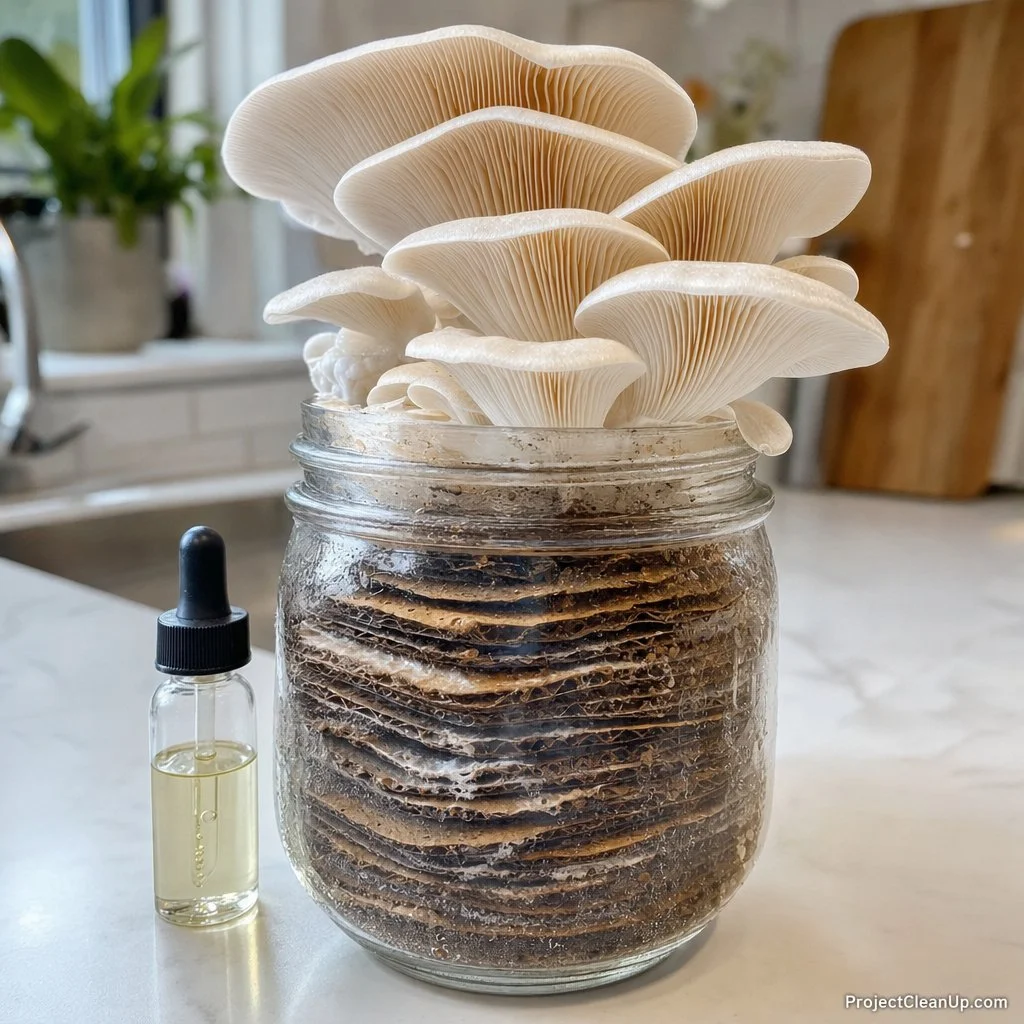
The Fruiting Phase: Eventually, the mycelium will fully colonize the jar and attempt to reproduce by pinning small mushrooms. CRITICAL WARNING: Do not consume these mushrooms. While the fungus completely dismantles the hydrocarbon chains, it cannot destroy heavy metals present in the oil (like lead, zinc, or iron). Instead, it bioaccumulates these metals, drawing them out of the substrate and storing them safely within the mushroom's fruiting body. In a real-world cleanup, these toxic mushrooms are harvested and incinerated, permanently removing the heavy metals from the ecosystem.
By completing this module, you have observed firsthand how applied biotechnology can heal chemical trauma in an environment. The same enzymatic mechanics happening in your glass jar are what environmental engineers deploy to remediate diesel-soaked soil at abandoned industrial sites worldwide.
