(11/13/2026)
The Entropy of the Hardware In the linear economy of Earth, when a mechanical component fails, we throw it away and purchase a replacement forged from freshly extracted virgin ore. In the vacuum of space, there is no supply chain. The mass of the spacecraft on launch day is the absolute maximum mass it will ever possess.
A closed-loop society cannot rely on external warehouses. It must possess the ability to regenerate its own physical infrastructure from the thermodynamic exhaust of its inhabitants. It must manufacture advanced structural components out of thin air and biological waste.
Synthesizing the Substrate To achieve this, we look back to the bioregenerative engine established in The Orbital Architecture - The Bioregenerative Engine. The microalgae and cyanobacteria digesting the crew's nitrogen waste are not just generating edible calories; they can be engineered as microscopic polymer factories.
When specific strains of bacteria are subjected to thermodynamic stress—such as a sudden deprivation of a secondary nutrient while bathed in excess carbon—they alter their metabolic pathways. Instead of dividing, they begin to aggressively synthesize Polyhydroxyalkanoates (PHAs). These are highly complex, naturally occurring, biodegradable polyesters stored as dense granules within the cell walls.
By harvesting this cellular byproduct, we extract a high-grade, thermoplastic biopolymer directly from the biological waste stream.
The Carbon Reinforcement A biopolymer alone is often too brittle or thermally sensitive to replace a structural titanium or aluminum component. It requires a reinforcement matrix.
We find that exact reinforcement in the exhaust of the Plasma Furnace from Installment 2. When we violently shattered the vented methane ($CH_4$) using microwave plasma, we completely closed the hydrogen loop, but we were left with a physical block of pure, solid carbon black.
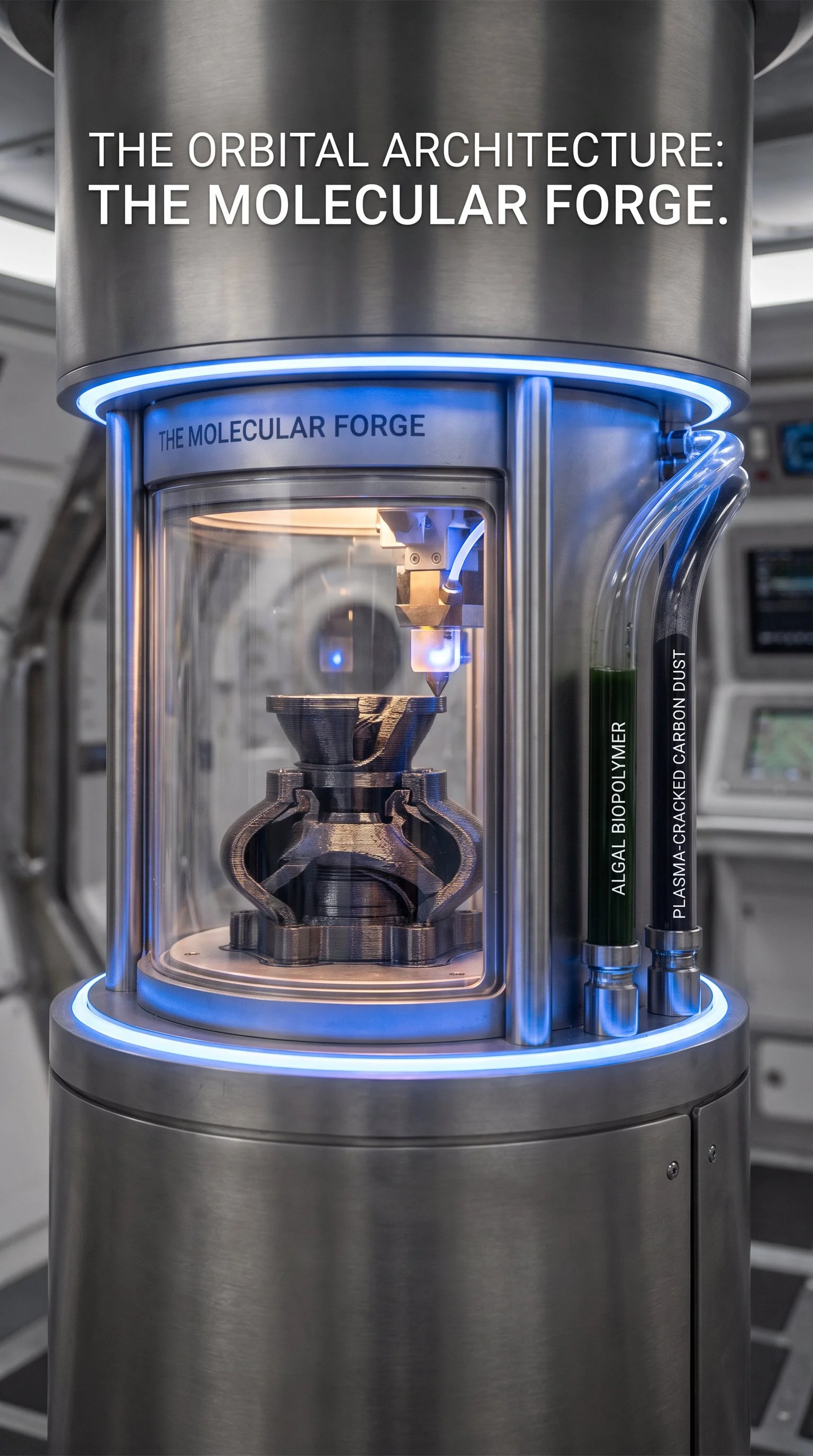
By intimately mixing the microscopic solid carbon dust from the plasma reactor with the PHA biopolymer extracted from the algal reactor, we create a molecularly advanced, high-strength carbon-composite filament.
The Ultimate Synthesis This composite material is then fed into the spacecraft’s Molecular Forge—a high-precision additive manufacturing system (3D printer).
When a critical mechanical valve breaks, the crew does not panic. They retrieve the broken valve, drop it into a chemical or thermal depolymerization bath to instantly dissolve and recover its base matrix, and then print a flawless replacement.
Look closely at the thermodynamic math of this new valve. It is not made of mined metals or drilled petroleum. It is forged entirely from the carbon dioxide the crew exhaled last month and the nitrogen brine they excreted last week. The breath and the waste of the crew have been chemically and biologically transmuted into the physical, structural architecture of the hull that protects them.
The Terrestrial Translation This is the absolute pinnacle of closed-loop engineering, and it is the exact blueprint required for the Planetary Retrofit.
On Earth, we currently tear open the lithosphere to build our cities, only to lock those materials into the paralyzed, high-entropy vaults we identified in The Urban Audit. If we scale the orbital Molecular Forge terrestrially, we fundamentally sever our reliance on virgin extraction.
We can capture the fugitive methane from our landfills and the carbon dioxide from our industrial stacks, crack them into pure carbon, and bind them with the biopolymers generated from our municipal wastewater. We can 3D-print our physical infrastructure, our vehicles, and our advanced materials using nothing but the atmospheric and biological exhaust of the city itself.
The spacecraft proves it is bound by the laws of physics. We simply have to choose to build it.
Interested in Space?
Learn more about the Cosmic Garden: The Cosmic Garden: Lessons in Food Production from the ISS and Biosphere 2
What we are doing about waste in closed environments like space: The Unending Fix: Lessons in Waste and Maintenance from Space and Earth