(11/06/2026)
The Caloric Deficit The physics of human metabolism are relentless. An astronaut can drink chemically synthesized water and breathe electrolyzed oxygen, but they must also consume roughly 2,500 kilocalories of complex carbohydrates, lipids, and proteins every day.
In low Earth orbit, we solve this linearly: we launch freeze-dried packets of food on cargo rockets. The mass of the food enters the astronaut, and the thermodynamic exhaust exits as solid waste and urine. If we attempt this on a multi-year transit to Mars, the physical mass of the food required would paralyze the mission.
We cannot afford to store calories. We must endlessly regenerate them. We must transition from physical chemistry to synthetic biology.
The Nitrogen Ledger and the Toxic Brine To grow biomass, you need more than just carbon and water; you need nitrogen.
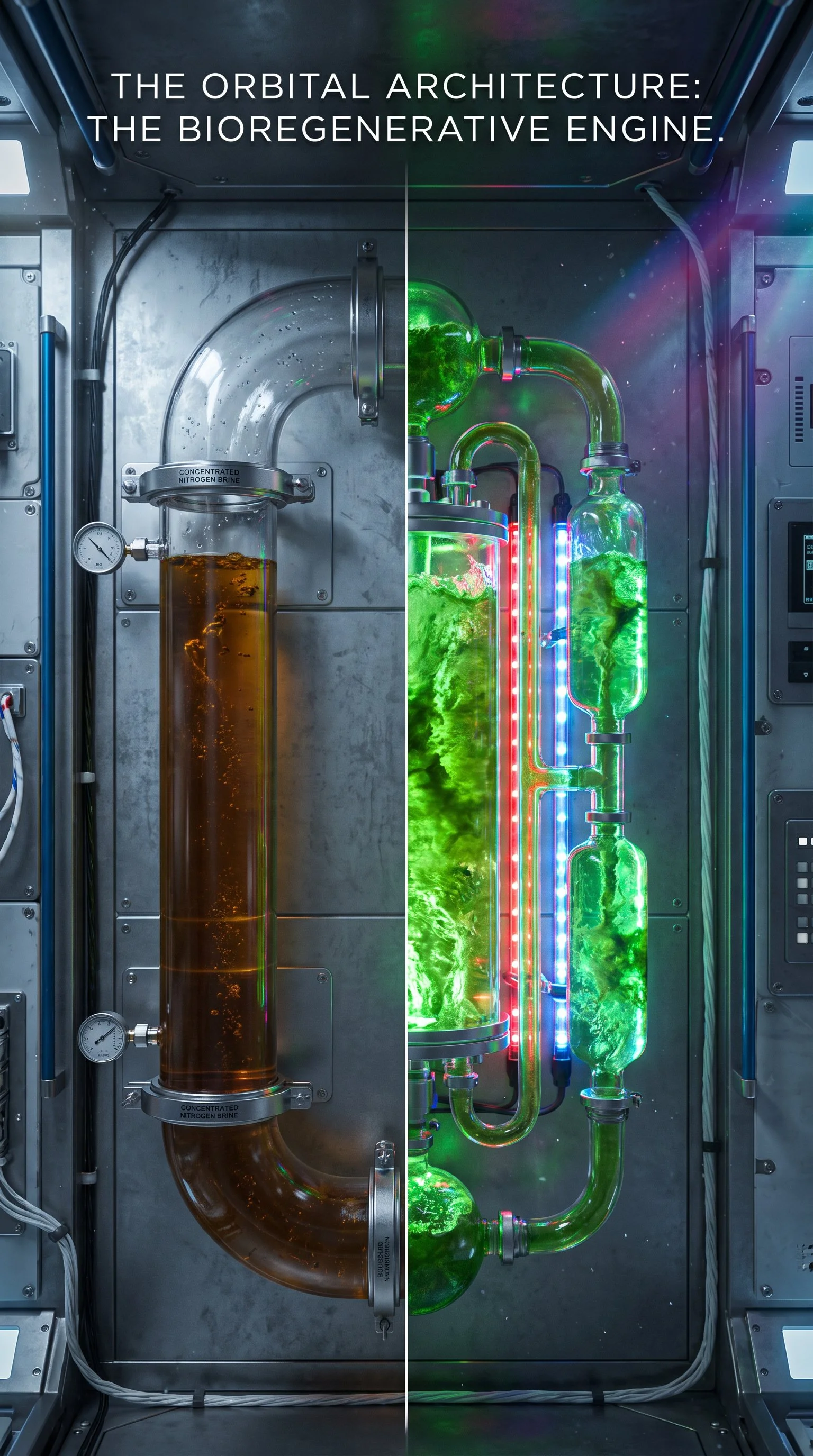
In the human body, the primary exhaust vehicle for nitrogen is urea ($CO(NH_2)_2$), expelled in urine. Current orbital life support systems handle urine with brute force. They run it through a distillation assembly to boil off and recover the pure water. But the thermodynamic remainder of this process is a highly concentrated, toxic brine of salts, complex organics, and trapped nitrogen.
In a linear system, this brine is a dead end. It is pumped into a storage tank and treated as hazardous waste. But in a closed-loop architecture, this brine is a high-grade liquid fertilizer. It contains the exact atomic building blocks required to synthesize the next meal.
The Algal Reactor To bridge the gap between human waste and human food, we cannot rely on traditional agriculture. Growing a field of wheat inside a spacecraft is energetically and spatially impossible. We need a microscopic, hyper-efficient biological catalyst.
Enter the photobioreactor.
Space agencies have spent decades engineering Micro-Ecological Life Support System Alternatives (MELiSSA), relying heavily on cyanobacteria and microalgae, such as Arthrospira platensis (Spirulina). The microalgae act as a dense, liquid biological engine.
We take the nitrogen-rich brine left over from the water recovery system and feed it directly into a sealed, transparent matrix. We pump in the residual $CO_2$ that bypassed the Sabatier reactor. Finally, we bombard the liquid with highly tuned LED photons.
The algae consume the toxic waste and the carbon gas, engaging their chloroplasts to rapidly multiply. They synthesize dense, highly bioavailable proteins and essential fatty acids at a photon-to-biomass conversion efficiency that obliterates terrestrial crops.
The Terrestrial Translation We have taken human exhaust, and through the precision of microscopic biological engines, we have transmuted it back into an edible, life-sustaining matrix.
The implications for the planetary retrofit are profound. On Earth, our municipal wastewater treatment plants treat nitrogen and phosphorus as dangerous liabilities. We spend massive amounts of energy aerating sewage just to force the nitrogen back into the atmosphere (denitrification), while simultaneously mining synthetic fertilizers out of the ground to grow our food. It is a dual thermodynamic failure.
If we scale the orbital bioregenerative engine to the municipal level, we stop destroying our waste. We route the urban brine into massive, automated photobioreactors, capturing the nitrogen and phosphorus before they ever reach a river or ocean. We transmute the sewage of the city directly into biofuel feedstocks, high-grade agricultural fertilizers, and animal feed.
The loop closes not with a chemical furnace, but with a living biological matrix.