


The Glass Vault - The Wild Breath of the Mind
After the Rain Engine has established a reliable hydrologic baseline, the next ledger to balance in the glass vault is carbon. If the water loop is the plumbing, the carbon loop is the metabolism.
When we discuss "carbon capture" on Spaceship Earth, we often treat it as a linear problem: we have too much CO2, so we must filter it out. But in a closed system, there is no filtering things out. There is only conversion. The carbon dioxide must be transformed back into life, and the life must eventually return to carbon dioxide.
In the sealed jar, the atmospheric ledgers do not just gently balance; they swing wildly and violently every single day.

The Glass Vault - The First Seal
When we discuss the Planetary Retrofit—the effort to close the massive, broken loops of human industry—the scale can be paralyzing. It is difficult for the human mind to fully grasp the atmospheric carbon ledger or the global nitrogen cycle.
To truly understand how a closed-loop system operates, we have to scale it down. We have to strip away the noise of the global economy and look at the bare thermodynamic minimum required for life to sustain itself. We do this by building a microcosm. We put a forest inside a glass jar, and we seal the lid.
This is not just a botanical display; it is a physical proof of concept for Spaceship Earth.
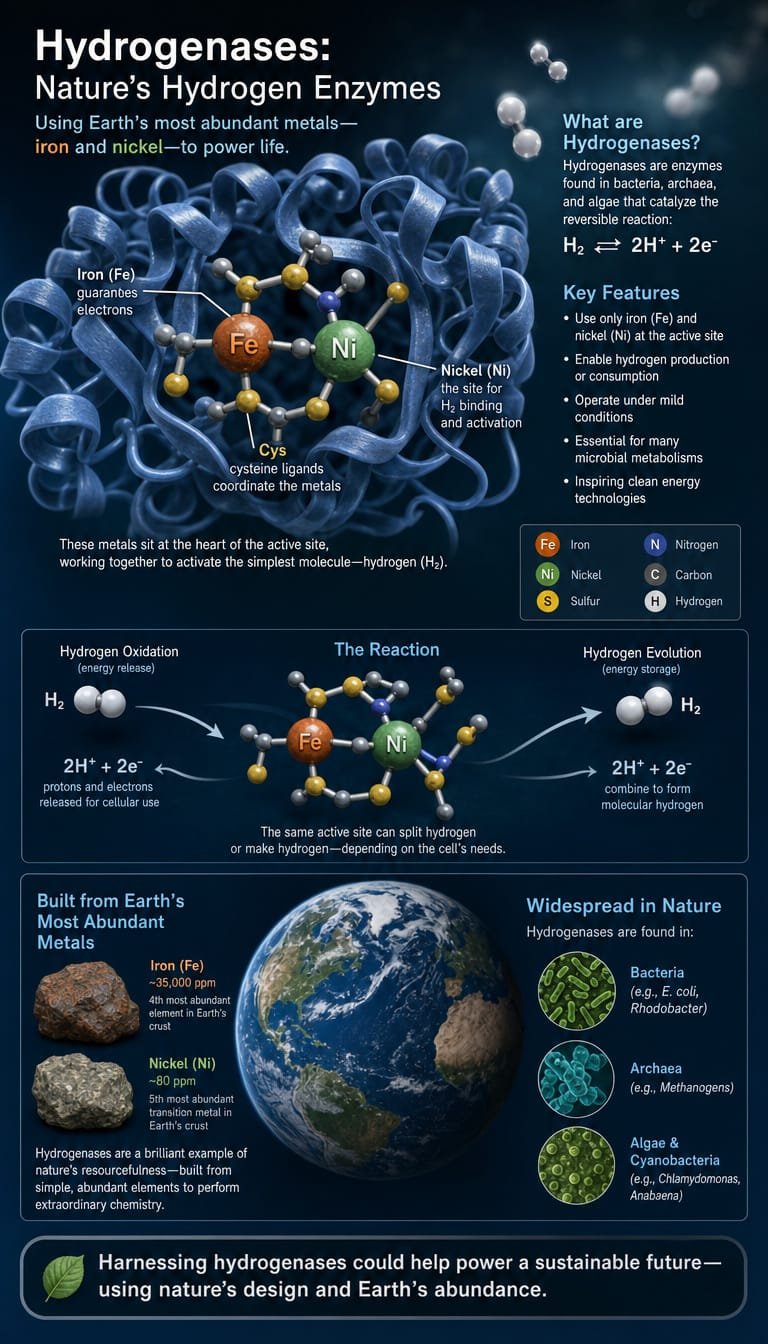
The Engines of Negentropy: Installment 7 - The Hydrogen Horizon
If you want to store renewable energy seamlessly and cleanly, the ultimate battery is hydrogen gas (H2). You use excess solar or wind power to split water into hydrogen, and when the sun goes down, you feed that hydrogen into a fuel cell to generate electricity, with pure water as the only exhaust. It is the perfect, zero-emission loop.
The roadblock to this utopia is the catalyst.
In human industry, the reversible oxidation of hydrogen requires platinum. Platinum is incredibly rare, astronomically expensive, and its mining is ecologically devastating. We cannot scale a global hydrogen economy if it requires paving the world in precious metals.
Nature, however, runs a massive, hidden hydrogen economy in the soil and the oceans without a single atom of platinum. It uses the most abundant metals on Earth—iron and nickel—housed within a class of enzymes known as the Hydrogenases.