


The Salt of the Earth – Why Sodium-Ion is Powering the Microgrid
When people think of the "battery revolution," they immediately think of Lithium-Ion. Lithium is the lightest metal on earth, making it the absolute gold standard for smartphones and electric vehicles, where every extra ounce drains efficiency.
But buildings do not move. If you are installing a massive battery bank in the basement of an apartment complex or a neighborhood sub-station to store solar energy, weight is entirely irrelevant. The criteria for stationary storage are cost, abundance, and absolute safety. This is where Sodium-Ion (Na-ion) batteries have taken over the market in 2026.

The E-Waste Micro-Loop – Urban Mining at the Point of Origin
The Domestic Mine: Reclaiming the Drawer of Obsolescence
Welcome back to the Project Clean Up (PCU) weekly newsletter! We have audited the kitchen, the drain, and the closet. This week, we confront the "junk drawer."
In almost every modern apartment, there is a designated space where old charging cables, dead smartphones, obsolete tablets, and degraded lithium-ion batteries go to quietly expire. E-waste is the fastest-growing domestic waste stream on the planet. Because we know we aren't supposed to throw batteries in the municipal dumpster, and because driving to a specialized hazardous waste facility feels like a massive chore, we choose paralysis. We simply keep it.
But that drawer isn't just a storage problem; it is an idle "Urban Mine." This week, we explore how to unlock the high-value materials trapped in our own homes without waiting for the slow wheels of municipal recycling.
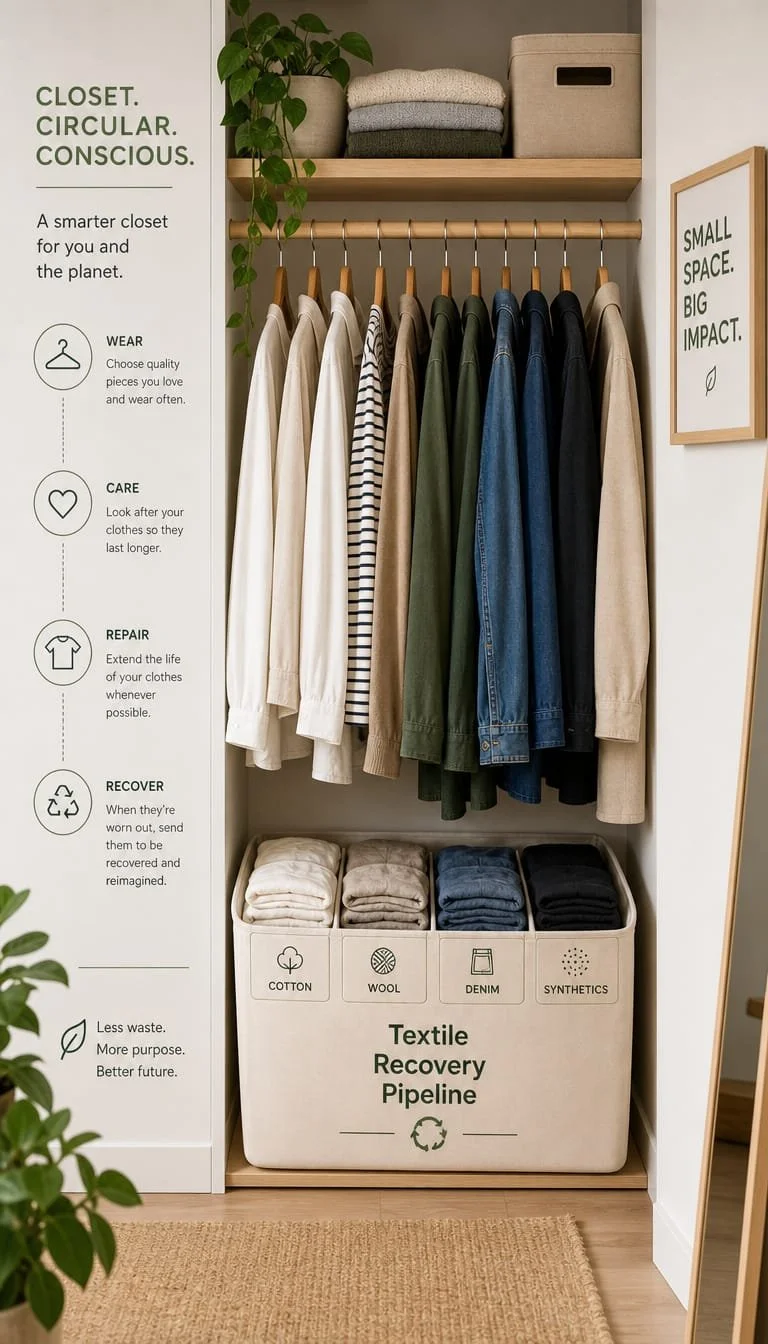
The Wardrobe Micro-Loop – Managing Fabric in Restricted Spaces
The average consumer discards dozens of pounds of clothing every year. In an apartment environment, textile waste accumulates silently in the backs of closets until a sudden move or spring cleaning forces a decision. Because municipal curbside recycling programs completely reject clothing, the burden falls entirely on the individual to find a sustainable alternative.
To build a true Wardrobe Micro-Loop, we must understand why traditional downstream methods fail and how to intercept our garments at the point of origin.