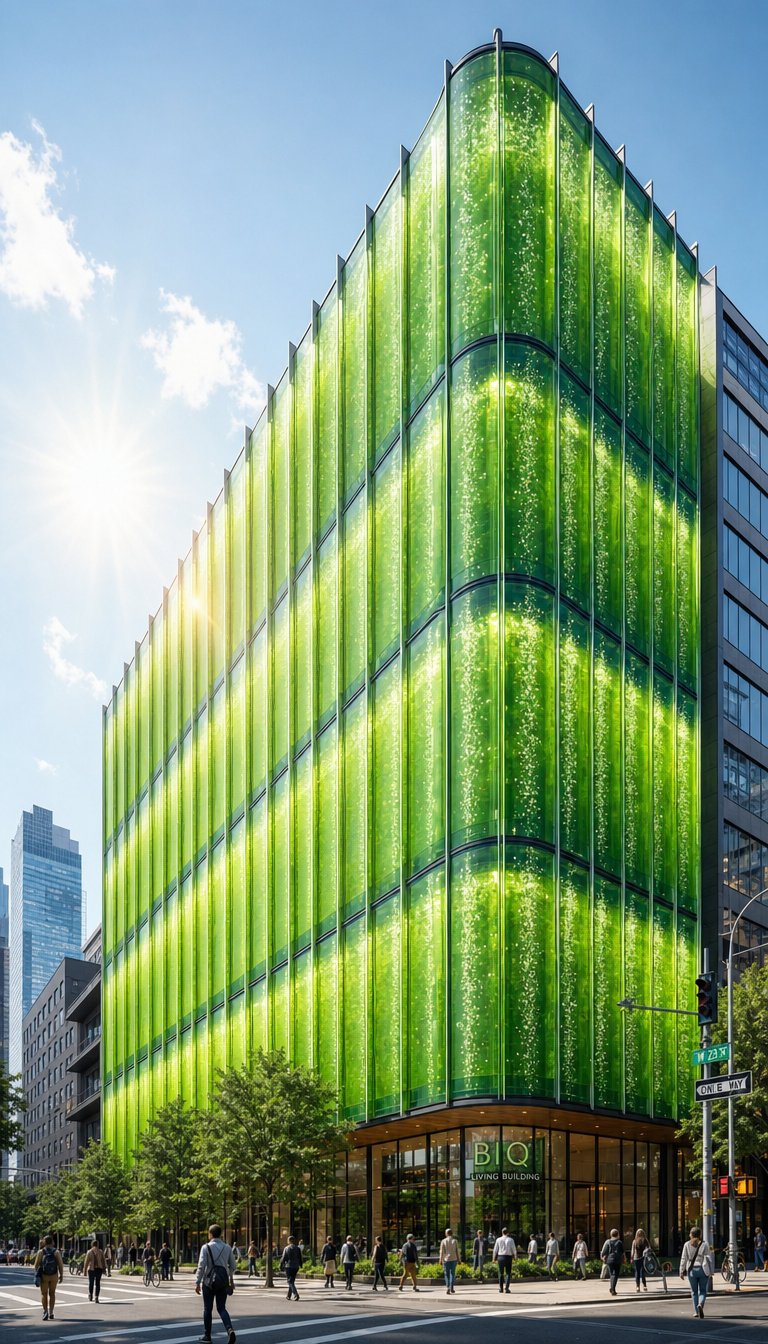
The Concept: Walk through the downtown core of any major city, and you are surrounded by monuments of glass, steel, and concrete. While architecturally impressive, modern skyscrapers are ecologically dead. They absorb solar radiation—creating suffocating urban heat islands—consume staggering amounts of electricity for heating and cooling, and sit completely passive while traffic fumes and carbon dioxide ($\text{CO}_2$) swirl around them.
Over the past few weeks, we have looked at how we can grow our building materials—from bacterial leather to fungal mycelium bricks. For the finale of this series, we are taking the concept one step further. Instead of just building with dead biological matter, what if the exterior skin of a building stayed alive? What if a skyscraper could breathe, scrub the city air, and generate its own energy like a massive vertical tree?
The Science: Vertical Photobioreactors The technology turning buildings into living organisms is called a photobioreactor facade.
Instead of standard glass windows or lifeless concrete siding, engineers clad the sun-facing exterior of a building in flat, hollow, double-glazed glass panels. These panels are filled with water, trace minerals, and billions of living, single-celled microalgae (such as Chlorella or Scenedesmus).
Here is how this living skin operates as an active bioremediation engine:
The Breath (Air Scrubbing): A continuous stream of compressed air is pumped into the bottom of each glass panel. As the bubbles rise, they keep the algae suspended in the sunlight and gently scour the inside of the glass to prevent buildup. More importantly, exhaust air rich in $\text{CO}_2$—either piped directly from the building's own ventilation and heating systems or pulled from the polluted street below—is injected into the water.
The Metabolism (Supercharged Photosynthesis): Microalgae are among the most efficient photosynthetic machines on Earth. Per square foot, they can capture $\text{CO}_2$ and release fresh oxygen ($\text{O}_2$) at rates 10 to 50 times higher than terrestrial trees. They also actively metabolize urban pollutants like nitrogen oxides ($\text{NO}_x$) dissolved in the air stream.
The Dynamic Shade: The facade responds automatically to the weather. On a blistering, sunny afternoon, the intense light causes the algae to multiply rapidly. As the colony grows denser, the water turns a deeper emerald green, naturally blocking out harsh sunlight and keeping the interior of the building cool without a single motorized blind or drop of extra air-conditioning power.
The Application: From Smog to Fuel This is no longer just a futuristic render in an architecture magazine; it has already been proven in the real world. The most famous pioneer is the BIQ (Bio-Intelligent Quotient) House in Hamburg, Germany—the world's first residential building powered by an algae facade. Its 129 glass bioreactor louvers shimmer in the sunlight, constantly bubbling with living green water.
What makes these living buildings a true triumph of bio-engineering is what happens when the algae finish eating the city's pollution:
Biomass Harvesting: As the algae gorge on $\text{CO}_2$ and sunlight, they double their mass every few days. An automated filtration loop periodically skims off the excess algal pulp. That harvested biomass is packed with lipids and proteins—it can be fed into an on-site digester to produce clean biogas for heating the building, or sold off as a high-value feedstock for biofuels and pharmaceuticals.
Solar Thermal Capture: Because the glass panels are filled with water sitting in direct sunlight, they also act as giant solar water heaters. The warmth absorbed by the algae water is pumped through heat exchangers to supply the building's hot water, with excess summer heat stored underground in geothermal wells for the winter.
By wrapping our cities in living microalgae, we transform urban infrastructure from an ecological drain into an active remediation engine. The building stops being part of the pollution problem and becomes the biological filter that solves it.
Want to learn how to master the bioreactor in your back yard? Read Level 1: The Master Bioreactor in Your Backyard.
Learn about how you are a bioreactor in The Walking Bioreactor: You Are Half Microbe.
Would you like to try your own bioremediation? Try our DIY Airborne Remediation: Constructing a Micro-Scale VOC Biofilter!