

The Plastic Eaters: Unzipping the Polymer
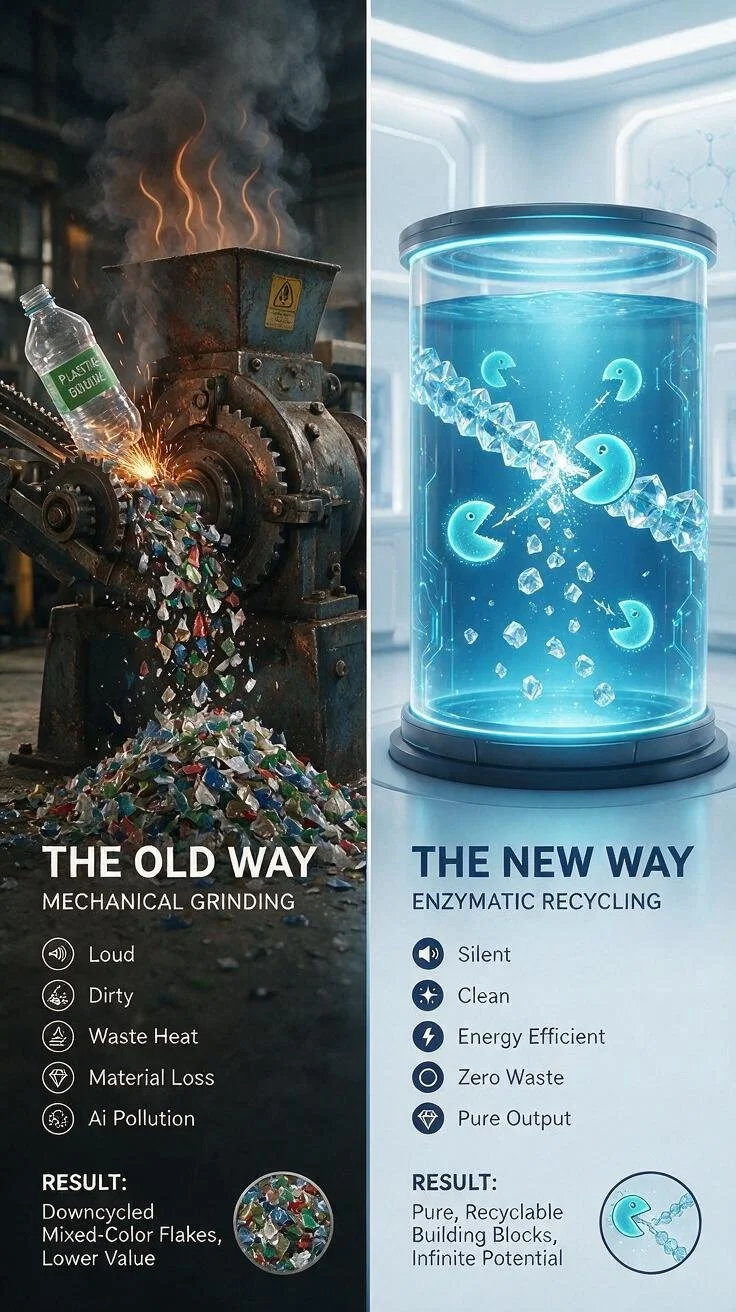
The Concept: We have a massive recycling lie to confront. When you throw a clear plastic clamshell or a water bottle into the blue bin, you assume it gets melted down and turned into a brand-new water bottle.
In reality, traditional mechanical recycling is highly inefficient. Heating and remolding plastic degrades its chemical structure. A clear water bottle usually gets "downcycled" into a lower-grade material, like polyester carpet fibers or park benches. Once that carpet wears out, it goes straight to the landfill. It is not a circle; it is just a delayed straight line to the dump.

The Protein Puzzle: AI and the Birth of Designer Enzymes
The Concept: For the past few months, we have talked a lot about enzymes. We’ve seen enzymes that cut plastic, enzymes that dissolve cotton, and enzymes that bleach paper. In nature, enzymes are the ultimate chemical scissors, acting as catalysts to speed up reactions that would otherwise take centuries.
But historically, we had a major limitation: we could only use the scissors nature had already invented. If a human-made pollutant—like a synthetic "forever chemical" (PFAS) or a novel pesticide—was dumped into the environment, we just had to cross our fingers and hope that some random soil bacterium eventually evolved an enzyme to eat it. Evolution is a brilliant engineer, but it is incredibly slow.
Today, we are no longer waiting for evolution. We are stepping into the era of rational design. We are building custom molecular assassins from scratch.
The Pearl and the Shell: Sculpting with Seawater
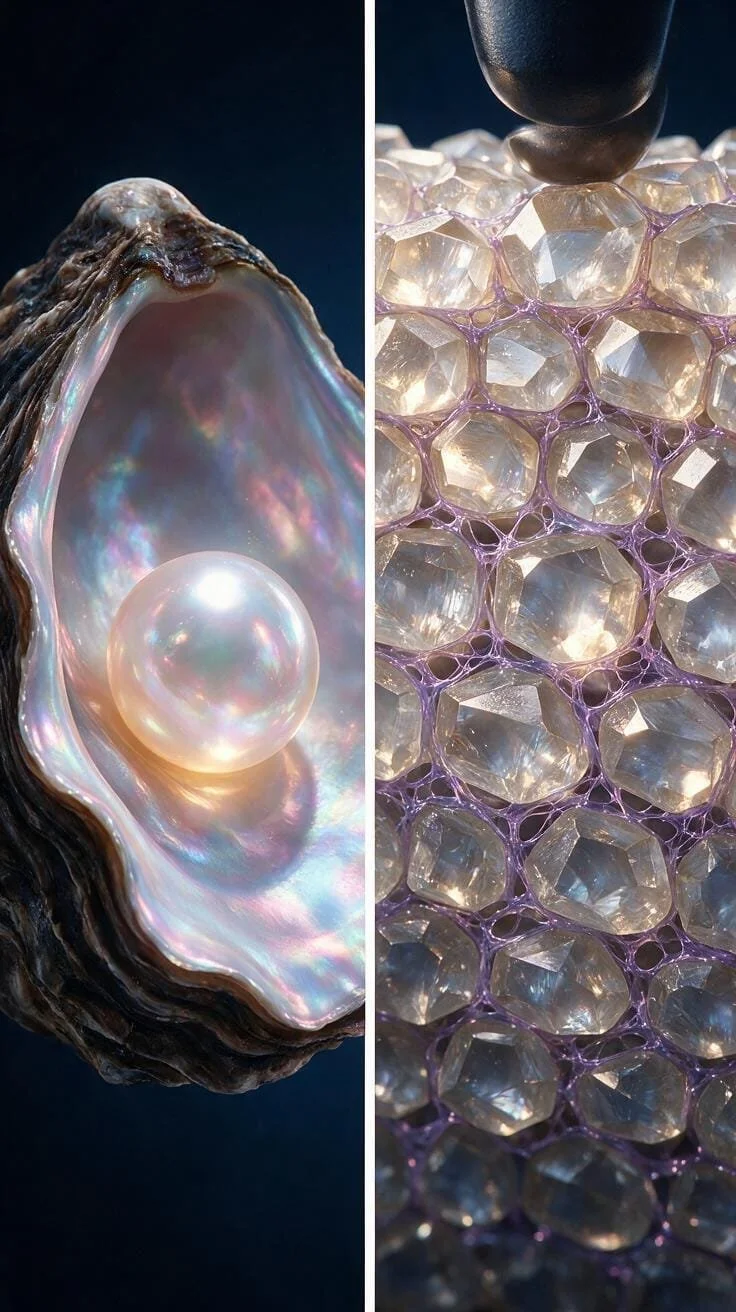
The Concept: If you crack open an oyster shell or look at a pearl, you are immediately struck by its smooth, iridescent, glowing surface. This material is called nacre (commonly known as mother-of-pearl). It is beautiful, yes, but it hides a much more important secret: it is practically indestructible.
If you take a piece of pure chalk (calcium carbonate) and hit it with a hammer, it shatters instantly into dust. An oyster builds its shell out of that exact same chalk, pulling the calcium and carbonate directly from the seawater. Yet, if you hit an oyster shell or a pearl with a hammer, it doesn't shatter. It is up to 3,000 times more resistant to fracturing than the raw mineral it is made of.