The Hidden Subsidy of Waste Linear economies are catastrophically wasteful, yet they are remarkably hard to kill. If a municipal water treatment plant loses a pump, it draws down a multi-day reservoir. If a power station trips offline, the regional grid pulls instant reserve power from natural gas peaker plants sitting idle fifty miles away. If a factory loses a shipment of raw steel, it burns through a warehouse holding three weeks of surplus inventory.
In the vocabulary of sustainability, we label these surpluses as inefficiencies—redundant capital, excess stockpiles, and idle capacity. In the vocabulary of systems engineering, they are buffers. They absorb shocks so that a localized failure stays local.
When you engineer a tightly coupled closed-loop system—whether a zero-waste industrial park or a mass-constrained orbital habitat—your primary design mandate is to eliminate waste and minimize excess mass. Every kilogram of idle inventory sitting in a tank looks like dead weight on a launch manifest or an architectural balance sheet. So you wire the output of Machine A directly into the input of Machine B.
In doing so, you strip away the shock absorbers. You trade resilience for efficiency.
The Mathematics of Tight Coupling In an open, buffered network, subsystems operate largely independently. If Node A goes down for maintenance, Node B keeps running on stored reserves until Node A comes back online.
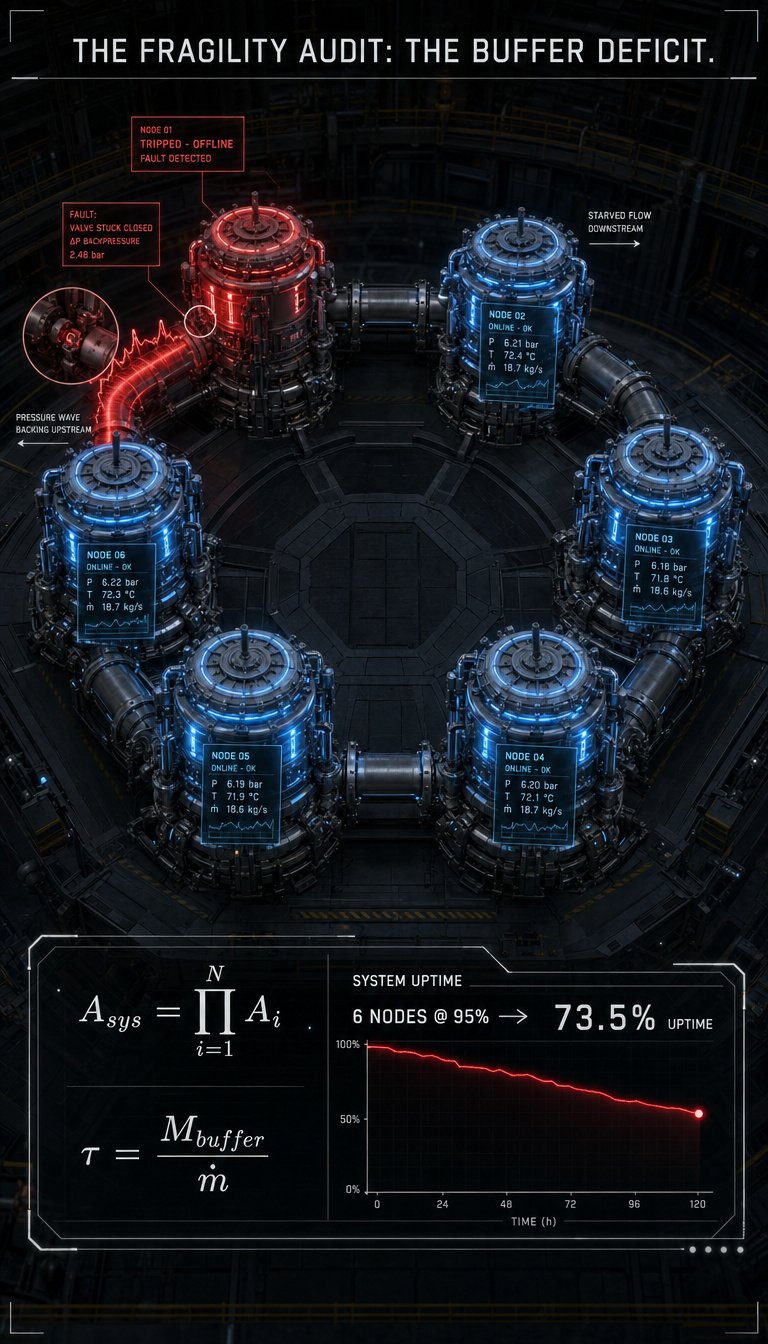
In a tightly coupled closed loop with zero intermediate storage, the entire chain behaves mathematically as a series system. If every node requires the real-time output of the node behind it to operate, the instantaneous availability of the entire loop ($A_{sys}$) is the product of the individual availabilities ($A_i$) of its $N$ sequential components:
$$A_{sys} = \prod_{i=1}^{N} A_i$$
The math is unforgiving. Suppose you engineer an exceptionally reliable closed-loop life support or resource-recovery chain consisting of 6 interdependent stages—water distillation, electrolysis, Sabatier reduction, microwave plasma pyrolysis, photobioreactor cultivation, and polymer processing. Suppose each individual stage is built to an impressive 95% uptime ($A_i = 0.95$).
Without buffers decoupling them, the probability that the entire loop is running at any given moment drops sharply:
$$A_{sys} = (0.95)^6 \approx 0.735$$
Six world-class, 95%-reliable machines wired directly together yield a system that is offline more than a quarter of the time. Scale that same closed-loop architecture to 10 tightly coupled industrial nodes at 95% reliability each, and uptime collapses to $(0.95)^{10} \approx 59.9\%$. Even pushing every individual machine to 98% reliability across 10 coupled nodes still leaves the overall loop stalled nearly one-fifth of the time ($(0.98)^{10} \approx 81.7\%$).
The Hold-Up Clock In a linear chain, a stall simply stops production. In a closed loop, a stall creates a dual crisis: downstream starvation and upstream overpressure.
To quantify how much time an engineer actually has before a minor glitch becomes a cascade failure, we calculate the buffer residence time ($\tau$)—often called the hold-up time—of any intermediate storage node:
$$\tau = \frac{M_{buffer}}{\dot{m}}$$
Here, $M_{buffer}$ is the usable mass of an intermediate feedstock held in reserve (such as compressed hydrogen, greywater, or liquid ammonia), and $\dot{m}$ is the continuous mass flow rate consumed or delivered by the adjacent engines.
If the Mean Time to Repair ($MTTR$) a faulty valve or sensor exceeds the residence time of its neighboring buffers ($MTTR > \tau$), the failure crosses the boundary into the next subsystem.
Look back at the orbital chain we engineered last month. Suppose the microwave plasma furnace trips offline for a routine 12-hour quartz-tube replacement, but your methane surge tank only holds 4 hours of Sabatier exhaust ($\tau = 4\text{ hr}$). At hour four, pressure spikes upstream. You now face a brutal binary choice: either vent the excess methane into space (breaking mass closure permanently) or shut down the Sabatier reactor. Shutting down the Sabatier reactor halts $CO_2$ scrubbing in the cabin and cuts off the return of recycled water to the electrolyzer. One clogged seal in a single reactor has just forced the entire habitat into emergency mode.
The Industrial Symbiosis Trap This exact failure mode haunts terrestrial circular engineering.
In celebrated eco-industrial parks—where a power plant pipes waste steam to a pharmaceutical facility, sends desulfurized flue-gas gypsum to a wallboard factory, and routes warm cooling water to an aquaculture farm—tight coupling creates mutual hostage situations. When the anchor power station shifts its fuel mix, scales down during mild weather, or goes down for an unscheduled turbine overhaul, the downstream factories instantly lose both their thermal energy and their chemical feedstocks.
Because industrial parks rarely tolerate total shutdowns, those downstream facilities quietly install backup natural gas boilers and keep contracts open with virgin gypsum mines. The "closed loop" only stays stable because a hidden linear economy is standing directly behind the curtain, ready to absorb the buffer deficit whenever the math slips.
The Price of Phase Margin Efficiency and stability are opposing vectors. A system operating at 100% material utilization with zero idle reserves has zero phase margin; any perturbation—a 10% drop in solar flux, a fouled filtration membrane, a delayed replacement bearing—immediately propagates around the ring and amplifies on the second pass.
True closed-loop engineering must abandon the fantasy of zero-inventory elegance. Buffers are not waste; they are decoupling capacitors for mass and energy. Every node in a circular city or spacecraft must be flanked by mathematically sized surge tanks, battery banks, and raw-stockpile vaults explicitly calibrated so that $\tau$ comfortably exceeds the worst-case $MTTR$ of its neighbors.
In a closed system, idle mass sitting in a tank is not a sign of sloppy design. It is the exact physical price you pay to keep a single broken pump from collapsing the entire world.
Want to learn how you can help? Read our Bioremediation Series!
Would you like to try your hand at closing the loop? Try our DIY Series! Botanical Execution - Windowsill Phytoremediation of Greywater and Airborne Remediation: Constructing a Micro-Scale VOC Biofilter are a great place to start.