(11/13/2026)
The Concept: The built environment is one of the heaviest burdens on our planet. Concrete and steel are the foundations of modern civilization, but manufacturing them requires massive amounts of mined resources and fossil fuels. The cement industry alone is responsible for roughly 8% of all global carbon dioxide emissions.
We need building materials that trap carbon instead of emitting it. Earlier in this blog's history, we touched briefly on how the root structure of mushrooms (mycelium) was being used to replace Styrofoam packaging. Today, structural engineers are taking that exact same biological mechanism and scaling it up to the size of a skyscraper. We are learning how to grow our houses.
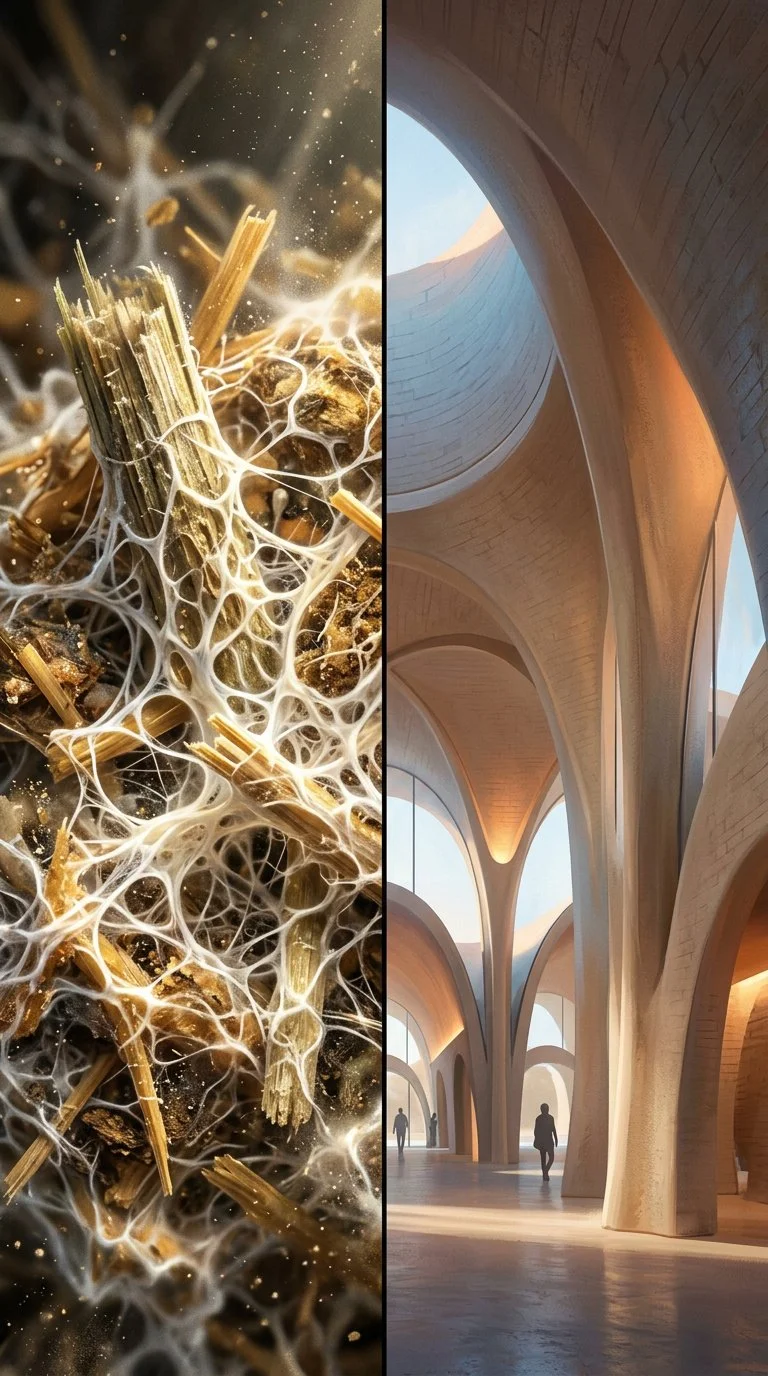
The Science: The Biological Binder If you look at a traditional concrete block, it is essentially gravel and sand glued together by Portland cement. Mycelium architecture uses the exact same physical principle—aggregate and binder—but replaces the toxic chemistry with biology.
The Aggregate: Instead of mining sand and gravel, bio-engineers use agricultural waste. Things like hemp hurds, corn stalks, and sawdust are low-value byproducts of farming that are usually burned or left to rot. This waste is chopped up and packed into a mold shaped like a brick or a wall panel.
The Binder: This is where the magic happens. The agricultural waste is inoculated with fungal spores. As the spores wake up, they send out microscopic, thread-like roots called hyphae.
The Matrix: These hyphae weave their way through the agricultural waste, eating the raw cellulose. As they grow and branch, they form a massive, incredibly dense, interwoven 3D matrix. The cell walls of the fungus are made of chitin (the same tough biological plastic found in crab shells and insect exoskeletons).
Within a week, the fungus acts like a living, self-assembling glue, completely engulfing and binding the loose waste into a solid, rigid block. Once the block has filled the mold, it is baked in an oven. This kills the fungus, stopping the growth process and leaving behind a lightweight, dry, structurally sound brick.
The Application: Fireproof, Fusing Architecture Mycelium bio-composites are entirely redefining sustainable architecture because they possess physical properties that rival or beat synthetic materials.
Acoustic and Thermal Insulation: Because the biological matrix is filled with microscopic air pockets, mycelium panels are incredible natural insulators, replacing toxic fiberglass and polyurethane foam in walls.
Fire Resistance: You might assume a brick made of dried fungus and wood chips would burn easily. It doesn't. Chitin is highly resistant to heat. When exposed to a direct blowtorch, a mycelium brick will char on the outside but will not catch fire or release toxic smoke, acting as a powerful natural fire retardant.
Living Bricks: In some of the most cutting-edge experimental architecture, engineers are skipping the baking process. If you take two living mycelium bricks and stack them on top of each other, the hyphae from the bottom brick will naturally reach out and weave into the hyphae of the top brick. Over a few days, the bricks physically fuse together. You don't need mortar; the wall literally grows into a single, seamless, monolithic structure.
When a concrete building is demolished, it creates toxic rubble. When a mycelium building is eventually torn down, you can simply toss the bricks onto the ground, let the rain hit them, and watch them safely compost back into the soil.
Keep learning about Bio-Concrete! Bio-Cement and Mycelium – Turning Buildings into Carbon Sinks
Want to know more about bio-concrete? Growing Our Cities: The Rise of Bio-Concrete
Learn how we can inject $CO_2$ directly into concrete! The Synthetic Metabolisms - The Lithic Loop